Anti-immigration protests have erupted across Belfast after a shocking knife attack left a local man seriously injured and triggered widespread anger throughout Northern Ireland.
The unrest began after a Sudanese man was arrested and later charged in connection with a violent attack that quickly became one of the most talked-about incidents in the United Kingdom this week.
As details of the attack spread online, hundreds of people took to the streets to voice their frustration over immigration policies, asylum systems and public safety concerns.
What started as protest gatherings soon escalated in some areas, with reports of vehicles being set on fire, homes damaged and clashes involving police.
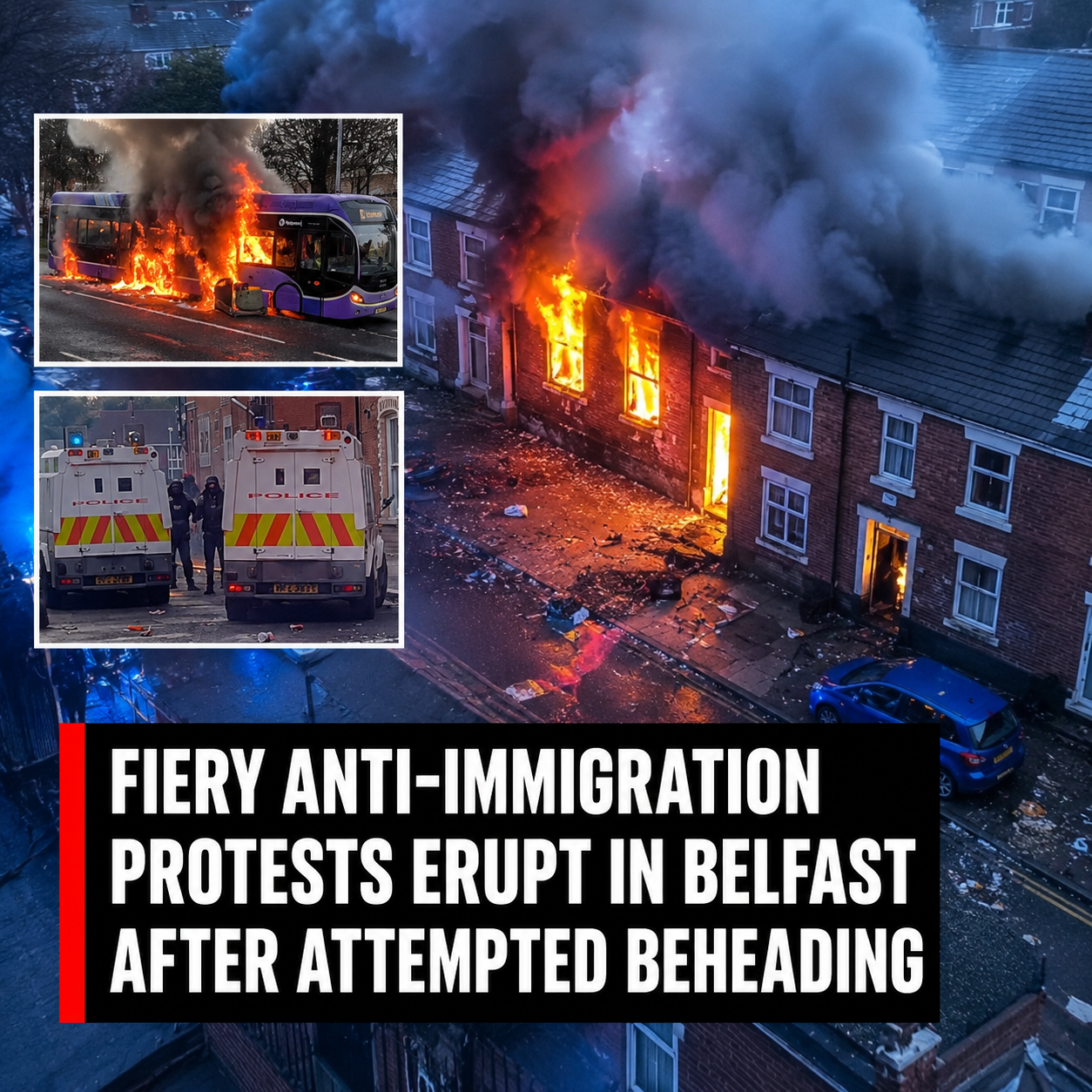
The incident at the centre of the controversy occurred in north Belfast.
Police arrested a 30-year-old Sudanese man following a knife attack that left a victim with serious injuries.
The suspect has since been charged with attempted murder as well as additional offences connected to the incident.
The graphic nature of videos circulating online helped fuel public outrage.
Within hours, calls for demonstrations began appearing across social media platforms.
By the following evening, large crowds had gathered in multiple parts of Belfast.
Many protesters argued that the attack represented a broader failure of immigration and asylum policies.
Some carried banners demanding tougher border controls and stricter enforcement against foreign offenders.
Others accused political leaders of ignoring concerns that had been building within local communities for years.
For many residents attending the protests, the issue was not only the attack itself.
They argued the incident had become a symbol of wider frustrations about crime, immigration and public safety.
Several protesters told local media they felt politicians had failed to listen to ordinary people.
However, not everyone agreed with the demonstrations.
Political leaders across Northern Ireland urged calm and warned against directing anger toward entire communities because of the actions of one individual.
Police also appealed for restraint as tensions continued rising throughout the city.
Those warnings came as some protests descended into disorder.
Cars were set alight in several locations.
Buildings were damaged.
Emergency services were called to multiple incidents throughout the evening.
Authorities described the scenes as deeply concerning and said public safety remained their priority.
The unrest has placed renewed pressure on political leaders already facing intense scrutiny over immigration policy.
Questions are now being asked about how asylum claims are processed, what background checks are conducted and whether current systems are capable of identifying potential risks before serious crimes occur.
Those concerns have been amplified by the speed with which the Belfast attack became a national story.
Images and video footage spread rapidly online, generating strong reactions not only in Northern Ireland but across the wider United Kingdom.
The political fallout has been immediate.
Immigration was already one of the most divisive issues in British politics before the attack.
The events in Belfast have now intensified that debate even further.
Supporters of tougher immigration policies argue the incident demonstrates the need for stronger controls and faster removals of individuals who commit serious crimes.
Critics argue that public anger should not be used to stigmatise entire migrant communities and warn that escalating tensions could lead to further unrest.
Those competing arguments are now playing out in real time.
Meanwhile, Belfast’s immigrant communities have reported growing fears following the protests.
Some businesses closed early while community leaders urged residents to remain cautious as tensions continued.
That has added another layer to an already volatile situation.
What began as a reaction to a violent crime has evolved into a much broader confrontation over immigration, public safety and social cohesion.
For authorities, the immediate challenge is restoring calm.
For politicians, the challenge is responding to public concerns while preventing further divisions from emerging.
And for many residents of Belfast, the central question remains whether the attack and the protests that followed will ultimately lead to meaningful policy changes.
As investigations continue and court proceedings move forward, the political consequences of the Belfast attack are still unfolding.
What is already clear, however, is that the incident has ignited a debate that extends far beyond one street, one suspect or one city.
The anger visible on the streets of Belfast has become part of a much larger national conversation about immigration, security and the future direction of public policy in the United Kingdom.






