A shocking attack in Belfast has sparked fierce political debate across Britain after a Sudanese immigrant allegedly attempted to behead a man in broad daylight.
The disturbing incident has triggered renewed concerns about violent crime, immigration policy and the government’s handling of foreign offenders.
But it was the response from Restore Britain leader Rupert Lowe that quickly pushed the story into the national spotlight.
Lowe demanded the return of the death penalty, called for mass deportations of foreign criminals and argued that Britain must bring mass immigration to an end.
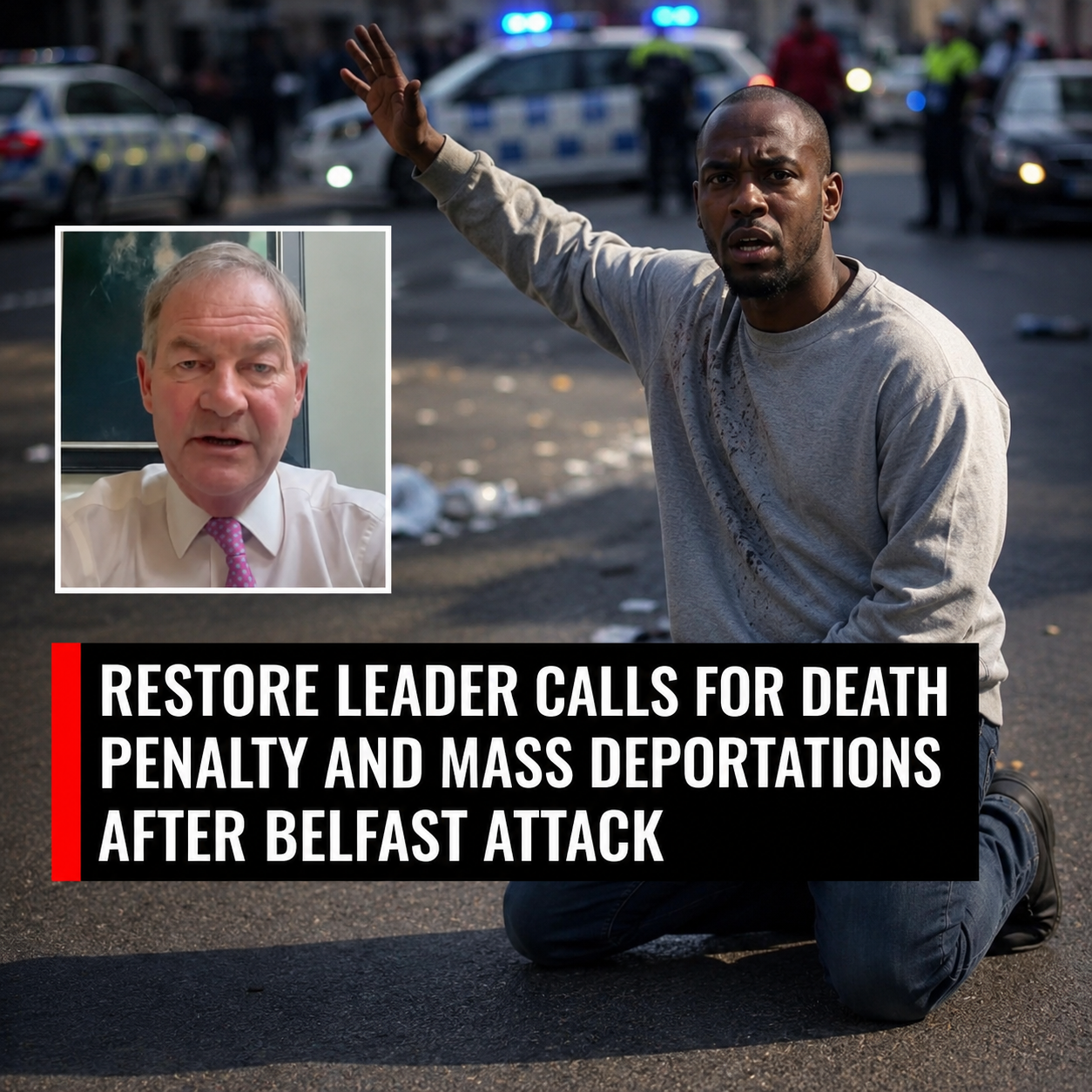
His comments came after details of the Belfast attack emerged, prompting outrage among many members of the public who questioned how such a violent incident could occur.
According to reports, the suspect is a Sudanese immigrant who allegedly attempted to decapitate another man.
The allegations have not only shocked local residents but have also reignited a wider political argument that has been building across Britain for years.
For Rupert Lowe, the case represents far more than a single criminal incident.
He argued that it reflects a broader failure of immigration policy and law enforcement.
In one of his strongest statements since launching Restore Britain, Lowe said the country needed a much tougher approach to violent offenders who are not British citizens.
He also argued that serious crimes committed by non-citizens should automatically trigger deportation and removal from the country wherever legally possible.
The comments quickly spread online, drawing support from people who believe Britain has become too soft on crime and immigration.
Supporters of Lowe’s position argue that public safety must come first.
They point to a series of high-profile crimes involving migrants and asylum seekers in recent years and say politicians have ignored public concerns for too long.
Many believe voters are increasingly frustrated with what they see as weak border controls and a lack of consequences for those who commit serious offences.
For those supporters, the Belfast attack has become another example of a system that they believe is no longer working.
Critics, however, strongly disagree.
They argue that individual crimes should be prosecuted and punished based on the law but should not be used to justify sweeping changes affecting entire communities.
Some also question whether proposals such as restoring the death penalty are realistic given Britain’s legal framework and international obligations.
Nevertheless, the attack has clearly touched a nerve.
Immigration remains one of the most politically sensitive issues in Britain.
Successive governments have promised to reduce migration levels, strengthen border security and improve public confidence.
Yet polling has consistently shown many voters remain dissatisfied with the results.
That dissatisfaction has created an opportunity for smaller political movements such as Restore Britain to attract attention and support.
Lowe has increasingly positioned himself as a voice for voters who believe mainstream parties have failed to address concerns about migration and public safety.
The Belfast attack has given him another opportunity to reinforce that message.
What makes this case particularly significant is the severity of the allegations.
Violent crimes naturally attract public attention.
Allegations involving attempted beheading generate an even stronger reaction because of their shocking nature.
As details continue to emerge, pressure is likely to increase on politicians to explain how dangerous individuals are identified, monitored and dealt with when serious crimes occur.
The debate is no longer limited to the specific circumstances of Belfast.
Questions are now being asked about deportation powers, border policies and whether existing laws provide enough protection for the public.
That broader discussion is exactly where Rupert Lowe wants the national conversation to go.
His supporters argue that the Belfast incident demonstrates the urgent need for stronger action.
His critics argue that emotional reactions should not drive national policy.
Both sides agree on one thing.
The attack has become far more than a local crime story.
It is now part of a much larger debate about immigration, crime and the future direction of Britain.
With public attention focused on the case and political leaders facing growing pressure to respond, the fallout from the Belfast attack is unlikely to disappear anytime soon.
For Rupert Lowe, the incident has provided a platform to push some of the toughest law-and-order proposals currently being discussed in British politics.
Whether those ideas gain broader support remains to be seen.
What is already clear is that the Belfast attack has intensified a national conversation that was already simmering beneath the surface.
As investigations continue and political arguments escalate, many voters will be watching closely to see whether the case leads to policy changes or simply becomes another flashpoint in Britain’s long-running immigration debate.






