A political controversy is unfolding in New Zealand after a senior police officer’s decision to run for Parliament triggered questions about transparency, neutrality and public confidence in law enforcement.
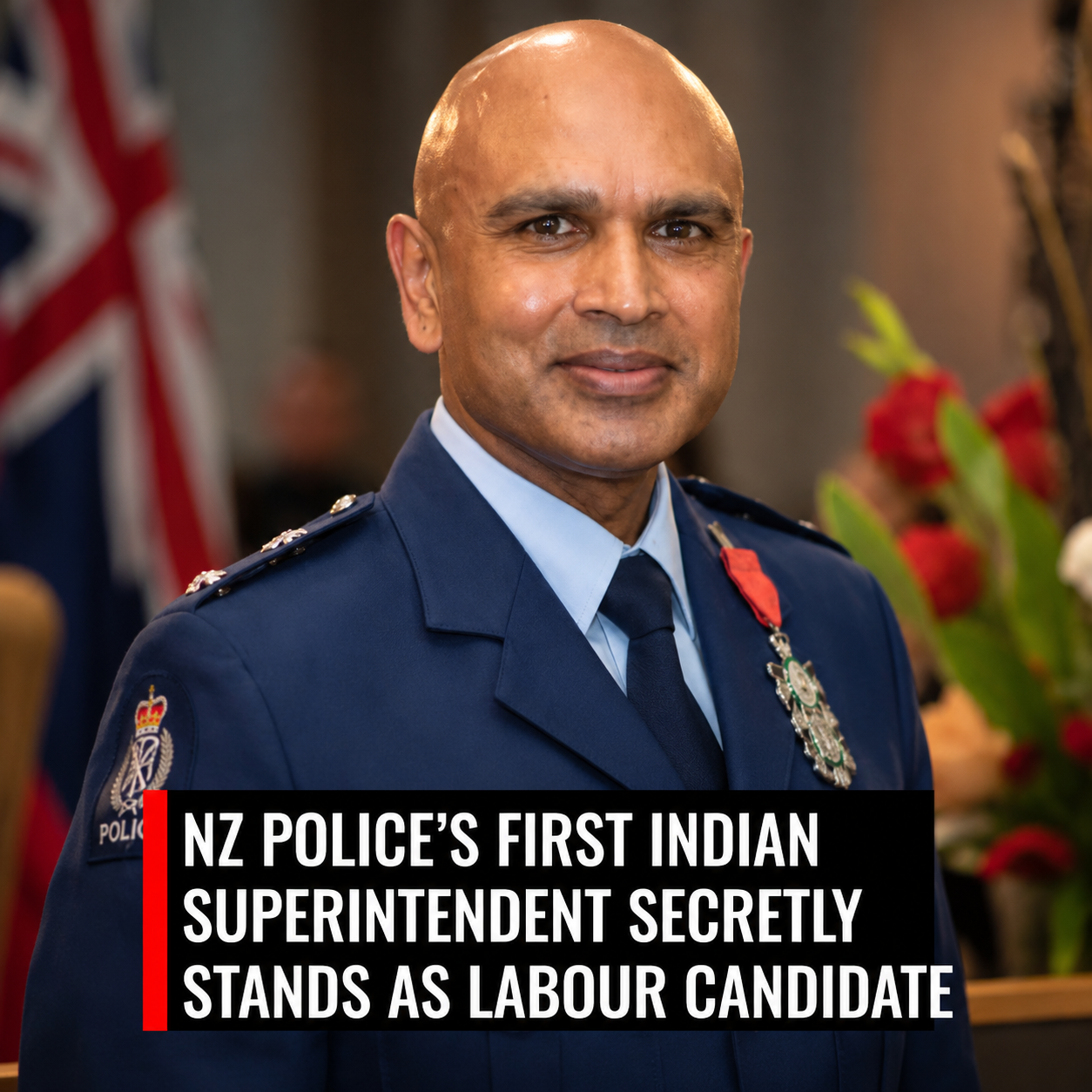
The debate centres on Superintendent Rakesh Naidoo, a high-ranking police official who was recently unveiled as a candidate for New Zealand’s Labour Party ahead of the country’s next general election.
Ordinarily, a police officer entering politics would not be unusual in itself.
Many former law enforcement officials around the world have gone on to careers in public office.
What has generated controversy is the claim that senior police leadership was not informed early enough about his political ambitions.
The timing has become the focus of intense scrutiny.
New Zealand Police Commissioner Richard Chambers publicly expressed disappointment after learning about the candidacy only shortly before it became public knowledge.
The commissioner indicated that police staff intending to seek elected office are expected to disclose their plans as early as possible so that potential conflicts of interest can be managed and public confidence protected.
The issue is particularly sensitive because senior officers often have access to confidential information, government briefings and operational discussions that require strict political neutrality.
For many voters, this is where the controversy begins.
Police officers hold significant powers on behalf of the public.
They enforce laws.
They investigate crimes.
They work alongside governments of different political persuasions.
As a result, public trust depends heavily on the perception that policing decisions are made independently of party politics.
That principle is considered fundamental across most democratic countries.
Even the appearance of political bias can become problematic.
People expect police officers to apply the law equally regardless of which party is in power.
When a senior officer suddenly appears on a political party’s candidate list, questions inevitably follow.
Not necessarily because rules were broken, but because public confidence can be influenced by perception as much as reality.
The situation has also created challenges for Labour.
The party has promoted Naidoo as a strong candidate with extensive community experience and leadership credentials.
Supporters argue that people with frontline public service experience can bring valuable perspectives to Parliament.
Critics, however, believe the circumstances surrounding the announcement have distracted from that message.
The controversy has become less about the candidate himself and more about the process that led to his selection.
Political opponents have seized on the issue, arguing that transparency should have been a priority from the beginning.
The discussion arrives at a time when trust in public institutions is under increasing pressure across many Western democracies.
Voters are paying closer attention to accountability, ethics and conflicts of interest.
Issues that may once have attracted limited attention can now dominate news cycles for days.
Social media has amplified that reality.
Questions that emerge in one news report can quickly become national debates.
For police leadership, the immediate concern is protecting confidence in the organisation.
Police rely heavily on community cooperation.
Public trust helps officers solve crimes, gather intelligence and maintain public safety.
Anything that risks undermining perceptions of independence can become a significant institutional issue.
That is why many policing organisations around the world have strict guidelines covering political activity by serving officers.
The rules are not necessarily designed to stop individuals from entering politics.
Instead, they are intended to ensure there is a clear separation between law enforcement responsibilities and partisan political activity.
The controversy has also reignited broader discussion about how public servants transition into political careers.
Government departments, military organisations and law enforcement agencies often face similar challenges when senior officials decide to run for office.
Managing that transition smoothly requires transparency, planning and careful communication.
When any part of that process becomes unclear, questions are almost inevitable.
For now, the focus remains on how the situation will be handled in the weeks ahead.
Police leadership is expected to manage leave arrangements and operational responsibilities while election preparations continue.
Meanwhile, political rivals will likely continue using the controversy as part of the wider election campaign.
Whether the issue has any lasting impact on voters remains to be seen.
But the episode has already highlighted an important reality.
In modern politics, public trust can be just as important as policy.
And when institutions built on neutrality become linked to political campaigns, even indirectly, scrutiny tends to follow quickly.
As New Zealand moves closer to election day, that scrutiny is unlikely to disappear anytime soon.






