A proposal that was rejected only a year ago is back on the table, and it is already reigniting one of Australia’s most sensitive public debates.
The Lakemba Mosque in Sydney has relaunched its bid to broadcast the Islamic call to prayer from loudspeakers mounted on its minaret, reopening a discussion that stretches far beyond a single suburb. At the centre of the dispute are competing questions about religious freedom, community expectations, multiculturalism and the changing character of Australian neighbourhoods.
Supporters say the proposal reflects a legitimate expression of faith in one of the country’s most diverse communities. Critics argue that public loudspeaker broadcasts are fundamentally different from private religious practice and could affect the daily lives of thousands of nearby residents.
The renewed application follows the mosque’s previous attempt, which failed after attracting significant public attention and opposition. Mosque representatives have argued that prejudice and anti-Muslim sentiment played a role in the resistance to the original proposal. Others maintain that their concerns have nothing to do with religion and are instead focused on noise, public amenity and community consultation.
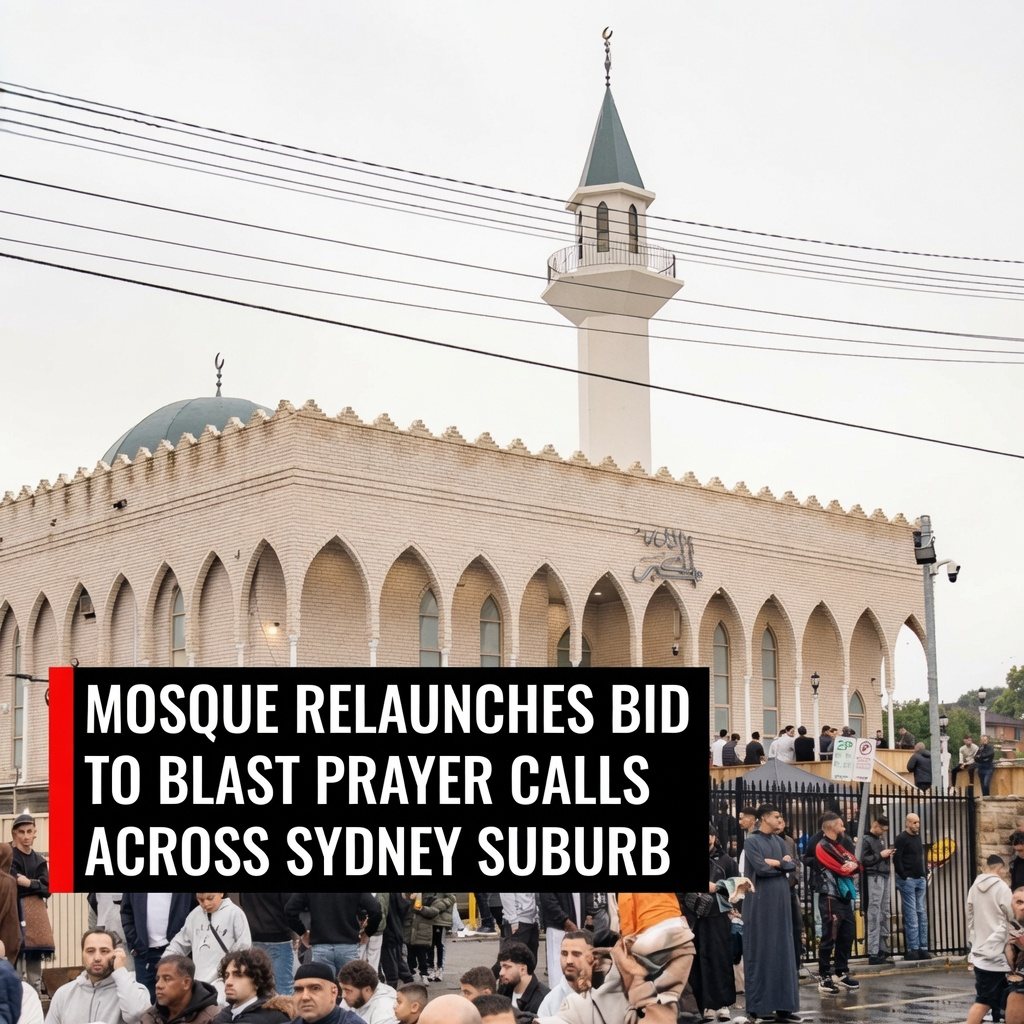
The dispute highlights a challenge that has become increasingly common across Australia. As communities grow more diverse, governments and local councils are often asked to balance competing rights and expectations. What one group views as an important expression of identity can be viewed by another as an unwanted change to the local environment.
That tension is one reason why the Lakemba proposal has generated attention well beyond Sydney’s south-west.
For many Australians, the issue is not simply whether a mosque should be allowed to make a prayer call. The larger question is where governments should draw the line when religious practices move from private spaces into the public sphere. Similar debates have emerged over church bells, religious symbols, cultural celebrations and public events across various communities.
Supporters of the proposal argue that Australia prides itself on religious freedom and multicultural inclusion. From their perspective, allowing a brief call to prayer is a natural extension of those values. They point out that many religious traditions have long had an audible public presence and argue that Muslim communities should be treated no differently.
Some also argue that opposition often appears strongest when the discussion involves Islam rather than other faiths. They believe that equal treatment requires authorities to evaluate applications based on objective planning considerations rather than public discomfort with a particular religion.
Opponents see the issue differently.
Many residents who oppose the proposal argue that the debate is being framed incorrectly. They insist that concerns about amplified sound are not equivalent to opposition toward Muslims or Islam. Instead, they say local councils have a responsibility to consider noise impacts, community expectations and the cumulative effect of public broadcasts in residential areas.
For those residents, the central issue is practical rather than religious. They ask whether any organisation, regardless of faith, should be permitted to project regular messages into surrounding neighbourhoods using loudspeakers.
This distinction is likely to play a major role in any future assessment of the application.
Local governments frequently find themselves navigating these disputes because planning decisions often require balancing competing interests rather than delivering outcomes that satisfy everyone. A council may recognise the importance of religious expression while simultaneously considering objections from residents who believe their quality of life could be affected.
That balancing act has become more difficult in recent years as social debates increasingly move beyond planning rules and into broader cultural discussions.
The Lakemba proposal arrives at a time when questions about integration, multiculturalism and national identity are receiving growing attention across Australia. Immigration levels, housing pressures, infrastructure demands and community cohesion have become recurring topics in political debate. As a result, local issues can quickly evolve into national conversations.
Some commentators argue that multiculturalism works best when communities maintain their traditions while adapting to shared public expectations. Others argue that a genuinely multicultural society requires broader acceptance of visible and audible cultural differences.
The disagreement is unlikely to disappear because both arguments resonate with different sections of the public.
One factor that makes the issue particularly sensitive is that people often approach it from entirely different starting points. A supporter may view the proposal primarily through the lens of religious liberty. A critic may view the same proposal primarily through the lens of neighbourhood amenity. Because they are answering different questions, the debate can quickly become polarised.
That dynamic has been evident in public discussions surrounding the application.
What happens next may be just as important as the decision itself.
If approval is eventually granted, some observers believe the outcome could encourage similar applications elsewhere in Australia. Local councils in other regions may face comparable requests, forcing policymakers to develop clearer guidelines regarding amplified religious broadcasts.
If the proposal is rejected again, different questions will emerge. Supporters could argue that authorities are failing to accommodate religious practices in a genuinely multicultural society. Critics would likely view the outcome as confirmation that public amenity concerns remain an important consideration regardless of the applicant.
Either scenario has implications beyond Lakemba.
For governments, the broader challenge is maintaining public confidence that decisions are being made fairly. Authorities must demonstrate that planning assessments are based on consistent principles rather than political pressure or emotional reactions. Failure to do so risks deepening divisions and fuelling further controversy.
Australia has generally managed religious diversity successfully compared with many parts of the world. Yet cases like this illustrate how difficult it can be to balance competing rights when different values intersect in shared public spaces.
Whether the prayer call proposal ultimately succeeds or fails, the debate itself reflects larger questions that are becoming increasingly relevant across modern Australia. How much accommodation should multicultural societies provide? Where should the boundaries of public expression sit? And how can governments protect both religious freedom and community expectations at the same time?
Those questions remain unresolved. As the application moves through the assessment process, the conversation surrounding Lakemba Mosque is likely to continue attracting attention from residents, policymakers and communities across the country.
The final decision may affect one suburb directly, but the principles being debated reach far beyond Sydney. That is why a local planning application has become a national discussion about faith, public space and the future shape of multicultural Australia.






