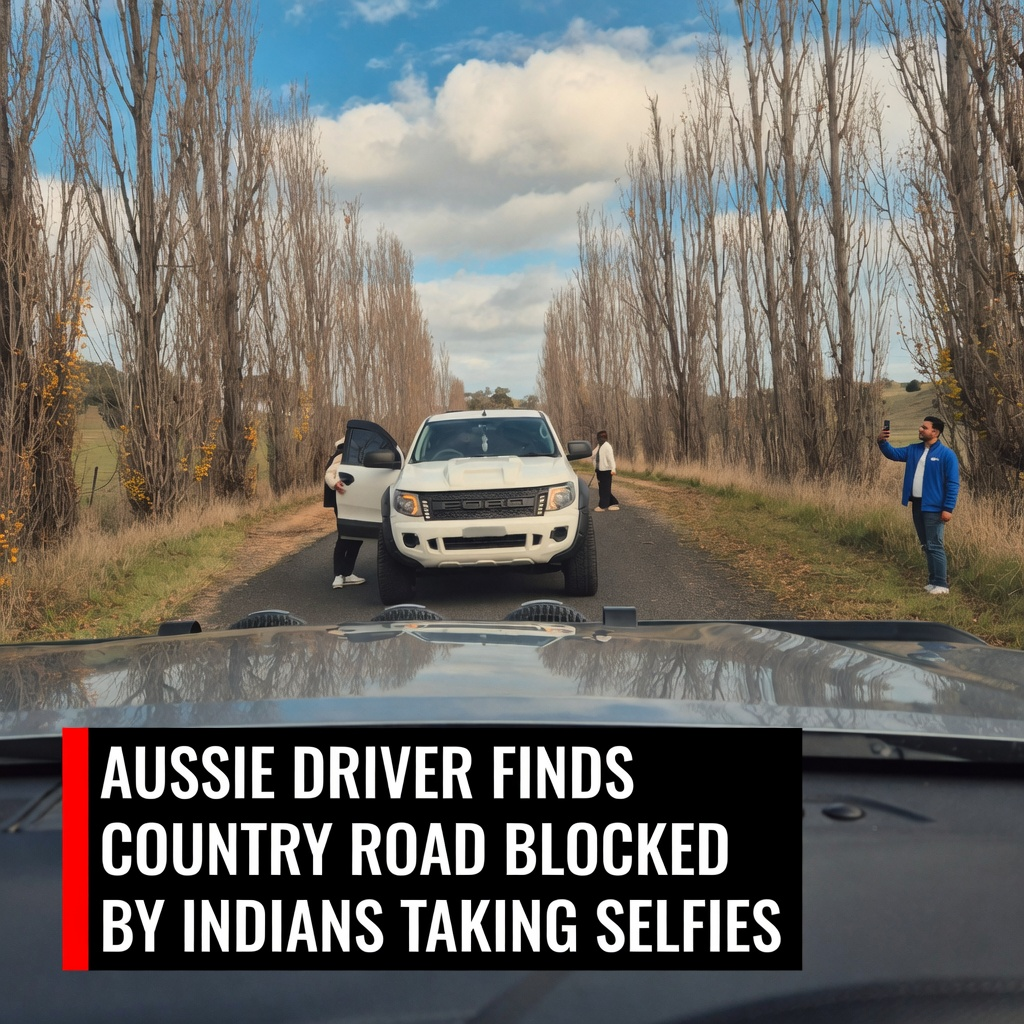
An Australian driver has sparked a heated online debate after sharing images of a country road blocked by a group of people who allegedly stopped in the middle of the roadway to take selfies.
The incident occurred on a narrow rural road west of Mudgee in New South Wales.
Photos showed a vehicle stopped across the road while several people stood outside taking photographs.
For many locals, the images were frustrating.
For others, they symbolised something much larger.
A growing feeling that basic public behaviour standards are becoming harder to enforce.
And that is where the controversy quickly expanded beyond a single traffic incident.
A country road selfie incident has reignited debate about road safety, community expectations and growing frustration over public behaviour in Australia.
The driver shared the image online after encountering the vehicle blocking Yarrabin Road.
According to the post, several people had exited the vehicle and were allegedly taking selfies while traffic was unable to pass.
The photos quickly spread across social media.
Public reactions were immediate.
Some people viewed the situation as reckless and dangerous.
Others saw it as another example of growing disregard for basic road etiquette.
That distinction matters.
Because public frustration often builds around more than the visible event itself.
People frequently react to what they believe the event represents.
That appears to be exactly what happened here.
The incident rapidly became part of a broader discussion about community standards, road behaviour and social expectations.
Many commenters argued that stopping in the middle of a country road for photographs showed a lack of awareness of both safety risks and consideration for other road users.
For rural communities, those concerns can carry particular weight.
Country roads often have limited visibility.
Vehicles may approach at higher speeds.
Unexpected obstructions can create significant safety risks.
That is why even relatively small incidents can trigger strong reactions.
People do not only see inconvenience.
They see potential consequences.
That is where the debate starts becoming larger than the original event.
Because many Australians increasingly feel social expectations that once seemed obvious are becoming less obvious.
Whether that perception is accurate or not, it remains politically and culturally powerful.
People often judge the health of a community through everyday experiences.
Road behaviour.
Public courtesy.
Respect for shared spaces.
Consideration for others.
When those experiences change, people often begin asking bigger questions.
Has public behaviour changed?
Are community standards weakening?
Or are isolated incidents simply becoming more visible because of social media?
Those questions help explain why stories like this generate so much engagement.
The incident itself is relatively simple.
The meanings people attach to it are far more complex.
Some Australians see incidents like this through the lens of road safety.
Others see them through the lens of immigration and cultural integration.
Others focus on broader concerns about respect, responsibility and community expectations.
That is why online discussions often become heated very quickly.
People are not always arguing about the same thing.
They are responding to different underlying concerns.
That creates a much larger conversation than the original event might suggest.
Australia is already experiencing significant debate around population growth, infrastructure pressure and social cohesion.
Housing affordability remains a major issue.
Transport networks continue facing strain in some regions.
Questions about integration, community identity and public expectations have become increasingly visible within political discussion.
Against that backdrop, relatively small incidents can become symbols of much larger frustrations.
That symbolic effect is often what drives public reaction.
Because people rarely argue only about the event itself.
They argue about what they believe the event represents.
That is where fairness enters the discussion.
Many people increasingly judge public situations through a simple question.
Is this fair to everyone else?
Road users expect roads to remain clear.
Residents expect shared spaces to function properly.
Communities expect basic consideration from others.
When those expectations appear violated, frustration often follows.
That frustration is not always about anger.
Sometimes it is about uncertainty.
Uncertainty about whether shared standards still exist.
Uncertainty about whether social expectations are changing.
And uncertainty about who is responsible for maintaining them.
Those concerns help explain why the story resonated so strongly online.
Most people understand that a single incident does not define an entire community.
Most people understand that isolated behaviour should not automatically be applied to larger groups.
But they also understand something else.
Small incidents often become powerful symbols during periods of broader social tension.
That may ultimately be why this story attracted so much attention.
Not simply because a road was blocked.
But because many people saw the images and immediately connected them to larger questions already sitting in the background.
Questions about public behaviour.
Questions about community expectations.
Questions about social cohesion.
And questions about whether the rules people once assumed were obvious are still being shared by everyone.
That is where the debate becomes much larger than a selfie.
It becomes a discussion about what people expect everyday life in Australia to look like.
And whether those expectations are beginning to change.