A homeless encampment in the heart of Canberra has sparked growing outrage after images showing makeshift shelters, graffiti, rubbish and personal belongings spread across a prominent city location began circulating online.
For many residents, the photos were shocking.
Not because homelessness is new.
But because of where it is happening.
The nation’s capital.
The political centre of Australia.
And for many locals, that is what makes the situation feel symbolic.
Because the biggest question emerging from the controversy may not be why people are sleeping rough.
It may be why so many Australians feel problems that once seemed temporary now appear increasingly permanent.
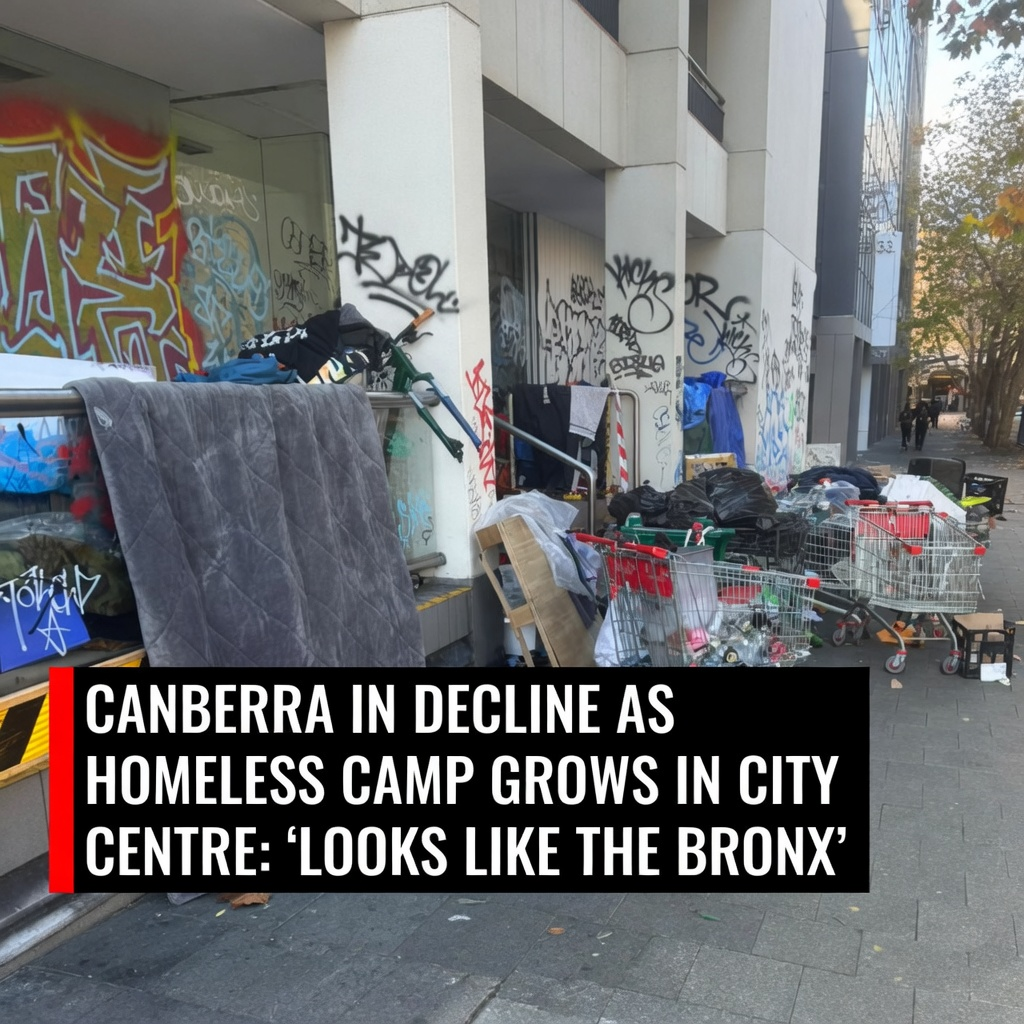
A growing homeless camp in central Canberra has reignited debate about housing pressures, public trust and whether Australia’s capital is reflecting deeper national problems.
The encampment appeared outside a former bank building near Civic, one of Canberra’s busiest public areas.
Images shared online showed trolleys, bedding, graffiti and large amounts of personal belongings spread across the site.
Locals reacted with frustration, sadness and concern.
Many described the scene as embarrassing for the capital city.
Others argued the images reflected a deeper social failure rather than simply an urban cleanliness issue.
That difference is important.
Because public reactions to homelessness often split into two very different conversations.
One conversation focuses on appearance.
The other focuses on causes.
The Canberra camp has now become the centre of both.
Some residents argue public spaces are becoming less safe, less welcoming and increasingly neglected.
Business owners and community members have previously raised concerns about growing rough sleeping activity across parts of Civic, saying the situation has become more visible over recent years.
Others argue the real issue is not the camp itself.
It is the housing crisis sitting behind it.
That argument is becoming increasingly difficult to ignore.
Canberra remains one of Australia’s most expensive cities for housing.
Demand for homelessness services has continued rising.
Community organisations say pressure on support systems is growing while resources remain stretched.
That is where the debate becomes much larger than one encampment.
Because people start asking a different question.
How did the nation’s capital reach this point?
Those questions are politically powerful because they connect directly to fairness.
Many Australians increasingly judge government performance through visible outcomes.
Not policy announcements.
Not budget speeches.
Visible outcomes.
If people see housing pressure increasing, rough sleeping becoming more visible and public spaces changing, they often judge success through those experiences rather than official statistics.
That perception can shape public trust very quickly.
Housing affordability has become one of the defining political issues across Australia.
Rental stress remains high.
Social housing shortages continue generating concern.
Homelessness services across multiple regions have reported increasing demand in recent years.
Against that backdrop, the Canberra camp has become more than a local story.
It has become a symbol.
For some, it symbolises a housing system under strain.
For others, it symbolises government failure.
For others still, it reflects the growing visibility of social problems that were previously easier to ignore.
That symbolic power is what drives public reaction.
Because people rarely argue only about tents.
They argue about what the tents represent.
That is why discussions surrounding homelessness often become emotionally charged.
The issue sits at the intersection of housing, mental health, addiction, public safety, cost-of-living pressure and government spending.
Different people focus on different parts of the problem.
Some prioritise compassion and emergency support.
Others prioritise public order and safety.
Many want both.
That is where governments often face their most difficult challenge.
Because solving visible homelessness requires more than removing camps.
It requires addressing the conditions creating them.
And those conditions are often far more complex.
Housing shortages.
Rental pressure.
Mental health struggles.
Family breakdown.
Financial hardship.
Substance abuse.
Employment instability.
Each contributes to a much larger system of pressure.
That reality is why homelessness debates rarely stay focused on one location for long.
The Canberra encampment quickly became a discussion about Australia itself.
About whether the country is moving forward.
About whether public services are keeping pace with demand.
And about whether governments are solving problems or reacting to them after they become visible.
Those questions help explain why the images generated such strong reactions.
Most people understand homelessness is a complex issue.
But they also expect visible progress.
When highly visible encampments emerge in central city locations, many begin questioning whether that progress is happening.
That may ultimately be the biggest issue behind the Canberra controversy.
Not simply the existence of one homeless camp.
But what many Australians believe it says about the direction of the country more broadly.
Because once people start viewing visible social problems as evidence of deeper decline, debates quickly move beyond local streets and into questions about trust, leadership and the future itself.






