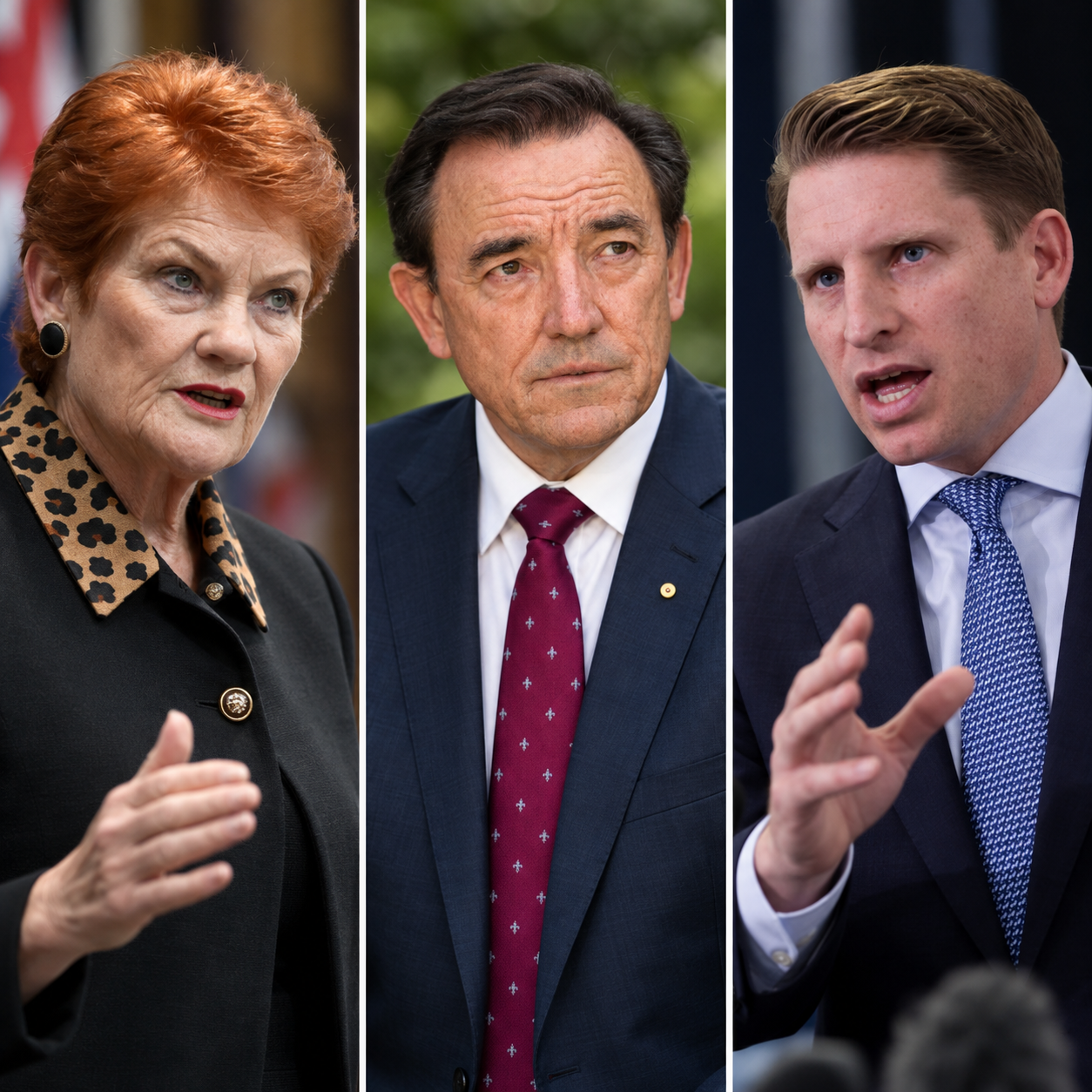
One Nation’s decision to directly target senior Liberal figure Andrew Hastie is about far more than one Western Australian seat.
It is a sign that Australia’s conservative political landscape is entering a far more unstable phase.
And for the Liberal Party, that instability may be becoming impossible to ignore.

Growing tensions between One Nation and the Liberal Party are reopening larger questions about conservative fragmentation, voter anger and whether Australia’s political right is heading toward a major realignment.
The immediate confrontation centres on Andrew Hastie, the high-profile Liberal MP for Canning and former SAS officer who has long been viewed as one of the Coalition’s most recognisable conservative figures.
One Nation has now openly declared it is targeting him politically, framing the campaign around accusations that Hastie betrayed former SAS comrade Ben Roberts-Smith during one of the most divisive military and legal controversies in modern Australian public life.
That framing is emotionally charged for obvious reasons.
Military loyalty carries enormous symbolic weight in Australia, particularly among conservative and patriotic voter blocs. Once political disputes become attached to narratives around loyalty, betrayal and institutional trust, reactions quickly become more personal than ideological.
That is exactly why this political fight matters.
Because beneath the surface, this is not just about Andrew Hastie.
It is about who controls the future identity of Australia’s conservative movement.
The polling dimension has intensified the pressure dramatically.
Recent modelling suggesting Hastie could lose his seat to a One Nation challenger would once have sounded politically unthinkable. Now it is being discussed seriously enough to unsettle strategists across both major parties.
Whether those exact polling numbers ultimately prove accurate is almost secondary to what they reveal politically.
Conservative voter loyalty is becoming increasingly unstable.
That instability is dangerous for the Coalition because fragmentation on the right can rapidly destroy seat mathematics, even where the broader conservative vote remains large overall.
This is the structural threat One Nation understands very well.
The party does not necessarily need to replace the Liberal Party nationally to reshape Australian politics. It only needs to weaken traditional conservative loyalty enough to fracture once-safe voting blocs.
That strategy becomes far more potent during periods of economic pressure and institutional distrust.
Australia’s cost-of-living crisis has created exactly that environment.
Mortgage pressure.
Energy costs.
Housing frustration.
Insurance increases.
Business uncertainty.
These are not niche frustrations.
They are daily realities shaping political mood.
And when voters feel economically squeezed for long enough, they often become more willing to abandon traditional political habits.
That creates opportunity for outsider parties positioning themselves as anti-establishment alternatives.
The Coalition’s challenge is especially complicated because One Nation draws heavily from voters who historically leaned conservative already.
This is not simply Labor versus Liberal.
It is increasingly a fight over who authentically represents disillusioned right-leaning Australians.
That distinction changes everything.
Because once the political battle shifts from left-versus-right into insider-versus-outsider dynamics, established parties often struggle to maintain authority.
The Hastie dimension adds another layer because he has long occupied a symbolic role inside conservative politics.
He is not viewed merely as a backbench MP.
He represents a particular type of national security-focused, defence-oriented conservatism that many Coalition supporters still strongly identify with.
That makes him both influential and vulnerable.
Influential because he carries profile and credibility.
Vulnerable because symbolic figures become high-value political targets.
The Ben Roberts-Smith issue also remains uniquely divisive in Australia.
For some Australians, the broader saga became a story about accountability and institutional scrutiny.
For others, it became a story about national shame, military reputation and the treatment of decorated veterans.
Those emotional interpretations never fully disappeared.
Now they are being politically weaponised.
That matters because emotionally unresolved national debates often remain politically combustible for years.
The Liberal Party faces a difficult balancing act.
If it aggressively attacks One Nation voters, it risks alienating frustrated conservatives already drifting away from the party.
If it shifts too far toward populist rhetoric itself, it risks validating the forces eroding its own support base.
That strategic tension explains why the Coalition increasingly appears caught between competing political instincts.
Defend institutional credibility.
Or reconnect emotionally with angry voters.
Doing both simultaneously is becoming harder.
Western Australia amplifies these tensions further.
WA has historically carried a stronger scepticism toward Canberra than many eastern states, particularly during periods where voters feel national political elites misunderstand regional economic realities.
That sentiment creates fertile territory for outsider messaging.
Especially when economic frustration already runs high.
The media environment intensifies the problem.
Social media ecosystems reward emotional authenticity, grievance politics and anti-establishment positioning far more effectively than cautious institutional messaging.
Minor parties no longer require the same traditional infrastructure advantages they once lacked.
That changes political scalability dramatically.
The deeper issue underneath all this is trust.
Do conservative voters still believe the Coalition understands their frustrations?
Do they believe traditional party leadership still represents their values?
Or do they increasingly see the Liberal Party as part of the same political establishment they no longer trust?
That trust question may ultimately matter more than any individual poll result.
Because once political loyalty becomes emotionally unstable, voter movement can accelerate very quickly.
And once fragmentation reaches critical mass, rebuilding old party coalitions becomes extraordinarily difficult.
This is why the fight over Andrew Hastie matters beyond one electorate.
It is becoming a test case for whether Australia’s conservative movement remains structurally united, or whether a deeper political split is now underway.