A tense exchange in parliament can sometimes reveal a much bigger national argument simmering beneath the surface.
This week’s clash over pregnancy protections and sex discrimination law appears to be one of those moments.
What began as a sharp parliamentary exchange over legal interpretation quickly spilled into a broader debate about how Australia’s anti-discrimination laws are being applied, what legal definitions now mean in practice, and whether public institutions remain aligned with ordinary community expectations.
That is why this story has travelled well beyond Canberra’s committee rooms.
At the centre of the dispute was a confrontation over how pregnancy-related protections under Australia’s sex discrimination framework apply in workplace settings, particularly in relation to legal protections around pregnancy or potential pregnancy.
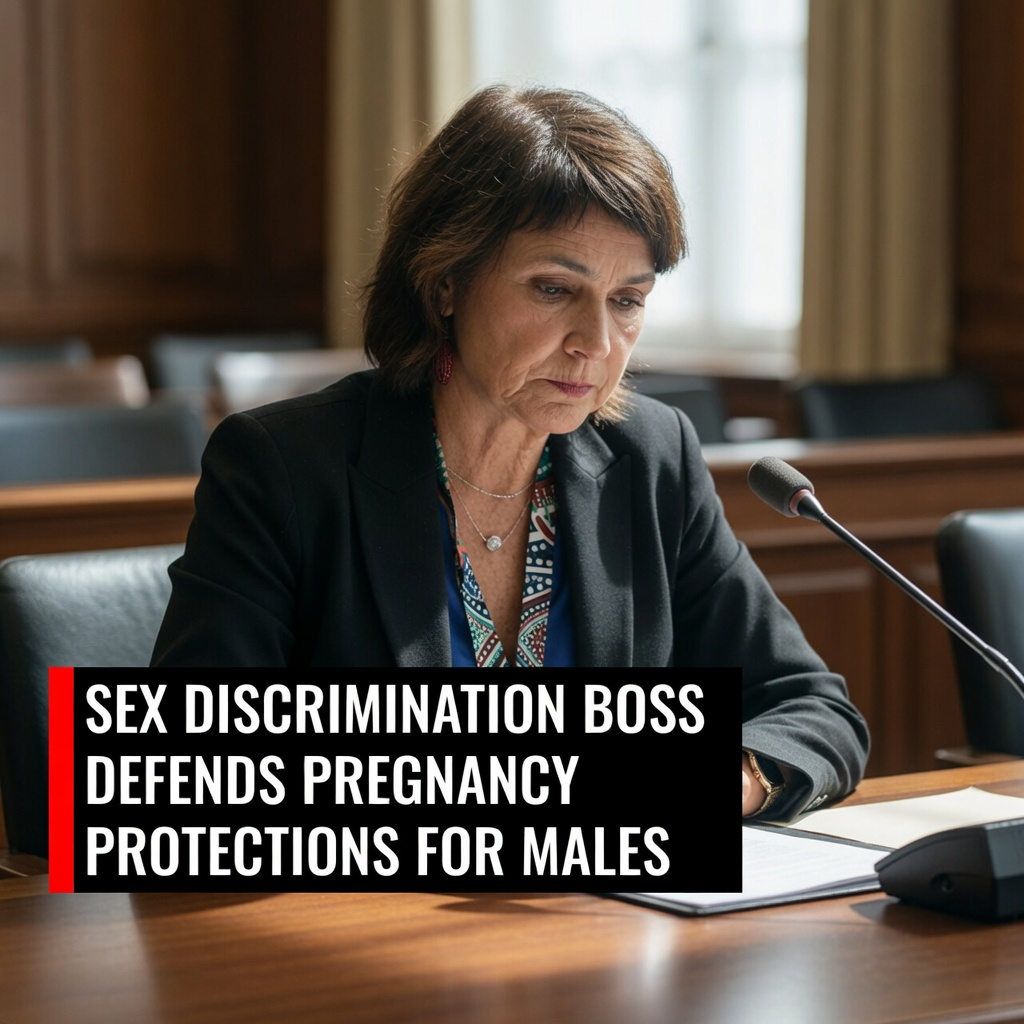
A parliamentary clash over legal interpretation has reopened wider questions about sex discrimination law, workplace protections and public confidence in institutional decision-making.
On the surface, this might look like another short-lived political controversy driven by culture-war outrage. In reality, the issue reaches much deeper because it touches workplace law, legal interpretation, human rights frameworks and one of the most politically sensitive policy battlegrounds in modern Australia.
For many ordinary Australians, the reaction is unlikely to begin with legal nuance. It will begin with instinctive questions about biological reality, legal language and whether lawmakers and institutions are operating from definitions that still make intuitive sense to the broader public.
That instinctive public reaction is exactly why debates like this become politically potent so quickly.
The legal issue itself is more technical than the headlines suggest.
Australia’s Sex Discrimination Act contains protections against discrimination on several grounds, including pregnancy, potential pregnancy and gender identity. The complexity comes in how those legal protections are interpreted when overlapping protected categories collide in real-world workplace scenarios.
That may sound like narrow legal theory, but workplace law rarely stays theoretical for long. Once interpretation changes, employers, HR departments, legal advisers and public institutions all need to understand what the practical consequences actually are.
That is where confusion can quickly turn into political controversy.
Critics argue the legal framework has drifted away from common-sense public expectations. Supporters argue anti-discrimination law exists precisely to protect minorities from exclusion, even when those protections are politically unpopular.
Both arguments have clear audiences.
That is what makes the issue so combustible politically, even when the legal details are highly technical.
The workplace dimension is especially important because this is not simply a symbolic ideological fight. Anti-discrimination law affects hiring decisions, workplace complaints, HR compliance, employer risk exposure and potential legal liability.
Once uncertainty enters that environment, the commercial consequences become real.
An employer navigating recruitment, leave entitlements, discrimination claims or workplace accommodation decisions cannot rely on social media slogans. They need legal clarity.
That is why politically charged legal ambiguity creates practical anxiety far beyond activist or parliamentary circles.
For business owners, confusion is rarely neutral. Confusion creates compliance risk.
And compliance risk creates cost.
Legal advice.
Policy rewrites.
Training obligations.
Potential litigation.
Reputational exposure.
These are not abstract concerns for employers already operating in a difficult economic environment.
This is one reason the issue resonates beyond pure political tribalism.
But the deeper political issue is public trust.
When complex legal interpretations produce outcomes that large parts of the public find confusing or counterintuitive, the trust problem grows quickly.
People start asking whether laws are still functioning as intended, whether definitions remain stable, and whether institutions are interpreting legislation in ways parliament originally expected.
Those questions are politically dangerous because they are not easily resolved through short media soundbites.
They require legal explanation, policy clarity and institutional credibility.
And once institutional credibility becomes part of the story, the controversy tends to last longer.
This debate is also unfolding at a time when broader questions around sex, gender identity and legal definitions are already politically charged across Australia.
Recent court rulings, legislative proposals and public disputes have already intensified scrutiny over how federal anti-discrimination law operates in practice.
That means this parliamentary clash did not emerge in isolation. It landed in an environment where public sensitivity was already elevated.
Timing matters in politics.
A technical legal exchange during a quieter policy period may have attracted little attention. The same exchange during an active national debate over sex law interpretation becomes headline material.
That is exactly what happened here.
The opposition will inevitably frame the controversy as evidence that legal frameworks have drifted too far from biological reality and ordinary public expectations.
Government defenders and rights advocates will argue that anti-discrimination protections exist precisely because majoritarian instincts do not always protect vulnerable minorities fairly.
Neither side is likely to retreat easily.
That ensures the issue will remain politically active well beyond the immediate exchange.
The communications challenge for public institutions is significant.
Technical legal reasoning often struggles against emotionally intuitive narratives.
A detailed statutory explanation may be legally accurate, but if the broader public experiences it as confusing or implausible, the political damage can still occur.
That gap between legal coherence and emotional public acceptance is where modern policy battles often become most difficult.
This is not unique to discrimination law.
It happens in taxation debates, migration debates, criminal justice debates and public health debates too.
But sex and gender law carries particular volatility because it intersects directly with identity, social values, family life, workplace rights and institutional legitimacy.
That combination guarantees strong reactions.
The practical policy question now is not simply who won a parliamentary exchange.
The more important question is whether the current legal framework remains clear enough for consistent public understanding and practical workplace application.
If legal experts, politicians, employers and ordinary voters are all interpreting the boundaries differently, pressure for reform inevitably grows.
That does not automatically mean existing protections are wrong.
But it does mean political pressure intensifies when legal clarity feels unstable.
The commercial angle matters too.
Australia’s business community generally values certainty over ideological ambiguity. Employers do not want to become unwilling participants in unresolved political culture wars while trying to comply with employment law.
That creates another reason the debate matters economically, not just politically.
The longer uncertainty persists, the more pressure builds for lawmakers to clarify definitions, responsibilities and enforcement boundaries.
That is how technical legal disputes evolve into major political policy debates.
For many voters, the core issue will ultimately come down to confidence.
Confidence that laws are understandable.
Confidence that institutions are applying them consistently.
Confidence that rights protections are balanced fairly.
Confidence that public policy still reflects coherent legislative intent.
Once confidence starts weakening, controversies grow beyond their original trigger.
That appears to be what is happening here.
Because this is no longer merely a parliamentary argument over wording. It has become part of a much larger national conversation about law, identity, workplace obligations and whether Australia’s anti-discrimination framework still commands broad public trust.






