The police were there.
The security operation was visible.
The flights landed in Sydney and Melbourne under close scrutiny.
But when the latest group of Australian women and children linked to ISIS arrived back on home soil, no arrests followed.
That single fact is likely to become the centre of a much larger political argument.
Because for many Australians, the emotional expectation is simple. If people connected to one of the world’s most feared extremist movements return to the country, surely there should be immediate consequences.
The legal reality is far more complicated than that.
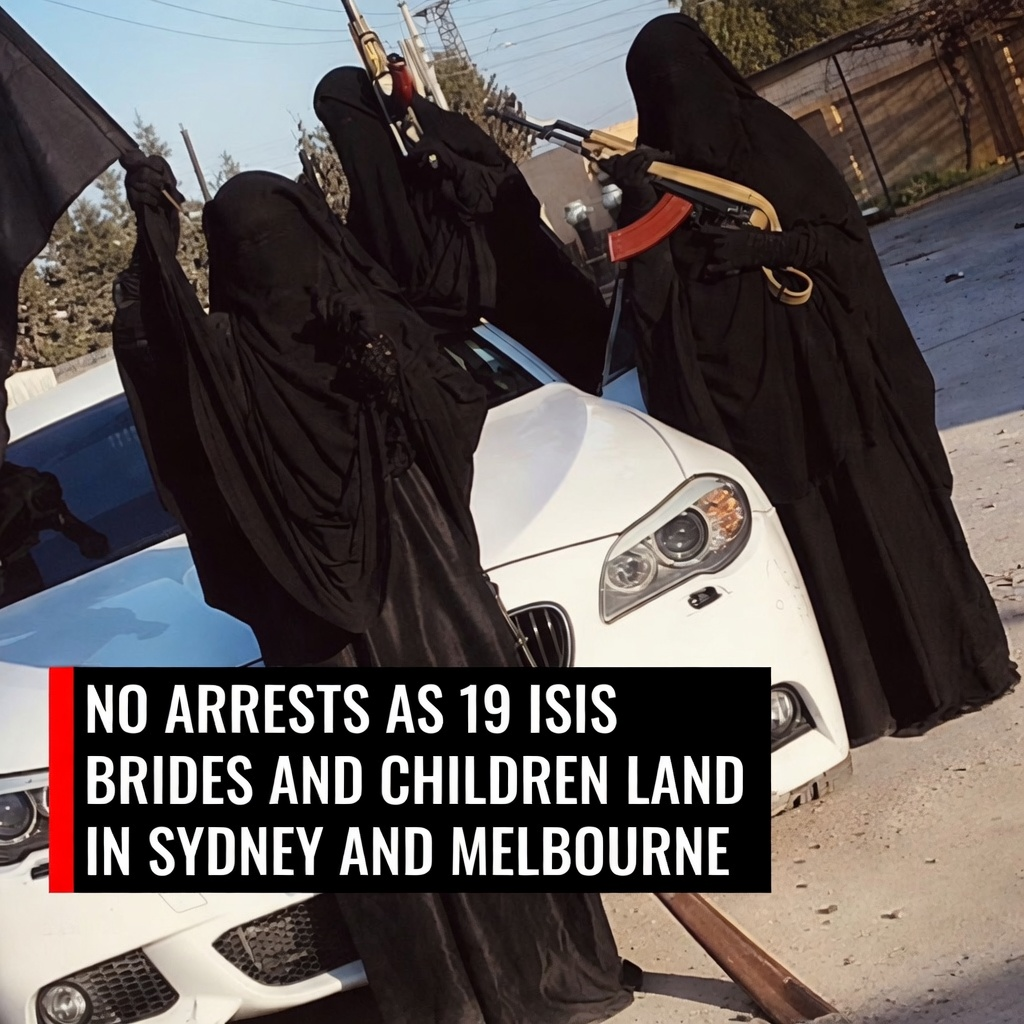
The latest ISIS-linked arrivals may not have triggered immediate arrests, but the broader national debate over security, citizenship and accountability is only intensifying.
The latest arrivals represent another chapter in one of Australia’s most politically sensitive national security debates.
A second recent group of Australian women and children linked to ISIS returned from Syrian detention camps, arriving through Sydney and Melbourne as law enforcement agencies monitored the operation closely.
Authorities confirmed the group was searched on arrival, but no charges were immediately laid.
That detail will inevitably divide public opinion.
Some Australians will see it as evidence that authorities are acting carefully within the law rather than making symbolic arrests for political optics.
Others will view the same outcome very differently, asking how individuals connected to extremist territory can arrive in the country without facing immediate criminal consequences.
That divide is exactly what makes this story politically volatile.
The federal government has already made its legal position clear in previous public statements. Australian citizenship creates legal protections, and where authorities have sufficient evidence of criminal conduct, prosecutions can and do follow.
But citizenship alone does not automatically create guilt, and suspicion alone does not automatically create a criminal case.
That distinction is legally obvious, yet politically difficult.
Public expectations in terrorism-linked stories rarely follow courtroom logic.
They follow emotion, memory and perceived risk.
The name ISIS still carries enormous weight in Australia, even years after the territorial collapse of the extremist group.
For many people, the association immediately brings back memories of terror attacks, foreign fighter recruitment, extremist propaganda and years of public anxiety around radicalisation.
That emotional backdrop changes how every detail of this story is interpreted.
A routine repatriation story would not trigger this reaction.
A standard immigration matter would barely attract national attention.
But once the ISIS label enters the conversation, the political atmosphere changes immediately.
The practical legal challenge is evidence.
That is where much of the public frustration often collides with institutional reality.
Investigators need admissible evidence, sustainable legal charges and material that can survive courtroom scrutiny.
That becomes far more difficult when alleged conduct occurred years earlier inside unstable conflict zones with fragmented records, limited witnesses and highly complex investigative circumstances.
That does not mean no wrongdoing occurred.
It means proving wrongdoing inside a democratic legal system is far more demanding than public emotion may assume.
Australia has already shown that when evidence exists, authorities will act.
Earlier recent returnees linked to ISIS did face serious charges, including terrorism-related allegations and slavery offences, demonstrating that the system is willing to prosecute where viable cases can be built.
That context matters because the absence of arrests in this latest arrival does not automatically mean authorities believe there is no risk.
It may simply mean the legal threshold for immediate action was not met at that moment.
That nuance, however, is unlikely to dominate social media discussion.
Stories like this move through emotional interpretation first.
The headline many readers will focus on is much simpler: people linked to ISIS arrived, police were present, and nobody was arrested.
That framing alone guarantees political debate.
The broader question quickly becomes one of public trust.
Do Australians believe security agencies are genuinely in control of long-term risk management?
Do they trust intelligence agencies to monitor individuals effectively after arrival?
Do they believe the public is being told the full truth about risk assessments?
Do they trust that legal safeguards and surveillance tools are strong enough to protect the wider community?
These are the kinds of questions that extend far beyond a single airport operation.
And once trust becomes the centre of the debate, stories gain a much longer political life.
This is also where the citizenship issue becomes unavoidable.
Australian governments face hard legal limits when dealing with citizens, even in politically toxic cases.
That creates an uncomfortable reality for leaders.
Democratic legal systems are designed to operate through evidence and due process, not public anger.
But public anger does not disappear simply because legal complexity exists.
That tension is politically difficult for any government, regardless of party.
The humanitarian dimension adds another layer.
Children returning from these environments are widely viewed differently from adults.
Many had no meaningful control over where they were taken, how they were raised or what extremist environment surrounded them.
That creates moral obligations alongside security obligations.
Governments are not simply managing a counter-terror issue. They are also managing child welfare, reintegration pathways, trauma recovery and long-term social risk reduction.
That balancing act is politically unforgiving.
A harsh message may satisfy public anger but ignore humanitarian realities.
A softer message may trigger accusations of weakness.
There is no politically comfortable middle ground.
The opposition and critics will inevitably frame the story through accountability and public protection.
Supporters of the legal process will frame it through democratic principle and rule of law.
Both narratives will resonate.
That is why the story remains so combustible.
The visible police presence matters politically because it reinforces the seriousness of the situation, even if the operation unfolded exactly as authorities intended.
To some readers, a strong security response signals competence.
To others, it signals that the underlying threat must be significant.
The same facts can support completely different public conclusions.
That is why national security communication is uniquely difficult.
The government’s most defensible position remains straightforward. If evidence supports charges, charges will be laid. If long-term monitoring is required, agencies will act accordingly. If children need structured support, intervention systems will engage.
Institutionally, that may be entirely reasonable.
Politically, the debate is much messier.
Because terrorism-linked stories are not judged purely on legal logic.
They are judged through fear, symbolism and public confidence in institutions.
Even if every agency performs exactly as intended, many Australians will still ask whether the country should ever have reached this point at all.
And that unresolved question is what ensures this debate is far from finished.