A major police operation at Australian airports is the kind of image that instantly changes the national mood.
It does not take legal expertise to understand why.
Security teams mobilised.
Counter-terror agencies on alert.
Families returning from detention camps once tied to the aftermath of the Islamic State collapse.
That combination alone is enough to trigger a fierce public reaction.
Australia is once again confronting one of the most politically sensitive national security debates of recent years, with the latest and largest recent group of Australian women and children linked to ISIS returning home under intense scrutiny from law enforcement and intelligence agencies.
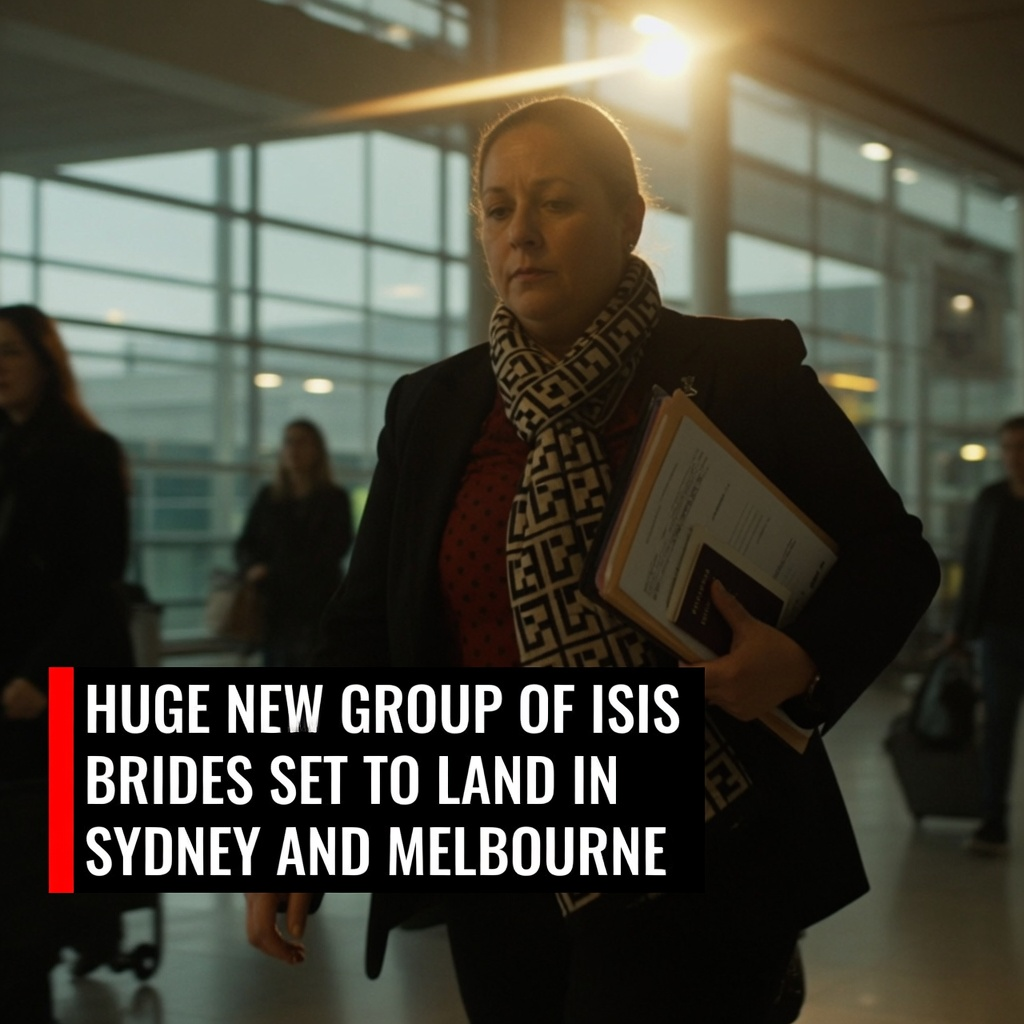
The return of another ISIS-linked Australian group is reopening a politically charged debate over national security, citizenship rights and whether public trust in government safeguards is justified.
On paper, the legal position appears relatively straightforward.
Australian citizens have legal rights.
Governments cannot simply block citizens indefinitely without lawful grounds.
Where criminal conduct can be proven, prosecution is available.
Where evidence does not meet prosecutorial thresholds, authorities rely instead on monitoring, intelligence oversight, risk assessment and ongoing intervention frameworks.
That is the institutional explanation.
The public conversation is far less clinical.
For many Australians, the emotional question arrives much faster.
How did the country reach a point where individuals linked to one of the world’s most notorious extremist movements are returning home at all?
And if they are returning, how confident should ordinary Australians feel that every genuine risk has been properly contained?
Those questions are politically powerful because they connect directly with public safety, trust in government institutions and broader anxieties around terrorism and national security.
The latest return has particular political weight because of its scale.
Reuters reported this latest cohort included multiple women and children returning through Sydney and Melbourne, making it one of the most significant recent repatriation events tied to Australian ISIS-linked families.
That scale changes public perception.
A single isolated case can be framed as an exception.
A larger coordinated return feels very different.
It looks systemic.
It looks like policy.
And once the public interprets something as policy rather than exception, the political scrutiny becomes far more intense.
The government has consistently maintained that community safety remains the top priority and that agencies have spent years preparing for scenarios involving returning Australians from extremist-controlled regions.
That preparation matters.
But politically, preparedness does not automatically reassure the public.
For sceptical readers, a major police operation can produce the opposite reaction.
If security agencies need this level of mobilisation, some people will naturally assume the underlying threat must be substantial.
That may not be the complete reality.
But perception is what shapes political narratives.
And political narratives often move faster than technical explanation.
This is exactly why stories like this spread aggressively across social media.
They combine several emotionally charged ingredients that almost guarantee engagement.
National security concern.
Terrorism history.
Citizenship rights.
Immigration politics.
Government accountability.
Public trust.
Children caught in geopolitical fallout.
That combination creates immediate emotional reaction because people do not need specialist policy knowledge to form strong instincts.
The political arguments are already familiar.
Critics will say Australia has been too permissive, too hesitant or too constrained in how it handles citizens connected to extremist movements overseas.
Supporters of the government’s approach will argue democratic nations are governed by law rather than emotional retaliation, and that citizenship protections cannot simply disappear because a case is politically uncomfortable.
Both arguments will find support.
That is what makes the issue so combustible.
There is also a moral complexity that makes simplistic outrage incomplete.
Not every returnee occupies the same category.
Children in particular are viewed through a different moral lens.
Many had no meaningful say in where they were taken, how they were raised or what ideological environment shaped their early lives.
That introduces a humanitarian dimension alongside the obvious security dimension.
For policymakers, this is not simply a policing file.
It is a collision between national security obligations, legal rights, humanitarian concerns and long-term reintegration realities.
That balancing act is politically brutal.
A heavily punitive message may satisfy immediate anger while creating legal and ethical complications.
A softer humanitarian message may trigger accusations that the government is underestimating risk.
Neither path offers easy political cover.
The legal challenge is equally difficult.
Public suspicion does not automatically produce prosecutable cases.
Investigators require admissible evidence, viable legal charges and material capable of surviving courtroom scrutiny.
That becomes dramatically harder when alleged conduct occurred years earlier inside unstable conflict zones with fragmented documentation and limited investigative access.
This is often where public expectation collides with legal reality.
Many citizens understandably assume that any association with extremist territory should lead to straightforward criminal consequences.
The justice system does not function that way.
It depends on evidence, legal thresholds and due process.
That distinction is foundational legally.
Politically, it is much harder to sell.
This is where the deeper trust question emerges.
Do Australians trust security institutions to monitor long-term risk effectively?
Do they believe governments communicate honestly about threat levels?
Do they believe rehabilitation or reintegration mechanisms, where used, genuinely reduce danger?
Do they trust that political leaders are prioritising public safety above optics?
These questions often sit beneath the public debate even when they are not explicitly stated.
And once trust becomes central, stories like this gain far longer political life.
Trust controversies rarely disappear quickly.
They evolve.
The citizenship debate guarantees even more scrutiny.
Questions about what citizenship means in national security cases remain deeply divisive.
How far should governments be allowed to go in excluding citizens linked to extremist groups?
What obligations remain once legal citizenship exists?
Can democratic legal protections fully coexist with public expectations around security risk?
There are no politically painless answers.
No major party gets a perfectly comfortable position here.
The government’s most defensible formal message remains simple.
If crimes can be proven, prosecutions follow.
If risks exist, agencies monitor aggressively.
If children require intervention, support systems engage.
That may be institutionally sound.
But terrorism-linked stories are rarely judged through calm institutional reasoning alone.
Fear, memory, symbolism and perceived vulnerability often shape public reaction far more strongly.
That is why this story has continuing political energy.
Even if every operational safeguard works.
Even if no immediate threat emerges.
Even if authorities manage the process exactly as intended.
The symbolism remains powerful.
For many Australians, the ultimate question will not simply be whether the process was lawful.
The bigger question will be whether the country should ever have reached this point in the first place.
And that is exactly the kind of unresolved question that keeps politically sensitive national security debates alive long after the airport operation ends.






