The Australian community is currently grappling with a fair dinkum crisis of confidence in the immigration system following a significant decision by the Administrative Review Tribunal (ART) in Melbourne.
In a case that has sparked severe debate across the nation, an African refugee who sexually abused his nine-year-old niece has been allowed to stay in Australia instead of being sent back to Sierra Leone.
The 37-year-old individual, identified only by the pseudonym YGTC to protect the identity of his victims, has been granted a reprieve to remain on Australian soil despite his serious criminal record.
The core of this questionable decision lies in the offender’s low IQ and his current reliance on the National Disability Insurance Scheme (NDIS) for ongoing support services.
ART Senior Member Margret Bourke recently overturned the October 2025 cancellation of the man’s humanitarian visa, citing the lack of equivalent disability support in his home country.
This decision was made under the controversial Ministerial Direction 110, a policy framework that continues to raise massive questions within the Canberra bubble.
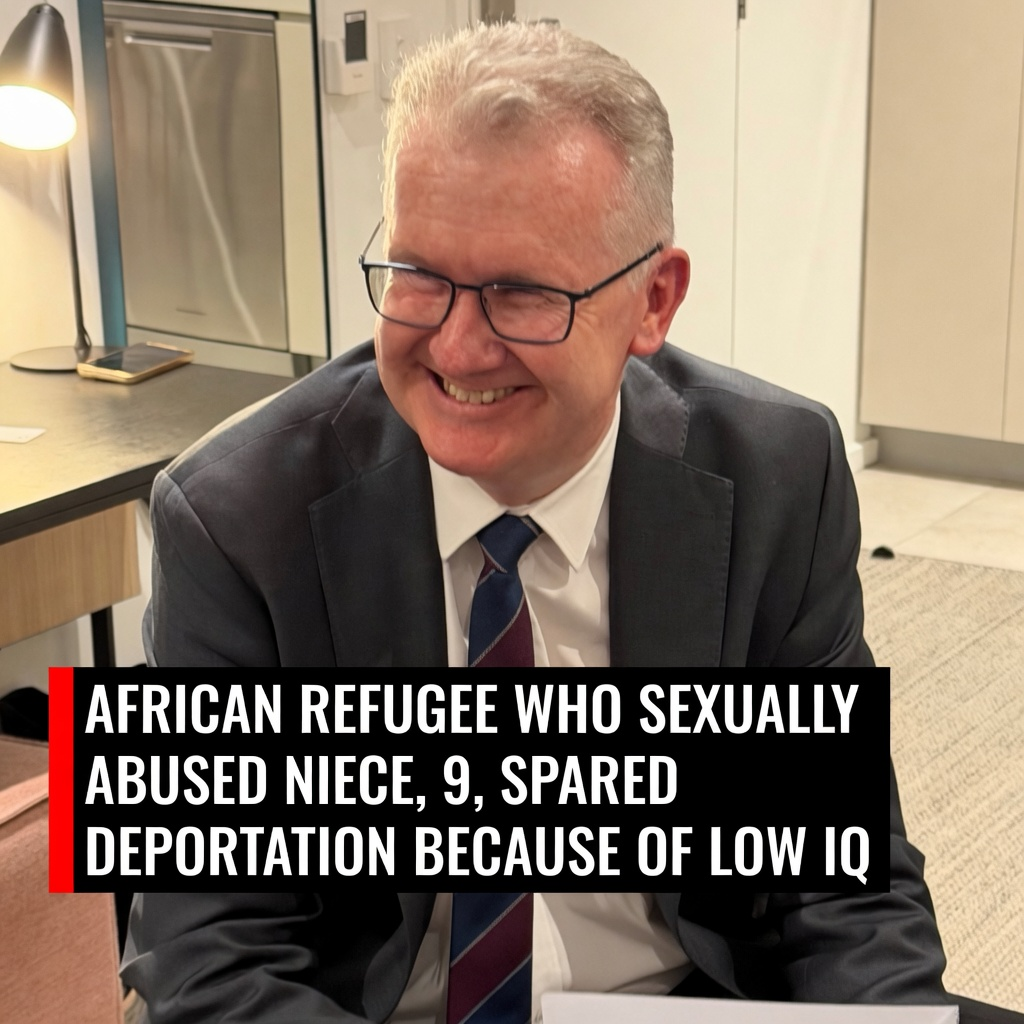
Immigration Minister Tony Burke remains at the center of the debate regarding Ministerial Direction 110 and its impact on national safety.
The offender, who is described as illiterate and functioning in the extremely low range of intellectual ability, was convicted of two counts of indecent acts with a child in 2015.
Despite the severity of the crimes involving his sister’s young daughter, YGTC was spared jail time in 2019 and instead given an 18-month Community Corrections Order.
While serving this order, he was successfully placed on an NDIS plan, which has since provided him with extensive social work and psychological assistance.
The Massive Financial Weight Of NDIS Support For Convicted Criminals
The economic implications of this decision are profound, particularly when considering the growing financial strain on the Australian taxpayer to fund the NDIS.
According to the latest data from the Australian Bureau of Statistics (ABS), government spending on social assistance and disability services has seen a significant upward trend over the past decade.
The NDIS is currently one of the largest budget items for the federal government, with costs projected to exceed $40 billion annually in the very near future.
From a fiscal perspective, every dollar spent on supporting a convicted non-citizen offender is a dollar that cannot be allocated to Aussie battlers who have contributed to the system their entire lives.
Taxpayers are rightfully asking why they should be responsible for the lifelong ongoing treatment and support of someone who has breached the fundamental trust of the community.
The ABS reveals that household incomes are under extreme pressure due to rising costs, making the transparency of government spending more critical than ever for the quiet Australians.
In the case of YGTC, the tribunal heard that the services he receives through the NDIS are chronically limited and difficult to find in Sierra Leone.
This creates a complex dilemma where Australian humanitarian values are being weighed against the harsh reality of finite economic resources.
The hard yakka of balancing a national budget is made even more difficult when policies like Direction 110 force the state to maintain the welfare of individuals who pose a risk to society.
Many argue that the primary purpose of the migration system should be the benefit of the Australian people, not the provision of a global safety net for those with criminal backgrounds.
Why Ministerial Direction 110 Is Raising Serious Questions Across Australia
Ministerial Direction 110, maintained by Immigration Minister Tony Burke, has become a lightning rod for criticism regarding community expectations and public safety.
The direction requires the tribunal to take into account a wide range of factors, including ties to Australia and the best interests of any minor children involved.
In this specific case, Ms. Bourke noted that YGTC has two children of his own, aged 1 and 2, whose interests were served by him remaining in the country.
However, the impact of his past actions on his niece, who was only nine at the time of the abuse, seems to have been overshadowed by his own personal impairments.
The tribunal heard that a psychologist found the offender had no insight into the effect of the behaviour on his niece, a fact that is deeply concerning for many parents.
Despite this lack of insight, the tribunal was satisfied that he accepts responsibility within the very limited range of his intellectual capability.
This raises a severe question about the pub test in Australia: does a low IQ excuse an individual from the consequences of harming the most vulnerable members of our society?
The list of serious criminals who have had their visas restored under this direction this year alone is a significant shock to the national conscience.
From wife-killers to drug smugglers and rapists, the pattern of the ART prioritizing individual impediments over community safety is becoming impossible to ignore.
The Canberra bubble often seems detached from the reality of life in the suburbs, where families just want a fair dinkum guarantee that their children are safe from known predators.
Community Safety Versus The Challenges Of Removing High-Risk Individuals
The case of YGTC highlights the extreme difficulty the government faces when attempting to deport individuals with significant intellectual disabilities.
Testing showed that the applicant functions in the first or second percentile, meaning his IQ is likely lower than 69, which complicates the legal proceedings.
The tribunal even had to refrain from warning him against self-incrimination to avoid confusing him during the hearing, illustrating the depth of his impairment.
While these medical facts are undeniable, the heavy pressure on local law enforcement to monitor such an individual remains a constant concern.
The offender was assessed as low risk for reoffending, but the psychologist’s report on his lack of empathy for the victim remains a massive red flag.
The ABS data on crime statistics shows that the safety of children is a top priority for the vast majority of Australian households.
When the system appears to favor the rights of the perpetrator over the safety of the public, it erodes the social contract that holds the nation together.
The Aussie Dream is built on the idea of a safe place to raise a family, but that dream is threatened when the gatekeepers of our borders are bound by questionable directives.
Furthermore, the reliance on a protective network of family and church communities assumes that these groups can provide constant supervision of a known offender.
If that network fails, the hard yakka of dealing with the fallout will once again fall on the police and the healthcare system, funded by the taxpayer.
The total cost of keeping high-risk individuals in Australia goes beyond mere NDIS payments; it involves judicial resources and community monitoring that are rarely fully accounted for.
Voters are increasingly frustrated that their hard-earned dollars are being diverted away from essential services for law-abiding citizens.
This policy failure represents a significant drain on national wealth and a betrayal of the Aussie battlers who expect their government to prioritize their safety.
According to recent economic reviews, the cost of the NDIS is rising faster than almost any other government program, putting the national AAA credit rating at risk.
Injecting millions into the support systems for non-citizens with criminal records is seen by many as a fair dinkum rort of the humanitarian program.
We must ask whether our migration policy has become so focused on the individual that it has forgotten its duty to the collective Australian public.
The case of YGTC serves as a stark reminder that the current legal framework is struggling to find a balance between compassion and common sense.
The quiet Australians are not asking for a heartless system, but they are demanding one that recognizes the fundamental right to live without fear in their own suburbs.
If Ministerial Direction 110 continues to allow child abusers and rapists to stay, the social cohesion of our diverse nation will be permanently damaged.
It is time for the Canberra elite to step out of their bubble and listen to the concerns of the people living on the front lines of these decisions.
The hard yakka of fixing the migration system must begin with a fair dinkum review of how the ART operates and the directives it follows.
Every decision to restore a visa to a violent criminal is a slap in the face to the victims who have already suffered enough at their hands.
We owe it to the next generation to ensure that Australia remains a safe haven for those who play by the rules and respect our way of life.
The Aussie Dream is too precious to be sacrificed on the altar of bureaucratic red tape and questionable humanitarian theories.
Let’s make sure that our borders are strong, our laws are firm, and our priorities are focused on the safety of our children above all else.
Anything less is a failure of leadership and a total shocker for a nation that prides itself on being the lucky country.
The time for talk is over; the Australian people want action, and they want it now.
We will be watching the next federal budget closely to see if there is any serious effort to rein in these escalating costs and protect our community.
The battle for the soul of our immigration system is far from over, and the Aussie battler will not be silenced.
Stay tuned as we continue to track the impact of these controversial decisions on our national security and our shared future.
The case of YGTC is just the beginning of a larger conversation that this country desperately needs to have about our values and our priorities.
We must ensure that the fair go always puts the victims and law-abiding citizens first.
Because at the end of the day, that is what being Australian is all about.
Let’s hope common sense eventually finds its way back to the decision-makers in Canberra.
Our children’s safety depends on it.






