Australia is routinely told it is in the grip of a crisis of misogyny, male violence and an increasingly dangerous “manosphere”. Yet on many of the broad measures used to judge women’s wellbeing — longevity, education, professional participation and political representation — Australian women have never been better placed. The harder question is whether the national gender debate has become so focused on female disadvantage that an increasingly serious set of problems facing men is being overlooked.
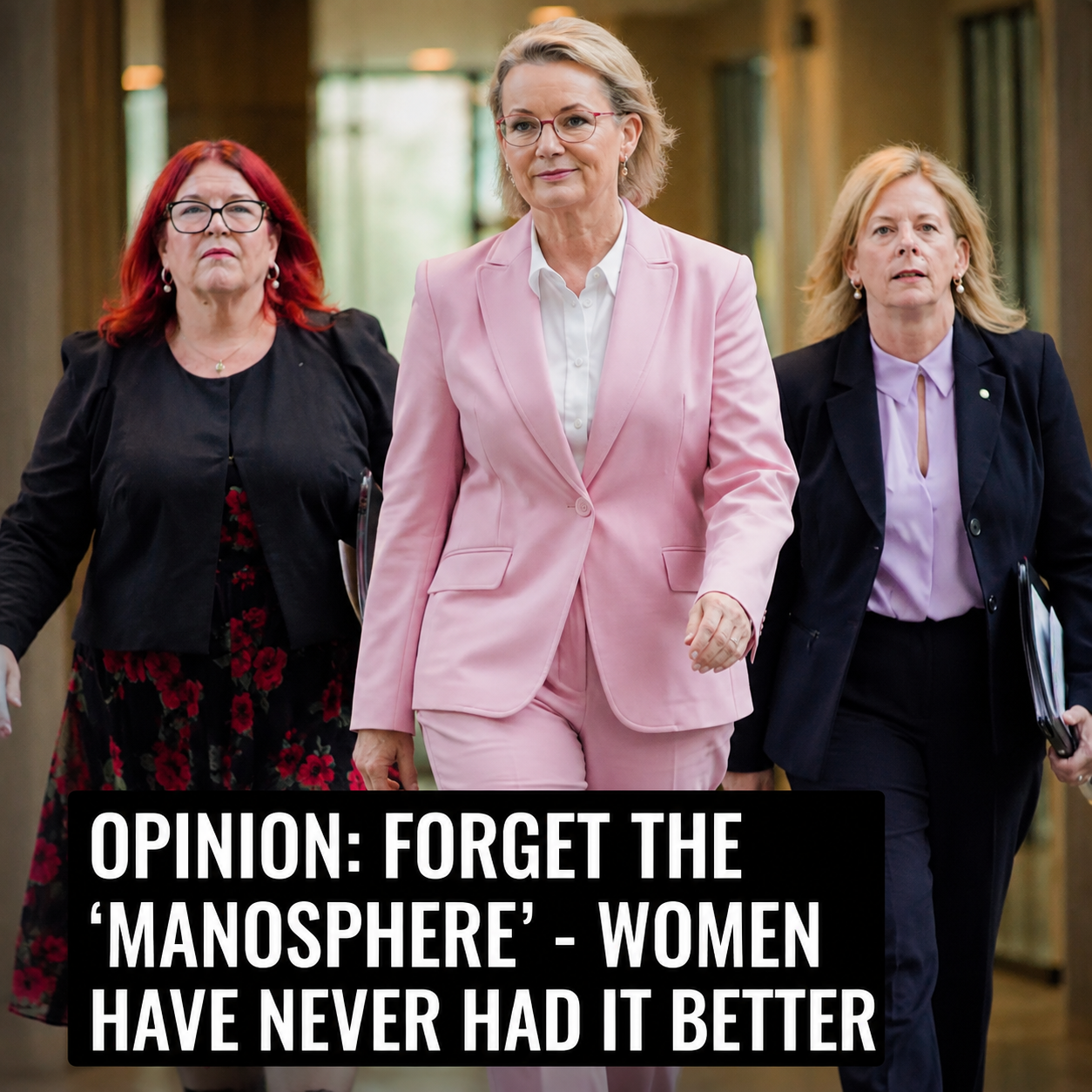
That is the argument advanced by commentator John Grant, who says the prevailing story about gender in Australia bears increasingly little resemblance to the country’s measurable social outcomes.
His thesis is deliberately provocative: Australia remains intensely focused on misogyny, violence against women and male behaviour at the same time as women are reaching unprecedented levels of educational, professional and political representation.
Some of the rhetoric in that argument goes further than the evidence comfortably allows. Violence against women remains a serious and measurable problem, and high national rankings do not mean every woman enjoys equal safety or opportunity.
But Grant’s larger challenge deserves examination because another set of statistics is becoming increasingly difficult to ignore. Men are substantially more likely to die by suicide, are falling behind women in university participation and increasingly form a minority in several professional and educational pathways.
The result is a gender debate containing two truths that are often presented as though only one can exist: women in Australia still face serious forms of violence and disadvantage, while men are simultaneously doing poorly on a growing range of social indicators.
Australia is one of the world’s best-performing countries for women
The claim that Australia is broadly hostile to women is difficult to reconcile with international comparisons.
Australia ranks 11th out of 181 countries on the latest Women, Peace and Security Index produced by Georgetown University’s Institute for Women, Peace and Security.
The index assesses women’s inclusion, justice and security using indicators covering education, employment, financial inclusion, political representation, legal discrimination and exposure to violence.
Australia also achieved its best result to date in the World Economic Forum’s 2025 Global Gender Gap Index, reaching 13th place after climbing 11 positions.
The measure is not designed to declare that gender inequality has disappeared. It compares gaps between women and men across economic participation, education, health and political empowerment.
But it does make one point difficult to dispute: measured internationally, Australia is not an unusually poor place to be a woman. It is among the stronger performers in the world.
Women also enjoy a substantial longevity advantage.
Australian life expectancy in 2022–24 was 85.1 years for women and 81.1 years for men, a four-year gap.
Overall mortality is also lower among women. In 2024, Australia recorded more than 98,000 male deaths compared with just under 89,000 female deaths, despite the population being broadly balanced by sex.
These are not trivial indicators. Longevity is one of the broadest measures of population wellbeing available.
Women have made extraordinary gains in politics and professional life
Political representation has also changed dramatically.
Following the 2025 federal election, women made up 56 per cent of Labor’s parliamentary representatives and Australia formed its first majority-women federal cabinet.
The country currently has a female Governor-General and has previously had a female prime minister.
Women have led major political parties, state governments, unions, business organisations, universities and some of the largest institutions in the country.
None of that proves structural barriers have vanished. Women remain underrepresented in some senior corporate roles and continue to experience a gender pay gap under several measures.
But Australian public life looks profoundly different from the landscape of several decades ago, when female participation at the top of politics, law and business was comparatively rare.
The legal profession offers a particularly clear example.
Women became the majority of Australian solicitors several years ago and now account for 56 per cent of the profession nationally.
The generational direction is even clearer. Since 2014, more women than men have entered the profession, and women heavily outnumber men among younger lawyers.
In government legal practice, female representation is particularly strong.
The old assumption that professional occupations are inherently male domains is increasingly difficult to maintain across large sections of the graduate economy.
The university divide may be the clearest warning sign for men
Education provides perhaps the strongest evidence for Grant’s broader concern.
Australian women are not merely closing an old educational gap. In higher education they have moved decisively ahead.
In 2024, women represented 62 per cent of domestic students commencing higher education, compared with 38 per cent for men.
There were about 252,600 female domestic commencements compared with approximately 158,100 male commencements.
The gap has been widening over the longer term.
A decade earlier, women represented about 58 per cent of commencing domestic students. Male participation has since declined as a share of the cohort.
The reasons are complex.
Some men who do not attend university move into vocational education, apprenticeships or trades, where earnings can be strong and a degree is unnecessary. A lower university participation rate therefore cannot automatically be interpreted as social failure.
But a persistent 62–38 split is large enough to raise legitimate questions, particularly as degrees remain gateways into law, medicine, teaching, public administration and much of the professional economy.
If the genders were reversed, a participation disparity of that size would almost certainly be treated as an equality issue requiring substantial investigation.
That is the strongest version of Grant’s argument: equality policy should be capable of recognising disadvantage wherever it appears rather than assuming in advance which sex must always occupy the disadvantaged position.
Male health outcomes tell an even more troubling story
The imbalance becomes more serious when education is combined with health and mortality data.
Men live four fewer years on average than women.
They also die by suicide at dramatically higher rates.
Australian Bureau of Statistics gender indicators put the male suicide rate at 18.7 deaths per 100,000 people in 2024, compared with 5.7 for women.
Men also have higher rates of several forms of risky behaviour and substance use.
They are more likely to exceed national alcohol guidelines and more likely to smoke daily.
Those outcomes cannot simply be blamed on discrimination against men. They reflect a complicated mixture of health behaviour, employment patterns, social expectations, relationship breakdown, economic circumstances, service use and willingness to seek help.
Yet they plainly constitute a serious male wellbeing problem.
A gender-equality conversation concerned with measurable outcomes should be able to discuss that problem without treating it as an attempt to minimise difficulties experienced by women.
But violence against women is not a manufactured crisis
This is also where the more sweeping version of Grant’s argument runs into the evidence.
Australia’s high international rankings do not make concern about domestic and sexual violence imaginary.
National survey data show approximately 23 per cent of women have experienced physical or sexual violence from an intimate partner since the age of 15, compared with 7.3 per cent of men.
When emotional and economic abuse are included, 27 per cent of women report having experienced violence or abuse by a partner, compared with 15 per cent of men.
Police-recorded data also show that family and domestic violence remains disproportionately lethal for women in intimate and family settings.
In 2024, nearly two-fifths of recorded homicide-related offences were classified as family-and-domestic-violence related, with 99 female victims in that category.
Sexual violence presents another substantial gender difference.
ABS data show 22.2 per cent of adult women report having experienced sexual violence since age 15, compared with 6.1 per cent of men.
Those numbers justify public policy attention.
They also make it difficult to support the contention that discussion of violence against women is merely a media invention or ideological campaign.
The more defensible criticism is not that women’s problems are fictitious. It is that political and media institutions can become selective about which gender disparities are treated as urgent social injustices and which are regarded as unfortunate background statistics.
Progress for women and hardship for women can coexist
Much of the argument becomes confused because national progress and individual suffering are often treated as mutually exclusive.
They are not.
Australia can simultaneously be one of the world’s safest and most prosperous countries for women and still have thousands of women experiencing serious domestic or sexual violence.
Female participation in politics can reach record levels while some industries retain substantial gender pay gaps.
Women can outperform men educationally while still experiencing forms of harassment that men experience less often.
Likewise, recognising those facts does not require pretending male disadvantage is insignificant.
Men can remain disproportionately responsible for serious violence while also being disproportionately represented in suicide deaths, workplace fatalities, imprisonment, rough sleeping and educational underachievement.
A mature public discussion should be capable of holding all of those realities at once.
The language of ‘male privilege’ increasingly struggles with younger generations
Where the changing statistics may have their greatest political impact is among younger men.
A young Australian man entering adulthood today did not personally design the institutions that historically favoured men.
He may instead look around his classroom or university and see considerably more women than men.
He may enter a profession in which women already form the majority.
He may hear repeated institutional messages about male privilege, toxic masculinity and the need for men to change while seeing relatively little discussion of male suicide, educational disengagement or social isolation.
That does not make hostile online ideologies inevitable or justified.
But it helps explain why language developed to describe gender relations several generations ago may increasingly fail to resonate with some younger men.
The term “manosphere” now covers a wide spectrum of online communities, from relatively ordinary discussions of dating and men’s wellbeing to explicitly misogynistic influencers and extremist subcultures.
Treating all male dissatisfaction as evidence of misogyny risks collapsing those very different phenomena into one category.
It can also become self-defeating.
If men experiencing genuine disadvantage are told their problems are primarily expressions of privilege, some will predictably seek alternative communities that at least acknowledge their difficulties — even when those communities offer destructive explanations or scapegoats.
The real equality test is whether disadvantage matters regardless of sex
The central question raised by Grant’s argument is therefore larger than whether Australia is a good place to be a woman.
By international standards, it plainly is.
The more interesting question is whether the institutions created to pursue gender equality are prepared to respond when evidence points in the opposite direction from the historical pattern.
If boys increasingly underperform in education, that should matter.
If men die by suicide at more than three times the female rate, that should matter.
If particular professions or university cohorts develop large and persistent sex imbalances, policymakers should be willing to examine why regardless of which sex is in the minority.
The same principle should apply when the evidence shows women disproportionately experiencing intimate-partner violence, sexual assault or economic disadvantage.
Equality becomes less credible when it operates as a predetermined hierarchy of deserving victims rather than an attempt to identify and reduce measurable disadvantage.
That principle also exposes the weakness in framing the issue as a contest between men and women.
Women gaining educational or professional opportunities did not cause male suicide. Male disadvantage is not solved by reversing women’s progress. Nor does the existence of successful women somehow invalidate women who experience violence or abuse.
The challenge is to design institutions capable of responding to both.
Australia’s gender story has become more complicated than its politics
There is substantial evidence behind the argument that Australian women have made extraordinary progress.
They live longer than men, dominate university commencements, form the majority of solicitors, occupy unprecedented numbers of political positions and live in a country ranked among the world’s strongest performers for women’s security and inclusion.
Those achievements deserve recognition rather than being obscured by a national narrative in which female progress can sometimes appear almost invisible.
There is also substantial evidence that violence and abuse affecting women remain serious social problems deserving concentrated attention.
The mistake is assuming that acknowledging one set of facts requires denying the other.
The emerging male picture is equally difficult to dismiss.
Men are a shrinking minority in higher education, have significantly shorter life expectancy and die by suicide at more than three times the rate of women.
Those numbers do not establish that men are now the universally “oppressed” sex, just as female representation in universities does not establish that women have achieved equality in every part of life.
They do show that the old one-directional model of gender disadvantage is becoming increasingly inadequate.
Australia may indeed be living through one of the best periods in its history to be a woman. But if equality is supposed to mean taking disadvantage seriously wherever it appears, the next stage of the gender debate will also have to confront an uncomfortable fact: on education, suicide and several other major measures of wellbeing, Australian men are increasingly the group falling behind.