Right-wing Australian influencer Hugo “Auspill” Lennon has taken his campaign against Australia’s new hate-group laws to the gates of the US Embassy in Canberra, appealing directly to President Donald Trump to intervene politically as a major constitutional challenge to the Commonwealth’s new prohibition regime heads towards the High Court.
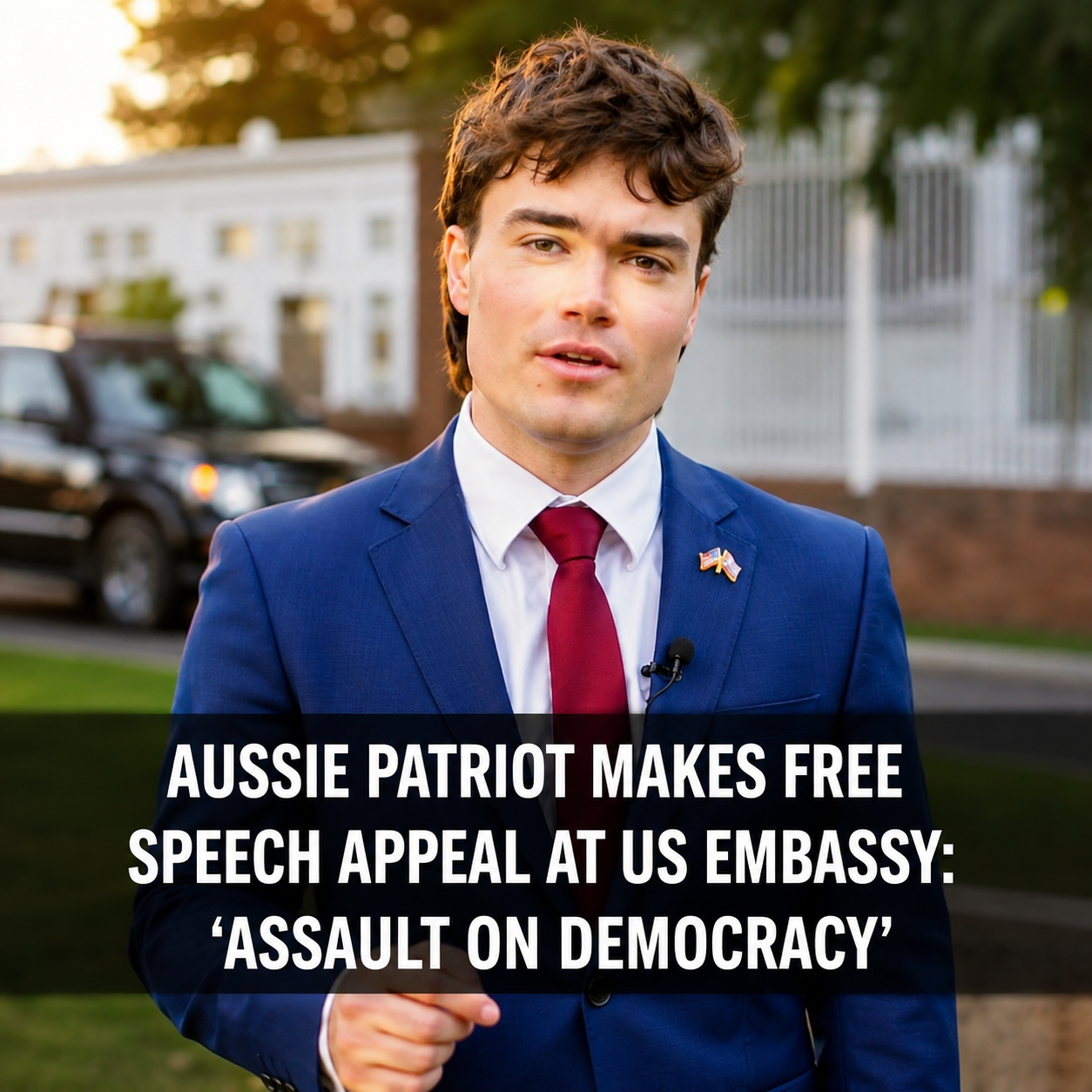
Lennon recorded the video outside the embassy on Wednesday, describing it as an “urgent message for President Trump” and arguing that Australia’s expanding laws dealing with hate groups and political extremism represented an assault on civil liberties.
The intervention comes ahead of planned “defend free speech” demonstrations on Sunday, August 30, where activists are expected to protest against the Commonwealth’s new prohibited-hate-group regime and other restrictions they regard as unacceptable limits on political expression.
Lennon used the Canberra appearance to frame the issue not merely as a domestic political dispute, but as one involving the relationship between Australia and the United States.
He argued that generations of Australians and Americans had fought alongside one another and said Washington should therefore pay attention to what he described as an erosion of political freedoms inside one of its closest allies.
Lennon sends ‘urgent message’ to Trump
Standing outside the embassy, Lennon invoked the military history shared by Australia and the United States.
“The crimson ties of shared blood and sacrifice unite the Australian and American people,” he said.
He pointed to Australians and Americans fighting alongside one another during the Second World War, Korea and Vietnam before turning his attention to the contemporary strategic competition with China.
“Our Anzac ancestors fought alongside you, the superpower vanguard of Western civilisation, in defence of the free world, but the so-called free world no longer feels so free,” Lennon said.
He then attempted to connect Australian domestic politics with the broader strategic challenge posed by Beijing.
Lennon argued that convincing another generation of Australians to stand beside the United States against a “rising China” would become harder if those Australians believed their own political freedoms were being restricted at home.
That is Lennon’s political argument rather than an established assessment of either Australian democracy or the Australia-US alliance.
White Australia prohibition at centre of dispute
Behind the rhetoric is a significant and very real constitutional dispute now before Australia’s highest court.
The Commonwealth Parliament enacted the Combatting Antisemitism, Hate and Extremism (Criminal and Migration Laws) Act 2026 in January.
The legislation inserted a new Part 5.3B into the Commonwealth Criminal Code, establishing a regime through which organisations can be specified as “prohibited hate groups”.
The legislation describes its purpose as protecting Australians against social, economic, psychological and physical harm and against the promotion of violence by organisations involved in conduct constituting hate crimes.
White Australia was formally listed under that regime on May 15, with the regulations taking effect the following day.
The Commonwealth identifies the organisation as also being known as WA and the White Australia Party and says it was formerly known as the National Socialist Network and European Australia Movement.
The government describes White Australia as a racist extremist organisation grounded in white-supremacist ideology.
That background is significant because Lennon’s video characterises the prohibition primarily as a ban on political opposition. The Commonwealth’s stated justification is substantially different: it says the regime is directed at organisations meeting statutory criteria concerning hate crimes and community harm.
What does being a ‘prohibited hate group’ actually mean?
The consequences of listing are substantial.
Under Division 114B of the Criminal Code, offences can apply to activities including directing a prohibited organisation, intentionally remaining a member in specified circumstances, recruiting people, providing training, funding the organisation or providing certain forms of support.
The government says those restrictions are intended to prevent a listed organisation from legitimately operating and to reduce its ability to spread its ideology or advocate conduct constituting hate crimes.
The legislation therefore goes considerably further than simply restricting a particular statement or social-media post.
It can affect the organisation itself, its membership and activities undertaken to keep it functioning.
That breadth is also one reason the constitutional litigation now before the High Court is consequential well beyond the future of a single organisation.
High Court will decide constitutional challenge
White Australia Party Inc and its national president, Thomas Sewell, have launched proceedings against the Commonwealth challenging the validity of the new legislative framework.
The matter is formally before the High Court as White Australia Party Inc & Anor v Commonwealth of Australia & Anor, case M50/2026.
The plaintiffs contend that the provisions lack sufficient Commonwealth legislative power.
They also argue that the regime impermissibly burdens the constitutionally implied freedom of political communication and conflicts with Chapter III of the Constitution.
The challenge draws a comparison with the landmark Communist Party Case, in which the High Court struck down the Menzies government’s attempt to dissolve the Australian Communist Party.
Those arguments have not yet succeeded.
Nor have they yet been rejected at a final hearing.
The critical distinction is that White Australia is currently legally listed as a prohibited hate group and the legislation remains operative unless and until the High Court decides otherwise.
Earlier attempt to freeze the laws failed
The plaintiffs have already tried to prevent the listing regime operating against them while their constitutional case proceeds.
That attempt was unsuccessful.
High Court documents show that an urgent interlocutory application was lodged on May 15, the same day the regulations specifying White Australia were made.
Justice Jayne Jagot declined to deal with the requested injunction before the listing took effect at midnight.
The High Court subsequently considered another attempt to suspend the operation of the law pending determination of the constitutional case.
Chief Justice Stephen Gageler declined to grant that injunction in June.
Importantly, refusing interim relief is not the same as deciding that every challenged provision is constitutionally valid.
The substantive constitutional questions remain before the court.
High Court records reveal scale of banned organisation
The court proceedings have also put previously important details about White Australia on the public record.
According to the High Court, the White Australia Party was incorporated in Victoria on December 20, 2025 and had 1,778 members as of May 15 this year.
The organisation had also sought registration as a political party.
The Parliamentary Joint Committee on Intelligence and Security records that the White Australia Party attempted to register with the Australian Electoral Commission in April.
The controversy therefore sits at the intersection of two questions: the Commonwealth’s power to protect the community from organisations it says advocate or engage in hate-related conduct, and constitutional limits on executive and legislative power over political organisation.
That conflict is now for the High Court to resolve.
Lennon urges Washington not to ‘stand idly by’
Lennon’s appeal sought to internationalise that domestic constitutional dispute.
He accused Australia’s political establishment of attempting to eliminate lawful nationalist opposition and urged the Trump administration to take notice.
“The United States cannot afford to stand idly by and allow one of its closest allies to abolish democracy and criminalise patriotic dissent, especially not at such a critical time as this,” Lennon said.
He invoked Australian soldiers who fought alongside Americans during twentieth-century conflicts and argued the alliance should involve more than military co-operation.
“Australians fought and died alongside Americans in the wars of the 20th century to keep Australia free,” he said.
He appealed directly to Trump not to allow Australia to “fall”.
There is no evidence in the material available that the Trump administration has adopted Lennon’s characterisation of Australian democracy or agreed to intervene in the White Australia litigation.
Activist says political opposition should remain democratic
Lennon also argued that nationalist political movements should be allowed to organise through ordinary democratic processes.
He said there were large numbers of Australians who could be politically mobilised “by democratic means”, but alleged the government was creating what he described as a “neo-Marxist repressive apparatus” to prevent that mobilisation.
Again, that description is Lennon’s political characterisation.
The Commonwealth maintains that the prohibited-hate-group regime is a community-safety mechanism aimed at organisations involved in hate crimes and the promotion of violence, not a general prohibition on conservative, nationalist or anti-government political views.
Whether the legislation nevertheless goes constitutionally too far is precisely the question now being litigated.
Parliamentary committee has also examined White Australia listing
The Parliamentary Joint Committee on Intelligence and Security began its own statutory review of the White Australia listing in June.
The committee received 23 submissions and held an in-camera hearing on July 30.
Parliamentary material confirms that the listing process involved information supplied by relevant security agencies and that the Director-General of Security recommended the responsible minister consider whether White Australia should be specified.
The statutory process also requires written agreement from the Attorney-General and a briefing for the Leader of the Opposition before an organisation is specified.
Those safeguards form part of the Commonwealth’s answer to concerns about allowing the executive government to effectively shut down an organisation without first obtaining a criminal conviction against every member.
Critics, meanwhile, argue that the existence of procedural steps does not resolve the more fundamental constitutional question of whether such power can validly be exercised against a political organisation.
Legal dispute reaches beyond ordinary ‘hate speech’ debate
The controversy is frequently described as a fight over “hate speech”, but the legal dispute is broader than whether offensive words should be criminalised.
The provisions challenged in the High Court concern the Commonwealth’s ability to designate an organisation as a prohibited hate group and then attach criminal consequences to membership and other forms of participation.
That raises questions about freedom of political communication, freedom of association, Commonwealth legislative power and the constitutional separation of judicial and executive authority.
Australia does not have a general constitutional right to free speech equivalent to the First Amendment of the United States Constitution.
Australian constitutional law instead recognises an implied freedom of communication concerning governmental and political matters.
That implied freedom is not a personal right to say anything without legal consequences.
It operates principally as a limitation on legislative and executive power where laws impermissibly burden the system of representative and responsible government established by the Constitution.
That distinction makes the High Court proceedings particularly important.
Free-speech rallies planned for August 30
Lennon delivered his appeal only days before demonstrations planned around Australia for Sunday, August 30.
Organisers and supporters have framed the events as protests against restrictions on political expression, the prohibited-hate-group regime and internet censorship.
The rallies are expected to bring together different sections of Australia’s nationalist and right-wing political movements, although attendance figures cannot be established in advance.
Lennon’s Canberra video effectively sought to place those protests before an international audience.
After recording the message, he distributed it through his substantial social-media following and tagged prominent US government accounts and officials, including the White House, State Department and Secretary of State Marco Rubio.
Two competing versions of what the new laws represent
The argument surrounding the laws is increasingly divided between two sharply different interpretations.
For Lennon and other critics, the White Australia listing demonstrates how powers created to fight extremism could be turned against organised political dissent.
For the Commonwealth, the legislation is designed to stop organisations assessed under a statutory process as engaging in, preparing for, assisting or advocating conduct constituting hate crimes.
The government says White Australia meets those requirements and poses social, psychological and physical risks to the Australian community.
Those positions should not be blurred.
It is established that White Australia has been prohibited under Commonwealth law.
It is established that membership and specified forms of involvement can consequently attract criminal liability.
It is also established that the legislation and its application to White Australia are being challenged in Australia’s highest court.
What has not been established is Lennon’s broader claim that Australian democracy itself has been abolished or that all forms of “patriotic dissent” have been criminalised.
September High Court case could settle much larger question
Ultimately, the most important development will occur not outside the US Embassy but inside the High Court of Australia.
The substantive proceedings expected in September will test whether the Commonwealth’s prohibited-hate-group framework can withstand constitutional scrutiny.
If the plaintiffs succeed, the consequences could reach far beyond White Australia and potentially constrain how future governments attempt to prohibit politically active extremist organisations.
If the Commonwealth succeeds, the decision could provide significant constitutional authority for the new framework and clarify how far Parliament can go in criminalising participation in organisations designated as hate groups.
Until that judgment is delivered, claims that the regime is definitively unconstitutional are premature — just as the failure of the plaintiffs to obtain an interim injunction does not settle the constitutional challenge in the government’s favour.
Lennon has now asked Washington to pay attention. But the institution with the immediate power to determine the future of Australia’s prohibited-hate-group regime is the High Court, where the constitutional confrontation over political communication, executive power and the White Australia listing is approaching its decisive stage.






