A Melbourne father who stormed his son’s high school and punched a 16-year-old student in the face before tracking down another alleged bully’s father and knocking him unconscious has avoided jail, after a court heard months of distress over his son’s bullying culminated in an explosive “angry outburst”.
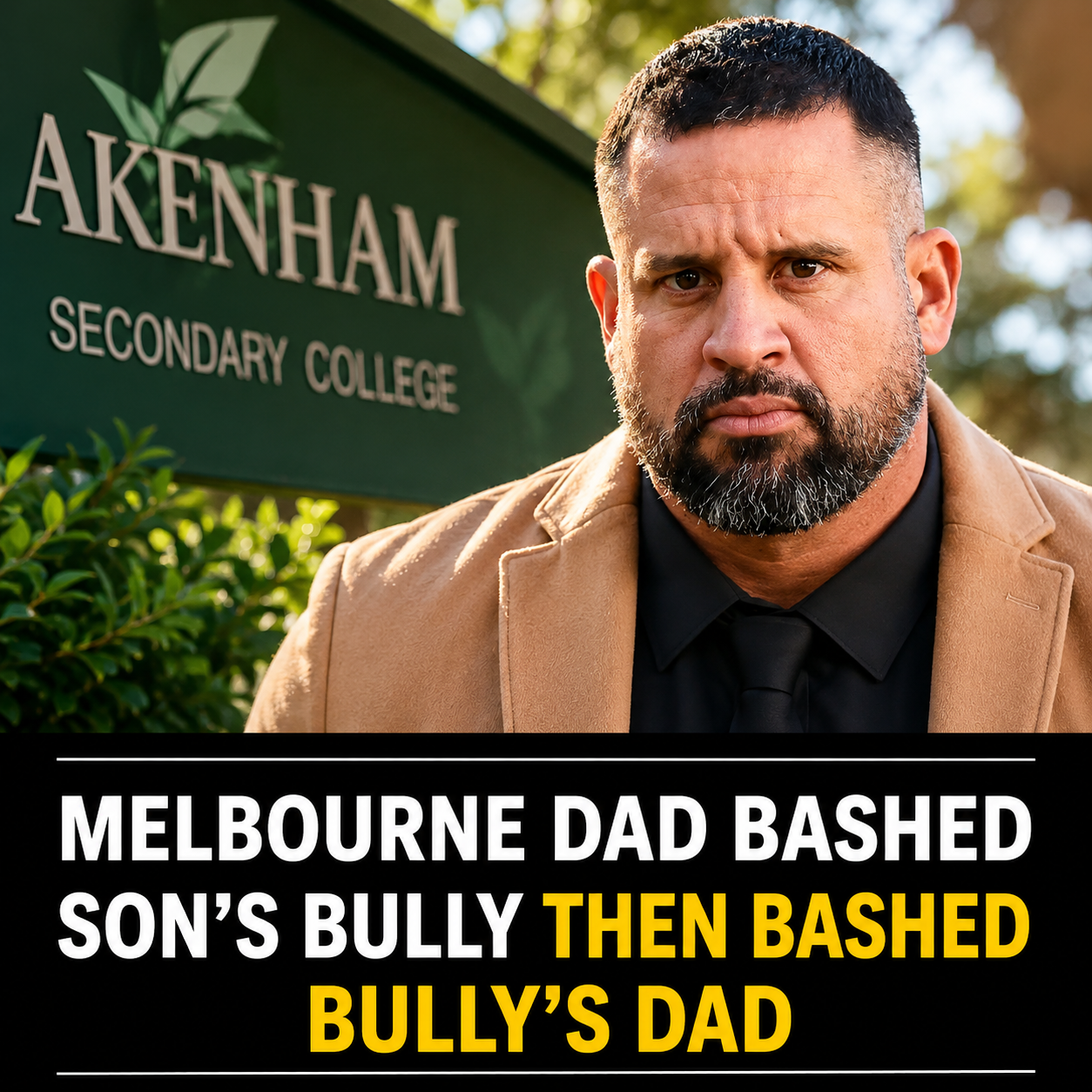
Bobby Backman, 39, was convicted in the County Court of Victoria after pleading guilty to a series of offences arising from two confrontations on March 11, 2025.
The court heard Backman believed his teenage son had been subjected to serious and repeated bullying at Pakenham Secondary College, including allegations that he had been threatened with a knife and forced to kneel in a school toilet at the feet of other students.
Backman and his former partner had previously raised concerns about the bullying with the school, prosecutors told the court.
But on the morning of March 11, Backman received another phone call from his son telling him the bullying had continued.
What followed turned a family’s frustration with school bullying into a criminal case of its own.
Backman drove to the school, approached students on the basketball courts and punched a 16-year-old boy in the face.
He then demanded to know where another student was.
Teachers attempted to calm the situation and move him away from the students.
Backman eventually left the school with his son.
Less than half an hour later, however, he arrived at the home of the other student.
He entered the property through an unlocked door and assaulted the boy’s father, striking him in the face and causing him to lose consciousness.
Judge Kevin Doyle described both attacks as serious and made clear that bullying, however distressing, did not entitle a parent to take punishment into his own hands.
A phone call that triggered the confrontation
Prosecutor James Sutherland told the court that Backman’s son called him on the morning of March 11 and complained about what was happening at school.
The broader background, the court heard, included claims of repeated intimidation and humiliation.
One of the most disturbing allegations was that the boy had previously been threatened with a knife.
He also told his father that he had been forced to kneel in the toilets in front of students who were bullying him.
The defence said Backman had reached a point of severe distress and helplessness over what he believed his child was experiencing.
But instead of leaving the matter to school authorities or police, he drove to Pakenham Secondary College himself.
The court heard he arrived at about 11.15am.
A group of students was standing near the basketball courts.
Backman approached a 16-year-old boy and punched him in the face.
The teenager was not an adult adversary confronting Backman in a private dispute. He was a school student on campus.
That distinction became particularly significant at sentencing.
Teachers tried to de-escalate the situation
School staff quickly became involved.
According to the prosecution, several teachers attempted to de-escalate the confrontation by moving Backman away from the students and towards another part of the school.
Backman demanded to know where another student was but eventually left the campus at approximately 11.27am with his son.
The intervention brought the immediate confrontation at the school to an end.
But Backman’s anger had not subsided.
Within about half an hour, he was at the home of another boy alleged to have been involved in bullying his son.
Second confrontation moved from school to family home
Backman knocked on the door and began yelling, the court heard.
The door was unlocked.
He opened it and entered the home.
Inside was the student’s father.
Backman struck the man in the face.
The blow was sufficiently forceful to cause him to lose consciousness.
The decision to enter the home elevated the criminal seriousness of the episode beyond the assault itself.
Backman ultimately pleaded guilty to aggravated burglary as well as the assaults.
Aggravated burglary is treated seriously in Victoria because it involves entering a premises in circumstances connected with an offence and heightened risk to those inside.
The court therefore had to assess two very different considerations at sentencing: the emotional context surrounding Backman’s son, and the seriousness of a grown adult deliberately confronting a teenager at school before carrying the dispute to another family’s home.
Defence describes a ‘perfect storm’
Backman’s barrister, Lauren Bull, argued that his conduct had occurred during a period of significant psychological strain.
The defence relied on a psychological report describing the combination of factors surrounding the family as a “perfect storm”.
Backman was already experiencing mental-health difficulties when the bullying allegations intensified, the court heard.
The defence said receiving another call from his son on the day of the offending produced feelings of severe distress, helplessness and horror.
The psychologist’s assessment said that experience appeared to precipitate an “angry outburst”.
That did not amount to a legal justification for the violence.
But it was relevant to understanding how a man with no previous criminal history reached the point of committing two assaults in a matter of minutes.
Judge says bullying explains conduct but does not excuse it
Judge Doyle drew exactly that distinction.
The judge acknowledged the disturbing background described to the court and accepted that the circumstances surrounding Backman’s son helped explain the emotional state in which the offences occurred.
But he did not accept that they excused the conduct.
Backman was the adult.
The first person he struck was 16 years old.
The court regarded that as a particularly serious feature.
Judge Doyle said offending of this type would ordinarily attract imprisonment.
Entering a school to assault a student, followed by entering another family’s home and assaulting a parent, carried obvious consequences that could not be dismissed simply because the offender believed he was defending his child.
The court’s approach reflected a basic principle: parents can advocate fiercely for their children, make complaints, contact police and demand intervention, but they cannot become judge and enforcer themselves.
No previous criminal history helped keep Backman out of jail
Several factors ultimately persuaded the judge that immediate imprisonment was not necessary.
Backman had no prior criminal history.
He had complied with his bail conditions after being charged.
He pleaded guilty.
The court also considered his personal circumstances, mental-health evidence and the particular background to the offending.
Judge Doyle concluded an intensive community-based sentence could appropriately punish and rehabilitate him without sending him to prison.
Backman was convicted and placed on an 18-month Community Corrections Order.
He must complete 220 hours of unpaid community work.
The judge told him he considered it unlikely that he would appear before the criminal courts again.
That was not an endorsement of what Backman did.
It was a sentencing assessment that the combination of punishment, supervision and community work was sufficient in his individual case.
The charges Backman admitted
Backman pleaded guilty to two counts of common law assault.
He also admitted aggravated burglary and entering a public place without authorisation or excuse.
The school confrontation and the later entry into the private home therefore produced offences spanning two very different locations.
The convictions also demonstrate why the phrase “took matters into his own hands”, frequently used to describe cases like this, can obscure the legal reality.
Backman did not simply confront people he believed were responsible for hurting his son.
He committed criminal offences while doing so.
The bullying allegations remain an important part of the story
At the same time, removing the bullying context entirely would also give an incomplete account of what happened.
The court was told the family had been dealing with alleged bullying before the assaults.
Backman and his former partner had reportedly raised those concerns with Pakenham Secondary College.
His son nevertheless told him he continued to be targeted.
The allegations included behaviour that, if established, would go far beyond routine schoolyard conflict.
A threat involving a knife is potentially criminal.
Forcing another student to kneel in a toilet as an act of humiliation would also represent serious intimidation.
Those allegations explain why the court heard evidence of a parent who felt increasingly powerless.
They do not establish that every student identified by the family committed every allegation, nor should they be treated as findings against minors who were not themselves on trial in Backman’s sentencing proceedings.
That distinction is especially important because the students involved are children.
School policy says bullying will not be tolerated
Pakenham Secondary College’s published Bullying Prevention Policy says the school is committed to providing a safe and respectful learning environment and that bullying will not be tolerated.
The policy says reported incidents should be appropriately investigated and addressed.
It also says support should be provided to students affected by bullying, including victims, witnesses, bystanders and students engaging in bullying behaviour.
The school acknowledges that staff owe students a duty of care and must take reasonable steps to reduce reasonably foreseeable harm, including harm arising from bullying.
Its stated approach is to respond proportionately and consistently, stop repeated bullying and seek constructive outcomes.
The college also operates a Student Services Team through which students, teachers and parents can seek help for issues including bullying, mental health, social difficulties and adolescent behaviour.
None of those policies determines what happened in Backman’s son’s individual case.
The court evidence established that his parents had raised concerns. It did not turn Backman’s criminal sentencing into a formal judicial inquiry into whether the school had properly handled each complaint.
Where parents should turn when bullying becomes serious
The case nevertheless highlights an exceptionally difficult problem faced by families when they believe school intervention is not stopping serious abuse.
A parent whose child says they are frightened to attend school can understandably feel pressure to act immediately.
But there are legal avenues available even where a family believes the school response has failed.
Threats involving weapons or physical violence can be reported to police.
Parents can document incidents, preserve messages or other evidence, make formal complaints through the school and escalate matters through education authorities.
Where there is an immediate threat to a child’s physical safety, emergency services can become involved.
Those processes can feel slow to a distressed family.
But the Backman case shows what can happen when a parent crosses the line into physical retaliation.
The original concern may have been about a child being victimised.
After the parent commits violence, the situation suddenly includes new victims, new criminal charges and potentially a prison sentence.
A teenager was punched by a grown man
Judge Doyle’s comments also ensure the alleged bullying does not erase the seriousness of what happened to the 16-year-old.
Backman was 39.
He travelled to the school deliberately.
He entered the grounds and punched a child.
Whatever Backman believed that student had done, responsibility for investigating and punishing that behaviour did not belong to him.
The same principle applies to the second assault.
The father in the home was not lawfully subject to physical retaliation because of allegations involving his son.
Backman assaulted him hard enough to render him unconscious.
For the court, that conduct required a real punishment even though imprisonment was ultimately avoided.
Community Corrections Order is not an acquittal
Because Backman avoided jail, the sentence may be interpreted by some as lenient.
But a Community Corrections Order is still a criminal sentence.
Backman was convicted.
He must comply with the order for 18 months and complete 220 hours of unpaid work.
Failure to comply can bring an offender back before the court and expose them to further consequences.
The sentence reflects the personalised nature of criminal sentencing: courts assess not only the offence but an offender’s record, plea, prospects of rehabilitation, personal circumstances and risk of future offending.
Judge Doyle expressly observed that this type of offending would ordinarily result in imprisonment.
The fact that Backman remained in the community therefore reflects the unusual combination of mitigating circumstances rather than any suggestion that attacking a student or entering another family’s home is acceptable.
The case leaves two uncomfortable truths
The first is that serious school bullying can devastate children and families.
Parents who believe their child is being threatened or humiliated can experience anger, fear and helplessness, particularly if they think previous complaints have failed to make the behaviour stop.
The second is that a parent’s desperation does not create a right to use violence.
Backman’s case demonstrates what happens when those two realities collide.
He told the court, through the evidence presented on his behalf, that an accumulation of distress ended in an angry outburst.
Within less than an hour, a 16-year-old had been punched at school, another parent had been knocked unconscious in his own home and Backman had transformed himself from the father of an allegedly bullied child into a criminal defendant.
The judge accepted the bullying as part of the explanation.
He refused to accept it as an excuse.
Backman has now avoided prison, but the 18-month community order and criminal convictions leave a clear message: parents can demand action when their children are bullied, but the law does not allow them to replace school discipline or police intervention with their own fists.