Pauline Hanson’s One Nation is sharpening its campaign machinery in New South Wales ahead of the 2027 state election, with Rebecca Thompson publicly stepping forward as the party’s state president at a time when polling suggests the minor party has an unprecedented opportunity to convert growing support into seats.
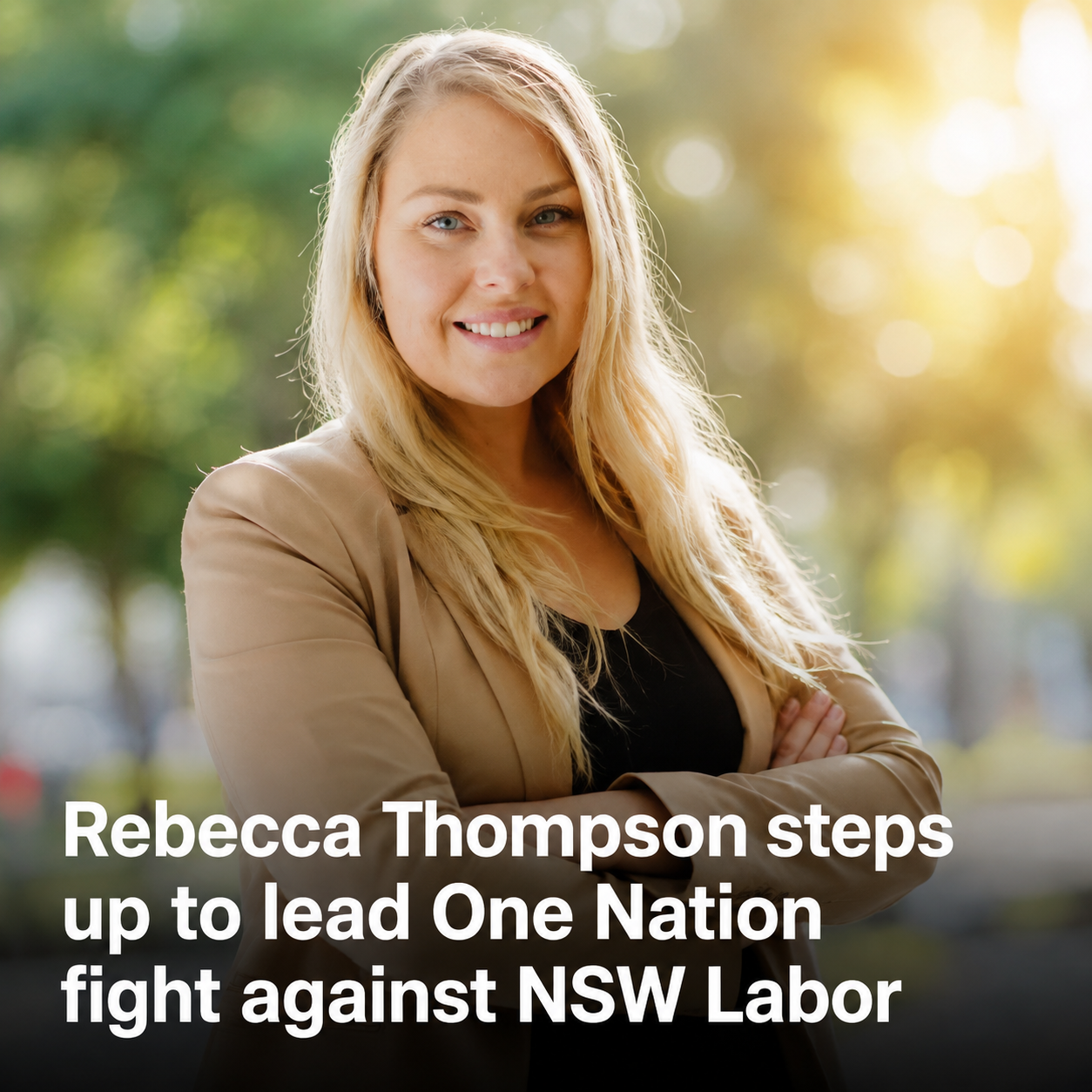
Thompson announced this week that she was “honoured to have been appointed as the NSW State President for One Nation”, declaring that she did not take the position or the trust placed in her lightly.
Her announcement comes as the countdown intensifies towards the New South Wales election on Saturday, March 13, 2027, when voters will elect all 93 members of the Legislative Assembly and 21 of the Legislative Council’s 42 members.
But there is an important qualification to Thompson’s announcement.
Although she has now publicly presented her appointment as state president, NSW Electoral Commission records updated in July 2024 already identified Rebecca Lea Thompson as One Nation’s NSW “President”, with responsibility for the “Control and Operation of PHON NSW”.
Rather than representing Thompson’s first involvement at the top of the state organisation, the announcement therefore signals her increasingly public leadership of the party as One Nation prepares for what could be its most consequential NSW state campaign in years.
“I look forward to the upcoming State election and thank the people who continue to back us and put their faith in us,” Thompson wrote.
One Nation has 198 days to turn polling into seats
The timing could hardly be more significant.
As of August 27, there are 198 days until polling day.
The NSW Electoral Commission has confirmed the election will be held on March 13, 2027, two weeks earlier than the date that would ordinarily have fallen at the end of the government’s four-year term because of a clash with the Easter long weekend.
And One Nation enters that campaign in a radically different political position from the one it occupied at the previous NSW election.
A DemosAU/Premier National survey of 1,038 NSW voters conducted from June 15 to 18 put Labor on 32 per cent of the primary vote, One Nation on 27 per cent, the Coalition on 20 per cent, the Greens on 13 per cent and others on 8 per cent.
The poll carried a reported margin of error of 3.8 percentage points, meaning the exact numbers should be treated cautiously.
Nevertheless, even allowing for that uncertainty, the result illustrated the scale of One Nation’s recent advance.
More strikingly, the survey reportedly put One Nation at 37 per cent among voters in regional NSW outside the Sydney Basin, compared with Labor on 23 per cent and the Coalition on 19 per cent.
Those figures do not mean One Nation is certain to win anything close to 37 per cent of regional votes next March. Polls are snapshots rather than election results, and translating statewide support into individual electorates can be exceptionally difficult.
But they do explain why the party is treating NSW as a major electoral opportunity.
Thompson brings experience from two previous campaigns
Thompson is not entering the campaign without electoral experience.
She first contested the federal electorate of Hume for One Nation at the 2022 election, challenging Liberal incumbent Angus Taylor.
She secured 7,700 first-preference votes, equivalent to 7.3 per cent of the electorate.
Taylor retained Hume with 43.1 per cent of the primary vote and ultimately defeated Labor 57.7 to 42.3 on the two-party-preferred count.
For Thompson, however, the campaign provided her first experience contesting an electorate under the One Nation banner.
“I became politically active in 2021, when I was first endorsed as a federal candidate for the seat of Hume,” Thompson said in announcing her latest role.
“I had no prior political experience but knew I wanted change for this great country.”
She said motherhood had been part of her motivation for becoming politically involved.
Thompson returned to the ballot less than a year later, this time contesting Wollondilly at the March 2023 NSW election.
Her result improved substantially.
She attracted 6,158 first-preference votes, representing 11.8 per cent of the total.
The seat was ultimately won by independent Judy Hannan, who defeated Liberal incumbent Nathaniel Smith.
During that campaign, Wollondilly Shire Council publicly noted that Thompson had committed to four of the five election priorities being pursued by the council.
Those two campaigns gave Thompson experience in both federal and NSW electoral contests before moving further into the party’s organisational structure.
“Since then I have run as a state and senate candidate and been on the state executive for almost 3 years,” she wrote this week.
Her government background could matter in the campaign
Thompson has also built much of her career outside politics.
Biographical material from her earlier campaigns describes her as having worked for years in government customer-service roles, assisting members of the public dealing with government policies and administrative processes.
During her 2022 Hume campaign, local reporting described Thompson as having more than 13 years of experience in state and federal customer-service positions.
Her latest account places her broader government experience at more than 16 years.
That background potentially gives One Nation something increasingly important as the party grows: organisational experience.
Running a protest campaign is one thing. Recruiting candidates, complying with electoral laws, managing volunteers, maintaining consistent messaging and operating a statewide campaign across 93 lower-house electorates is considerably more difficult.
That challenge becomes larger as polling support increases.
A minor party attracting single-digit support can focus resources on a relatively small number of winnable contests.
A party polling competitively with the major parties faces a different problem: suddenly there are many more electorates in which candidate quality, campaign organisation and preference strategy could determine whether support produces representation.
One Nation has already experienced the cost of internal instability in NSW
Party discipline is particularly relevant to One Nation because of its complicated recent history in the NSW Parliament.
Mark Latham and Rod Roberts were elected to the Legislative Council on the One Nation ticket in 2019.
Latham was subsequently re-elected in 2023, while former Labor MP Tania Mihailuk joined One Nation before that election and secured an upper-house position on its ticket.
But none of the three now represents One Nation.
Latham left the party following a bitter internal split with Hanson.
Roberts later resigned from One Nation and became an independent.
Mihailuk also left and now sits as an independent.
The result is an unusual political reality heading into 2027: One Nation can point to voters having elected candidates under its banner, but the party currently has no members sitting for it in either chamber of the NSW Parliament.
For Thompson, rebuilding parliamentary representation will therefore require more than simply winning votes.
The party also needs candidates capable of remaining effective and cohesive once elected.
Thompson appeared to acknowledge the importance of loyalty in her announcement.
“Despite the media spin, One Nation is a genuine party, that rewards hard work, commitment and loyalty,” she wrote.
Two former One Nation upper-house positions return to voters
The structure of the Legislative Council election creates a particularly important opportunity.
Only half of the 42-member upper house is elected at each NSW general election, meaning 21 seats will be contested in March.
Members normally serve eight-year terms spanning two lower-house elections.
The terms associated with Rod Roberts and Tania Mihailuk expire immediately before the 2027 election, while Latham’s current term continues beyond it.
That effectively gives One Nation an opportunity to rebuild representation corresponding to two positions previously won under its banner.
But the party will have to win those positions again from voters rather than simply reclaim them organisationally.
At the polling levels currently being reported, the upper house could become one of the most important battlegrounds of the election.
If One Nation were to maintain anything approaching its current poll numbers statewide, it could become a substantial force in the Legislative Council.
Whether it can do so will depend on candidate selection, preference behaviour, turnout and how much support survives the pressure of a full election campaign.
NSW uses optional preferential voting
The lower-house challenge is more complicated.
New South Wales uses optional preferential voting for Legislative Assembly elections.
Unlike federal House of Representatives elections, voters do not have to number every candidate.
They can vote “1” for their preferred candidate and stop, although they may choose to number additional candidates.
That produces significant strategic consequences for a rapidly growing third party.
If One Nation finishes third in an electorate, it cannot assume all of its preferences will flow to another conservative candidate.
Likewise, if One Nation finishes second, it cannot assume Coalition voters will provide enough preferences to carry it over the line.
A high primary vote therefore becomes particularly valuable.
It also means the regional figure in the DemosAU poll deserves attention.
If One Nation can establish a sufficiently large primary vote in individual country electorates, it may be able to reach the final count without relying as heavily on preference flows from other parties.
But a statewide regional polling figure cannot tell voters which individual seats are genuinely winnable.
Farrer changed expectations for One Nation in NSW
One reason those possibilities are being taken more seriously is the result of the federal Farrer by-election in May.
David Farley won the traditionally Coalition-held southern NSW electorate for One Nation following the departure of former Liberal leader Sussan Ley.
The result was historic.
Farley became the first One Nation candidate ever directly elected to the federal House of Representatives.
He secured approximately 39.5 per cent of first preferences and ultimately defeated independent Michelle Milthorpe with about 57.6 per cent of the two-candidate-preferred vote.
The Liberal candidate received just 12.4 per cent of first preferences, while the Nationals attracted about 9.8 per cent.
That was not simply a good result for One Nation. It demonstrated that under the right circumstances the party could move beyond attracting a sizeable protest vote and actually replace the Coalition as the dominant conservative electoral vehicle in a regional seat.
That distinction matters enormously heading towards the NSW election.
For decades, One Nation has periodically recorded strong primary votes without building a durable lower-house presence.
Farrer showed that the ceiling may be higher than previously assumed.
But Farrer also demonstrates the danger of extrapolating too far
There are important reasons not to treat Farrer as a template for every regional NSW electorate.
It was a federal by-election rather than a state general election.
Labor did not field a candidate.
The contest followed the resignation of a high-profile Liberal MP.
And local circumstances helped create an unusual electoral environment.
A NSW state election involving Labor, the Coalition, One Nation, the Greens, independents and other candidates across dozens of electorates will produce very different contests.
One Nation also faces the normal challenge confronting rapidly expanding political organisations: finding enough credible candidates.
A party can experience a surge in support faster than it can build the organisational infrastructure required to take advantage of it.
That is where Thompson’s presidency becomes significant.
Candidate discipline could determine whether the surge lasts
Recent events have already illustrated the political risks facing One Nation as its parliamentary representation grows.
Farley was forced into the national spotlight again this month after comments about One Nation’s migration target appeared to conflict with Hanson’s position.
During an ABC Insiders interview, Farley described a target of 130,000 net overseas migrants while discussing additional categories of temporary and essential workers.
He eventually acknowledged the resulting raw number could be “not too different” from Labor’s proposed migration level.
Hanson subsequently intervened to clarify the party’s policy, while Barnaby Joyce described Farley’s comments as a mistake by a relatively new parliamentarian.
The episode provided an example of the organisational challenge confronting One Nation.
The larger the party becomes, the harder it is for a small leadership group to maintain absolute message discipline across candidates and MPs.
For a NSW campaign potentially involving dozens of candidates, vetting, training and communication could become as important as the popularity of Hanson herself.
One Nation’s regional opportunity
The party’s strongest opportunity appears to lie outside central Sydney.
National polling analysis has repeatedly identified regional and rural voters as a major component of One Nation’s recent rise, alongside outer-suburban voters experiencing cost-of-living pressure.
DemosAU research director George Hasanakos has previously identified older voters, people without university degrees and regional Australians as particularly important components of the party’s growing coalition.
Economic dissatisfaction is central to that shift.
Communities affected by the decline or transformation of manufacturing, timber, mining and other traditional industries have become increasingly volatile politically.
Housing affordability, energy prices, migration, infrastructure, crime and pressure on public services are also providing fertile ground for minor-party campaigning.
For Labor Premier Chris Minns, the danger is that discontent does not necessarily move neatly back to the traditional Coalition opposition.
For the Liberals and Nationals, the danger may be even more immediate: One Nation could compete directly for voters who once regarded the Coalition as their natural alternative to Labor.
A three-way contest changes the electoral mathematics
That is what makes One Nation’s rise potentially disruptive even in seats it does not ultimately win.
For most of modern NSW political history, analysts could begin with a relatively straightforward assumption: the principal contest for government was between Labor and the Coalition.
A third party polling around the levels now being recorded by One Nation complicates that model.
In some electorates, Labor could finish first while the Coalition and One Nation divide the anti-Labor vote.
Elsewhere, One Nation could push the Coalition into third place and become Labor’s principal challenger.
And in traditionally conservative regional seats, Labor could potentially be eliminated before the final count, leaving One Nation and the Nationals or Liberals fighting for the seat.
The optional preferential system makes each scenario highly dependent on local primary votes.
That means Thompson and the NSW executive will have to decide where to concentrate money, volunteers and candidates rather than simply chasing an impressive statewide percentage.
Thompson’s immediate job is converting momentum into an organisation
Polling numbers generate headlines.
Organisation wins seats.
That distinction is likely to define Thompson’s next six months.
One Nation must recruit candidates, establish local campaigns, comply with NSW electoral rules, raise money, train volunteers and decide where it can realistically compete.
The NSW Electoral Commission’s election timetable is already under way, with the campaign-finance claimable period having commenced on July 1.
March 13 will see every Legislative Assembly seat contested and half of the Legislative Council elected.
The opportunity is therefore enormous, but so is the organisational burden.
One Nation has experienced surges before. The test in 2027 will be whether this one can be institutionalised.
Labor, Coalition and One Nation now face different risks
For Minns and Labor, the objective is to defend government while preventing economic frustration in outer-suburban and regional communities from becoming a permanent realignment.
For the NSW Coalition, the threat is existentially different.
If polling showing One Nation ahead of it proves durable, the Liberals and Nationals would not merely be fighting Labor for government. They would also be fighting One Nation over which party becomes the principal opposition to Labor in parts of the state.
For One Nation, the problem is expectations.
The stronger its polls become, the less credible it becomes to campaign solely as an outsider protesting against the political establishment.
Voters will increasingly demand detailed candidates, policies, costings and evidence that the party can operate effectively inside Parliament.
That transition from protest movement to serious parliamentary contender is difficult for any minor party.
It is particularly significant for One Nation after the departures of all three politicians who had previously represented it in the NSW Legislative Council.
Rebecca Thompson now has to prove the numbers mean something
Thompson’s elevation into a more visible leadership role therefore comes at a pivotal moment.
She has already fought federal and state campaigns.
She has worked within the NSW organisation for several years.
Official electoral records demonstrate that she has held substantial organisational responsibility within One Nation NSW since at least 2024.
And she now enters the 2027 campaign with something previous One Nation organisers in the state rarely possessed: polling suggesting the party could compete at a genuinely major-party level in parts of NSW.
But 27 per cent in one statewide poll is not 27 per cent on election day.
Thirty-seven per cent across a broad regional polling category does not automatically translate into winning individual regional electorates.
Nor does Farley’s remarkable federal victory in Farrer guarantee equivalent results under the NSW electoral system.
Those distinctions will determine whether One Nation’s current surge becomes a political breakthrough or another temporary high-water mark.
Thompson appears conscious that the party has reached a different stage of its development.
“I do not take this role or the trust placed upon me lightly,” she said.
She described One Nation as an organisation that rewards “hard work, commitment and loyalty” and said she was privileged to work with its membership, state and national executives and parliamentary team.
For the next 198 days, those qualities will be tested.
The question confronting One Nation is no longer simply whether dissatisfied NSW voters are prepared to tell pollsters they support Pauline Hanson. It is whether Rebecca Thompson can build the candidates, discipline and statewide campaign needed to turn that support into seats — and potentially redraw the balance of power in New South Wales.






