Three One Nation senators have turned their backs during the Acknowledgement of Country in the opening minutes of Parliament’s new sitting fortnight, staging a silent protest as the party intensifies its campaign against Indigenous ceremonies in government institutions.
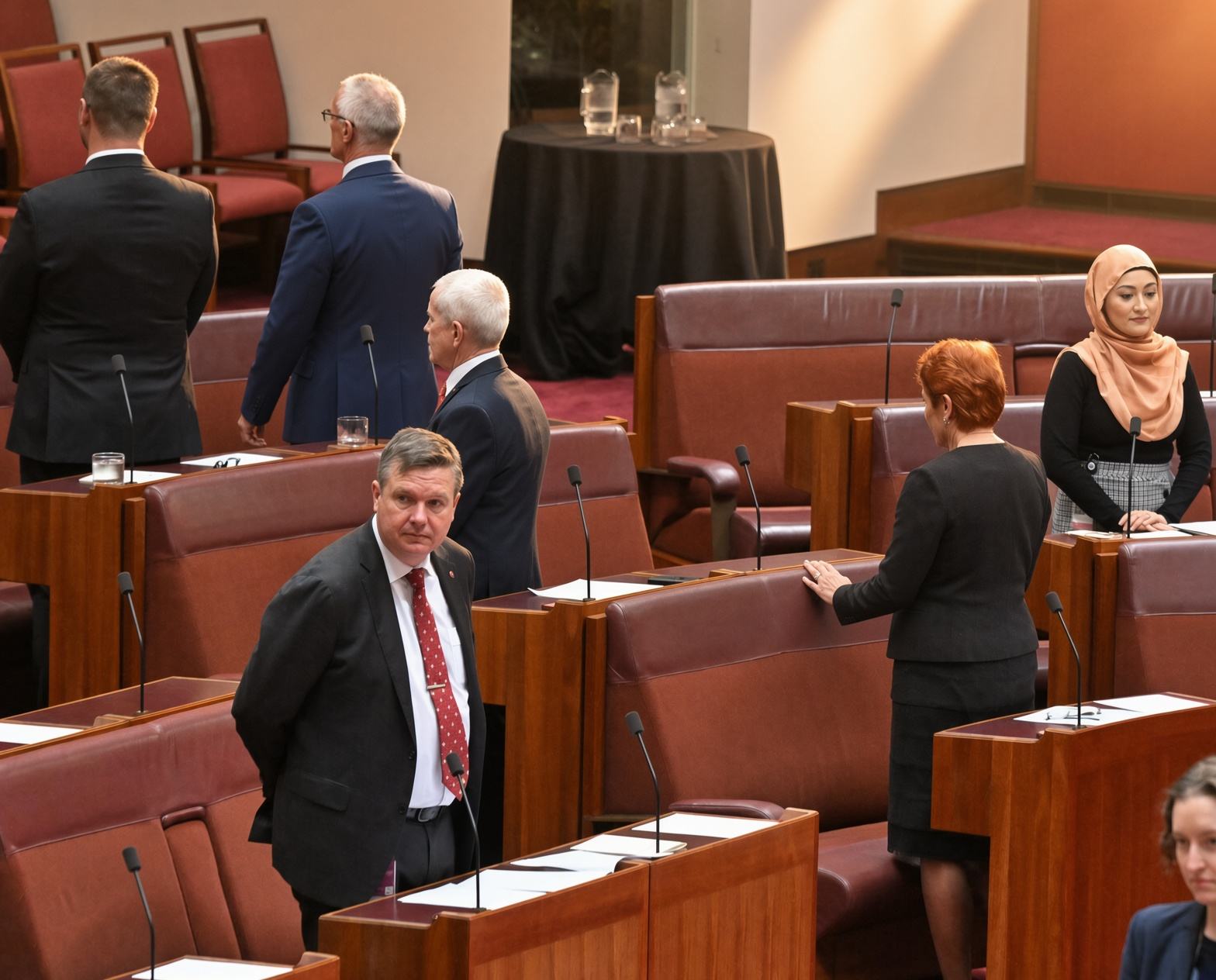
Queensland Senator Malcolm Roberts, New South Wales Senator Sean Bell and Western Australian Senator Tyron Whitten were seen facing away from Deputy Senate President Slade Brockman as he delivered the customary Acknowledgement of Country in the Senate chamber on Tuesday.
The three senators remained standing but turned back around when proceedings moved to the Lord’s Prayer.
One Nation leader Pauline Hanson, the party’s fourth representative in the Senate, was not present during the protest.
She later appeared in the chamber and attempted to suspend standing orders to allow a motion condemning the Albanese government’s handling of Australian women and children linked to Islamic State camps in Syria.
The opening-day protest was immediately recognisable as part of One Nation’s broader campaign against Acknowledgement of Country and Welcome to Country practices — an issue Hanson has increasingly presented as part of the party’s argument for a single Australian national identity.
Roberts, Bell and Whitten turn away
The protest unfolded without a speech or announcement.
As Brockman began the Acknowledgement, Roberts, Bell and Whitten stood but faced away from the front of the chamber.
When the Acknowledgement ended and the Senate proceeded to the prayer, the trio turned around again.
The deliberate contrast made the senators’ position clear without interrupting proceedings.
Hanson’s absence did not represent any difference of opinion within the party.
She has been one of Australia’s most vocal political opponents of repeated Acknowledgement of Country and Welcome to Country practices and has previously participated in similar protests herself.
Hanson wants ceremonies removed from government
Hanson has gone considerably further than simply turning her back in Parliament.
She has said that if she became prime minister, her government would remove Welcome to Country and Acknowledgement practices from Commonwealth departments and seek to eliminate them from schools and other government settings.
During a recent television interview, Hanson was asked directly what she would do about the ceremonies in education.
“I wouldn’t be having it in schools or the education system. I’d shut that all down,” she said.
She also linked the policy to another One Nation campaign concerning the display of national and Indigenous flags.
“I’ll tell you another thing too, there won’t be three flags,” Hanson said.
One Nation argues the Australian National Flag should occupy the central position in government institutions and that repeated ceremonies separating Australians according to Indigenous ancestry undermine rather than strengthen national unity.
Indigenous leaders and political opponents reject that argument, saying the ceremonies recognise Australia’s history and First Nations peoples without diminishing anyone else’s Australian identity.
Acknowledgement and Welcome are different ceremonies
Although the terms are frequently mixed together in political debate, an Acknowledgement of Country and a Welcome to Country are not the same thing.
A Welcome to Country is generally performed by a Traditional Owner or authorised Indigenous representative connected to the land on which the event takes place.
An Acknowledgement of Country can be delivered by Indigenous or non-Indigenous people and recognises the Traditional Owners and pays respect to First Nations peoples.
What Roberts, Bell and Whitten turned away from on Tuesday was the Senate’s Acknowledgement of Country.
It forms part of the chamber’s established opening procedure and is followed by the parliamentary prayer.
That distinction is significant because Hanson’s broader political campaign targets both practices, while Tuesday’s protest specifically concerned the parliamentary Acknowledgement.
One Nation has staged the protest before
The party’s senators have previously used the same tactic.
One Nation senators turned their backs during an Acknowledgement of Country at the opening of Parliament in 2025, triggering condemnation from Indigenous Australians Minister Malarndirri McCarthy.
McCarthy described the protest as an “incredibly childish stunt” and accused the senators of deliberately disrespecting First Nations Australians.
Her argument focused partly on the fact that senators were not compelled to be present for the Acknowledgement.
If they disagreed with it, she said, they could simply remain outside the chamber.
Entering or remaining in the Senate and deliberately turning away transformed their objection into a public political demonstration.
That is also precisely why One Nation considers the protest effective.
The party wants its opposition seen.
Hanson says the rituals divide Australians
Hanson has repeatedly argued that many Australians have grown tired of what she regards as the excessive use of Indigenous ceremonies at meetings, public events, sporting fixtures, government functions and schools.
She says the practice increasingly makes non-Indigenous Australians feel as though they are visitors in their own country.
“They’re tired of being made to feel like outsiders,” Hanson said while defending an earlier protest.
She has described repeated ceremonies as tokenistic rituals that now divide Australians rather than unite them.
Supporters of Acknowledgements strongly reject that characterisation.
They argue recognising Aboriginal and Torres Strait Islander peoples as the continent’s First Peoples is compatible with a shared Australian identity and requires no one else to surrender their own connection to the country.
The disagreement has consequently become about much more than a short statement at the beginning of a meeting.
It reflects competing ideas about what national unity should look like.
Hanson moves immediately to ISIS issue
After missing the Acknowledgement protest, Hanson later entered the Senate and attempted to suspend standing orders over another issue central to One Nation’s current political agenda.
She sought to advance a motion condemning the government’s handling of Australians linked to Islamic State-controlled territory in Syria.
The women involved are commonly described as “ISIS brides”, although individual circumstances differ and that label does not establish that every woman committed or supported a terrorism offence.
Hanson has taken an uncompromising position on the cohort and has pushed for tougher measures intended to prevent Islamic State-linked fighters and supporters from returning to Australia.
The issue allows One Nation to connect several of its core political themes: immigration, national security, radical Islam, citizenship and what obligations Australia owes to citizens who travelled to conflict zones.
Hanson has argued Australians who deliberately aligned themselves with Islamic State should not be able to rely on Australian citizenship when they later seek to return.
Successive governments have had to balance those arguments against citizenship law, constitutional constraints, national-security assessments and the circumstances of Australian children born or taken overseas.
One Nation now has a voice in both chambers
Tuesday also highlighted an important change in One Nation’s parliamentary position.
The party is no longer represented only in the Senate.
David Farley entered the House of Representatives after winning the Farrer by-election in May, becoming the first candidate elected to the lower house under the One Nation banner.
The victory was particularly significant because Farrer had been one of the Coalition’s safest regional strongholds.
The seat had previously been held by former Liberal leader Sussan Ley.
Farley’s breakthrough gave Hanson something One Nation had never previously secured through an election: a directly elected member sitting in the House of Representatives under the party’s banner.
Farley delivers maiden speech
Farley delivered his maiden speech on Tuesday afternoon, giving One Nation another platform on a day that had begun with the Senate protest.
The 69-year-old former agribusiness executive used the address to speak about Australian identity, regional communities, immigration, national resilience and the responsibilities of government.
Farley described Australia as a generous and inclusive country but argued that generosity had to be protected from exploitation.
He called for people who seek to harm Australia or fundamentally reject its values to be removed swiftly, while stressing his own upbringing in multicultural Narrandera in regional New South Wales.
Farley also focused heavily on issues directly affecting Farrer.
He criticised aspects of the Murray-Darling Basin Plan and spoke about the consequences of government decisions for agricultural communities.
He warned about Australia’s exposure to fragile international supply chains and argued for greater domestic capacity in critical industries.
The speech illustrated the challenge and opportunity created by One Nation’s expansion into the lower house.
The party can now attempt to translate Hanson’s national culture-war campaigns into representation focused on the everyday economic concerns of a regional electorate.
A protest that changes no parliamentary rule
Turning away from the Acknowledgement does not alter Senate procedure.
The ceremony remains part of the chamber’s opening arrangements unless the Senate itself changes those rules.
Nor does One Nation currently have the parliamentary numbers to abolish the practice by itself.
The action is therefore symbolic rather than legislative.
But political symbolism is exactly what makes it effective.
A conventional speech opposing Acknowledgement of Country would compete with dozens of other parliamentary statements.
Three senators visibly turning their backs produces an image capable of travelling immediately through television and social media.
It communicates opposition before a voter hears a single argument explaining it.
The political argument is getting larger
The protest also fits into One Nation’s increasingly broad campaign around national identity.
The party is advocating lower immigration, stronger assimilation, greater prominence for the Australian flag and reduced use of Indigenous acknowledgements in public institutions.
Those positions share a common argument: Australians should be treated primarily through a single national identity rather than according to race, ancestry, religion or ethnic background.
Opponents argue the approach ignores historical disadvantage and can turn calls for unity into a justification for removing recognition of minority communities.
That debate is unlikely to be resolved by parliamentary ceremony.
But the return of Parliament has demonstrated that One Nation intends to keep forcing it onto the national agenda.
Tuesday began with Roberts, Bell and Whitten standing silently with their backs turned.
Hanson then returned to the chamber to pursue her campaign over Islamic State-linked Australians.
And in the House of Representatives, Farley delivered his first speech as the party’s historic lower-house representative.
For One Nation, those were not unrelated moments.
Together they presented the political message the party increasingly wants voters to associate with it: a more assertive definition of Australian identity, tighter expectations about national allegiance and a willingness to confront parliamentary conventions it believes no longer reflect the views of a substantial section of the electorate.
The senators’ protest changed no law on Tuesday.
But it made clear that the fight over Acknowledgement of Country is not disappearing from federal Parliament.






