Thousands of high school and university students across Australia are preparing to walk out of classes next week as part of a coordinated nationwide protest targeting Pauline Hanson and her political party, One Nation.
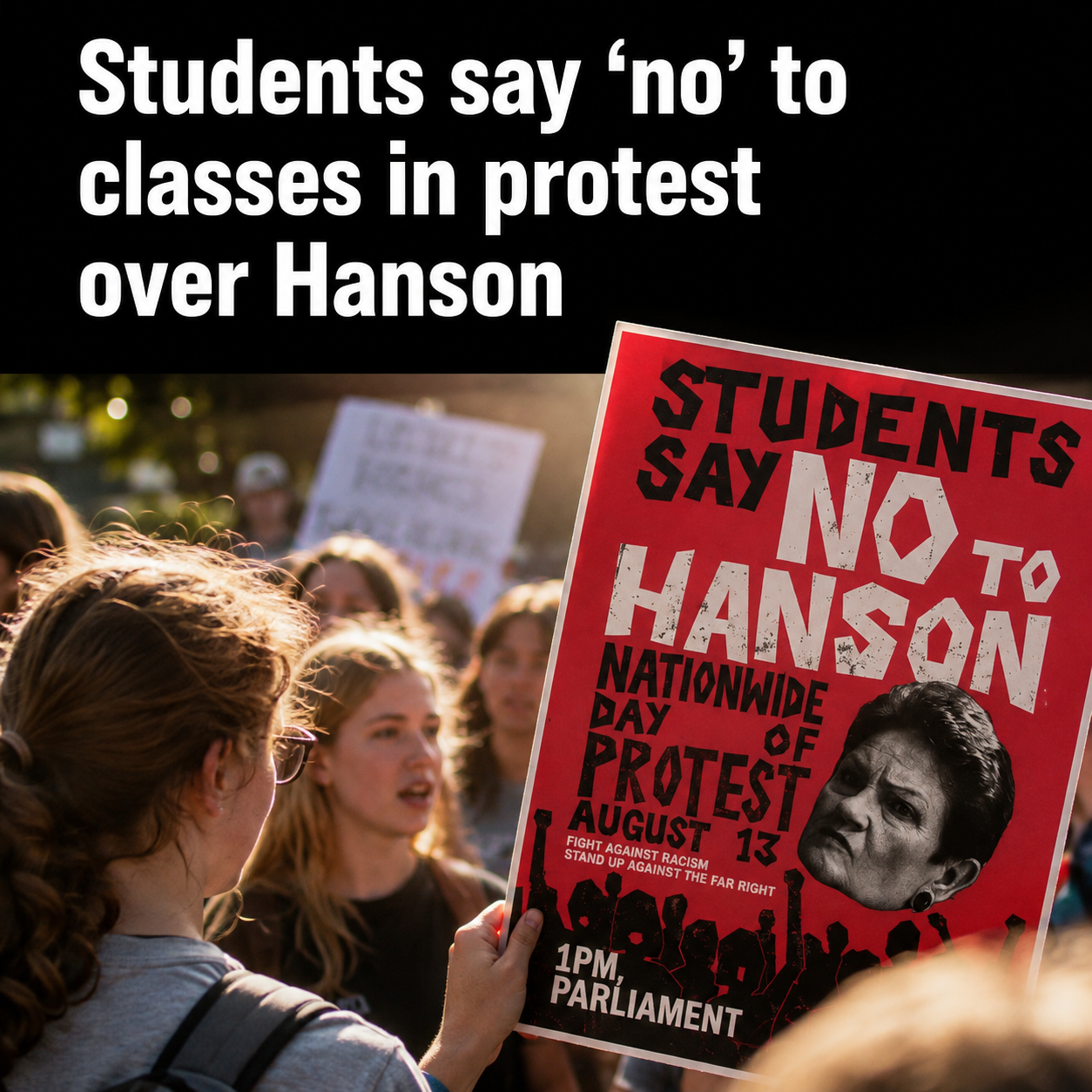
The campaign, titled Students Say No to Hanson, began with student organisers in South Australia before expanding to demonstrations planned in Adelaide, Melbourne, Sydney, Brisbane, Canberra, Perth, Newcastle and Wollongong.
Organisers say the demonstrations are intended to oppose what they describe as One Nation’s political agenda, while supporters of the party have criticised the protests as politically motivated and questioned whether students should be leaving classrooms to participate.
The largest South Australian rally is scheduled to take place outside Parliament House in Adelaide on 13 August, with similar events planned in other capital cities.
Student organisers expect participation from both secondary school and university students, with several Adelaide schools and tertiary institutions reportedly represented during planning meetings.
The movement is being supported by a number of left-wing student organisations, including Socialist Alternative groups operating at Adelaide and Flinders universities, along with the High School Anti-Capitalists student network.
According to organisers, the protests are aimed at challenging what they describe as racism, sexism, anti-worker policies and anti-LGBTQ rhetoric associated with Pauline Hanson and One Nation.
Campaign material distributed online encourages students to recruit classmates through group chats, posters and social media ahead of the coordinated walkout.
Jordan Armstrong, one of the organisers involved in the Adelaide protest, said thousands of students around Australia were expected to participate.
Organisers argue young Australians should actively engage in political issues that they believe will shape the country’s future, particularly ahead of upcoming elections in several jurisdictions.
The planned demonstrations come after several months of protests directed at Pauline Hanson and One Nation events across Australia.
Earlier this year, demonstrators gathered outside One Nation functions in Melbourne and Perth, while protests also accompanied Senator Hanson’s first National Press Club address in Canberra.
One Nation has rejected the accusations made by protest organisers.
Party representatives say students have every right to express political opinions peacefully but argue the demonstrations present a one-sided view and discourage genuine discussion with those holding different political beliefs.
According to reports, two One Nation staff members attempted to attend one student planning meeting but were asked to leave after being recognised by organisers.
South Australia’s Education Minister Lucy Hood said decisions about whether students attend the protest ultimately rest with parents and carers.
At the same time, she reiterated that regular school attendance remains important and that schools continue to expect students to attend classes unless appropriately absent.
Education departments across Australia generally require students to attend school unless an absence is approved under existing attendance policies.
Individual schools will determine how absences connected with the planned protests are recorded under their normal attendance procedures.
The proposed walkout has also reignited debate over the role of political activism within Australian schools.
Supporters argue students have a democratic right to peacefully protest issues they consider important, pointing to previous student-led campaigns on climate change, Indigenous recognition and other social issues.
Critics, however, contend that school hours should remain focused on education rather than organised political demonstrations, particularly where younger teenagers are involved.
The latest protests arrive during a period of heightened political attention surrounding Pauline Hanson and One Nation.
In recent months, the party has continued campaigning on issues including immigration, cost of living, housing and crime while expanding its electoral efforts in several states ahead of upcoming elections.
One Nation has also attracted attention for controversial decisions surrounding media access at some campaign events and fundraising functions, generating further public debate about the party’s relationship with political opponents and sections of the media.
Political protests involving students are not new in Australia.
School students have previously organised nationwide climate strikes, demonstrations supporting Indigenous causes and rallies concerning international conflicts.
The Hanson protests, however, differ by focusing directly on a specific political leader and party rather than a broader public policy issue.
Whether the demonstrations ultimately attract the numbers predicted by organisers remains to be seen, but they are expected to generate significant public attention as students gather simultaneously in multiple Australian cities.
For supporters, the rallies represent an opportunity for young Australians to express their political views through peaceful protest.
For critics, they raise questions about political campaigning within schools and whether organised student walkouts encourage civic participation or distract from education.
Regardless of perspective, the planned demonstrations underscore the increasingly active role many younger Australians are playing in national political debates, with Pauline Hanson and One Nation once again emerging as focal points in Australia’s broader discussion over immigration, multiculturalism, social policy and the direction of the country’s political landscape.






