Pauline Hanson has intensified her long-running dispute with sections of Australia’s mainstream media by excluding journalists from the ABC, The Age and The Guardian from a Melbourne press conference that marked the official launch of One Nation’s Victorian state election campaign.
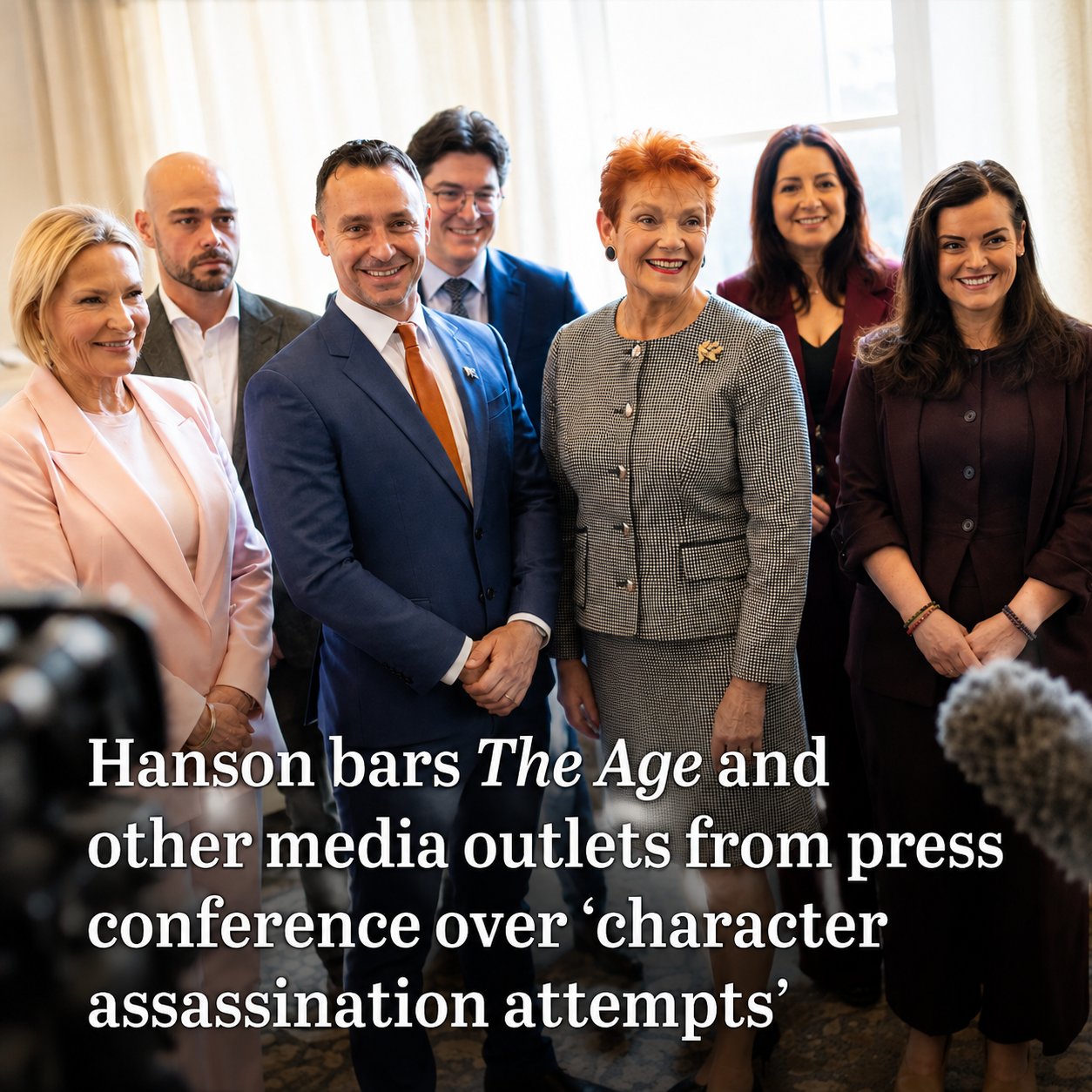
The extraordinary move quickly overshadowed the party’s announcement of its first Victorian election candidates, placing renewed attention on One Nation’s increasingly confrontational relationship with several major Australian news organisations.
Standing before supporters and invited media representatives, Senator Hanson confirmed that journalists from the three organisations had deliberately been refused entry.
“ABC were denied entry … and The Guardian. I’m not putting up with their rubbish. I’m not putting up with their spin, their lies whatsoever. I want truth and honesty. You get it from me. I expect it back from the media,” Hanson said.
Her comments followed months of public criticism directed at several mainstream media outlets, particularly the ABC and The Guardian, which Hanson has repeatedly accused of unfair and politically motivated reporting.
The Melbourne event represented the strongest practical step yet in that dispute, moving beyond criticism to actively excluding major news organisations from covering a significant political announcement.
Joining Hanson at the launch was Warren Pickering, who was unveiled as One Nation’s Victorian leader ahead of the November state election.
Pickering reinforced the party’s position by warning that One Nation would no longer tolerate reporting it considered defamatory.
“We expect and invite a healthy amount of scrutiny of our candidates and our policy positions,” Pickering said.
“However, any blatant character assassination attempts based on fabrications of our candidates will be met with swift legal action.”
His remarks suggested the party intends to adopt a far more aggressive legal strategy when responding to media reports it believes are inaccurate or damaging.
The warning immediately drew attention because Pickering himself has previously been the subject of media scrutiny.
Earlier this year, reports examined his role during the Nepean by-election campaign, alleging that he advised a One Nation candidate to receive campaign donations through a personal bank account rather than an official campaign account.
According to those reports, implementing such advice could potentially have placed the party in breach of Victorian electoral funding requirements.
Pickering has consistently rejected those allegations and continues to dispute the reporting.
The controversy nevertheless became part of the public discussion surrounding his appointment as One Nation’s Victorian leader.
Despite questions surrounding the earlier reports, Hanson expressed confidence in Pickering’s leadership and described him as the right person to guide the party into what it believes will be its most ambitious Victorian campaign to date.
The launch also introduced several candidates who will contest the November election as One Nation attempts to significantly expand its parliamentary representation in Victoria.
Among those announced were incumbent upper house MP Rikkie-Lee Tyrrell, former Liberal Party member Colleen Harkin, Geelong councillor Chris Burson, Mark Nicholson, Aaron Sandford, Fiona Lopez and Natalie Adams, while Pickering himself will contest the lower house seat of Pakenham after initially being expected to seek an upper house position.
Party officials said candidate recruitment had been underway for many months and indicated that One Nation still intends to field candidates across virtually every lower house electorate.
Although the campaign launch focused heavily on candidate introductions, Hanson also outlined the broad direction of the party’s election platform.
She argued Victoria faced serious challenges relating to crime, government debt, cost-of-living pressures, infrastructure spending and declining confidence in public institutions.
According to Hanson, voters had become increasingly frustrated with both Labor and the Liberal Party, creating an opportunity for One Nation to present itself as an alternative.
Specific policy announcements were deliberately limited, with Hanson indicating that detailed commitments would be released progressively throughout the campaign rather than all at once.
However, she foreshadowed stronger support for agriculture, tougher law-and-order measures, increased police resources, scrutiny of major infrastructure projects including the Suburban Rail Loop and continued opposition to policies the party associates with what it describes as excessive government spending and ideological activism.
While those policy themes received attention, they were largely overshadowed by the decision to exclude several of Australia’s largest media organisations.
For press freedom advocates, the exclusion revived questions about whether political leaders should selectively determine which accredited journalists are permitted to attend campaign events.
Political parties are generally free to control access to privately organised campaign launches, unlike formal government press conferences that carry broader public accountability expectations.
Nevertheless, excluding major national news organisations during an election campaign is uncommon and almost always attracts significant public debate.
The Media, Entertainment and Arts Alliance had already criticised Hanson’s earlier public attacks on journalists following her National Press Club appearance in June, describing them as harmful to press freedom after she targeted Guardian political reporter Sarah Martin and warned that some organisations would no longer be welcome at future events.
At that earlier appearance, Hanson accused sections of the media of deliberately pursuing political agendas rather than objective reporting, while her critics argued elected representatives should remain accountable to all accredited journalists regardless of disagreements over coverage.
The latest Melbourne press conference demonstrates that the dispute has continued to escalate rather than subside.
For supporters of One Nation, the exclusion represents an attempt to prevent what they regard as persistently hostile reporting by organisations they believe misrepresent the party’s policies and candidates.
Critics, however, argue that limiting media access reduces transparency during an election campaign and risks allowing politicians to avoid difficult questioning from experienced political journalists.
The disagreement therefore reflects a much broader debate that extends well beyond One Nation itself.
Across many democratic countries, political leaders have increasingly challenged traditional media organisations, accusing them of bias while choosing to engage more frequently with sympathetic or alternative outlets.
Hanson has previously praised independent and alternative media platforms that she believes provide more balanced coverage of One Nation’s activities, contrasting them with what she describes as entrenched hostility from parts of the mainstream press.
Monday’s launch illustrated that strategy in practice, with some alternative media outlets receiving access while several major national organisations remained outside the venue.
As Victoria’s election campaign gathers momentum, the relationship between One Nation and Australia’s mainstream media is likely to remain under close scrutiny alongside the party’s electoral ambitions.
Beyond the immediate dispute over media access, the confrontation also reflects the changing political landscape in Victoria as minor parties seek to capitalise on growing voter dissatisfaction with the major parties.
One Nation believes concerns about the cost of living, rising state debt, crime, housing affordability and pressure on regional communities have created opportunities that did not exist during previous Victorian elections.
Party officials say they intend to contest almost every lower house electorate while mounting an aggressive campaign for Legislative Council seats across the state.
The strategy represents One Nation’s most ambitious Victorian campaign since entering the state’s Parliament after the 2022 election.
Although the party currently holds limited parliamentary representation in Victoria, opinion polling over recent months has suggested increasing support for minor parties nationally as both Labor and the Coalition face growing voter frustration over economic pressures and housing costs.
At the Melbourne launch, Hanson argued that Victoria had become an example of what she described as poor government administration, claiming many residents felt let down by both major political parties.
She criticised the state’s financial position, major infrastructure spending, crime rates and what she described as declining confidence among businesses and regional communities.
While Hanson outlined those broad concerns, she deliberately avoided releasing a detailed election manifesto, saying the party would progressively unveil policies throughout the campaign rather than announcing them all at once.
Among the priorities flagged were increasing frontline police numbers, reviewing major infrastructure projects, strengthening regional services, expanding support for agriculture, reviewing renewable energy policies and establishing a royal commission into alleged corruption associated with Victoria’s Big Build program.
Pickering echoed that message, arguing Victoria required significant political change after years of Labor government.
He claimed many voters no longer believed either of the traditional major parties adequately represented their concerns and said One Nation intended to campaign as an independent alternative rather than positioning itself as a future coalition partner.
That position is consistent with Hanson’s repeated statements that One Nation would seek to govern according to its own policies rather than negotiating formal coalition arrangements before an election.
The media controversy nevertheless dominated much of the day’s reporting.
Political opponents accused Hanson of attempting to avoid difficult questions by excluding experienced political reporters, while supporters argued the party was entitled to decide which organisations were invited to privately organised campaign events.
The debate also prompted renewed discussion about the balance between press freedom and a political party’s right to control access to campaign functions.
Unlike official government media conferences, campaign launches organised by political parties are generally private events, meaning organisers have broad discretion over invitations.
However, constitutional experts and media organisations have long argued that denying access to major news outlets during election campaigns can reduce transparency by limiting opportunities for public scrutiny.
The issue has become increasingly prominent internationally as political leaders from across the ideological spectrum have adopted more selective media engagement strategies.
Rather than relying primarily on traditional newspapers and broadcasters, some politicians have increasingly chosen friendly outlets, online platforms and social media to communicate directly with supporters.
Hanson has frequently criticised what she regards as institutional bias within parts of Australia’s media industry.
For many years she has argued that One Nation policies are often presented without adequate context or are framed in ways she considers politically motivated.
The ABC, The Guardian and publications owned by Nine Entertainment have all rejected suggestions that their political reporting is influenced by partisan considerations, maintaining that coverage is conducted according to established editorial standards.
The latest confrontation also follows Hanson’s criticism of Guardian political reporter Sarah Martin during her National Press Club address in June, where she suggested some journalists would no longer be welcome at future One Nation events.
That earlier episode attracted criticism from the Media, Entertainment and Arts Alliance, which warned that singling out individual journalists risked undermining confidence in press freedom.
The Guardian likewise defended its reporting and said it stood by the work of its political correspondents.
For Warren Pickering, Monday’s campaign launch represented both an opportunity and a challenge.
As the newly appointed Victorian leader, he now becomes responsible for leading One Nation’s campaign in one of Australia’s most politically competitive states while simultaneously dealing with continuing questions arising from earlier reporting concerning the Nepean by-election.
Pickering has consistently rejected suggestions that he acted improperly during that campaign and has denied allegations relating to campaign donation advice.
No court has made findings against him regarding those allegations, and he continues to dispute the reporting.
His warning that fabricated claims would result in legal action therefore appeared designed both to defend One Nation candidates generally and to signal how the party intends to respond to future reporting during the election campaign.
Whether legal proceedings are ultimately commenced remains uncertain.
Defamation actions involving politicians and media organisations are relatively uncommon due to Australia’s robust legal thresholds, the availability of public interest defences and the significant costs associated with litigation.
Nevertheless, Pickering’s comments suggest One Nation intends to scrutinise media reporting closely as campaigning intensifies over the coming months.
The Victorian election, scheduled for 28 November, is expected to feature intense competition not only between Labor and the Coalition but also among a growing number of crossbench and minor party candidates seeking to expand their parliamentary representation.
For One Nation, success will depend on converting broader public dissatisfaction into votes across metropolitan and regional electorates while demonstrating organisational discipline throughout the campaign.
Monday’s launch was intended to showcase that ambition by introducing the party’s leadership team and its first group of Victorian candidates.
Instead, much of the national attention centred on the party’s deteriorating relationship with several of Australia’s largest media organisations.
Whether that strategy ultimately benefits One Nation politically or simply deepens existing divisions between the party and mainstream media is likely to remain a subject of debate throughout the remainder of the Victorian election campaign.
What is already clear is that the confrontation marks another significant chapter in Pauline Hanson’s long-running conflict with sections of Australia’s press, ensuring that questions surrounding media access, political accountability and campaign transparency will continue to feature prominently alongside debates over policy in the months leading to polling day.






