A newly launched interactive website that tracks the changing share of people of European descent across the world has ignited widespread discussion online, drawing attention from billionaire Elon Musk while also reviving debate over one of the most controversial topics in modern demographic politics.
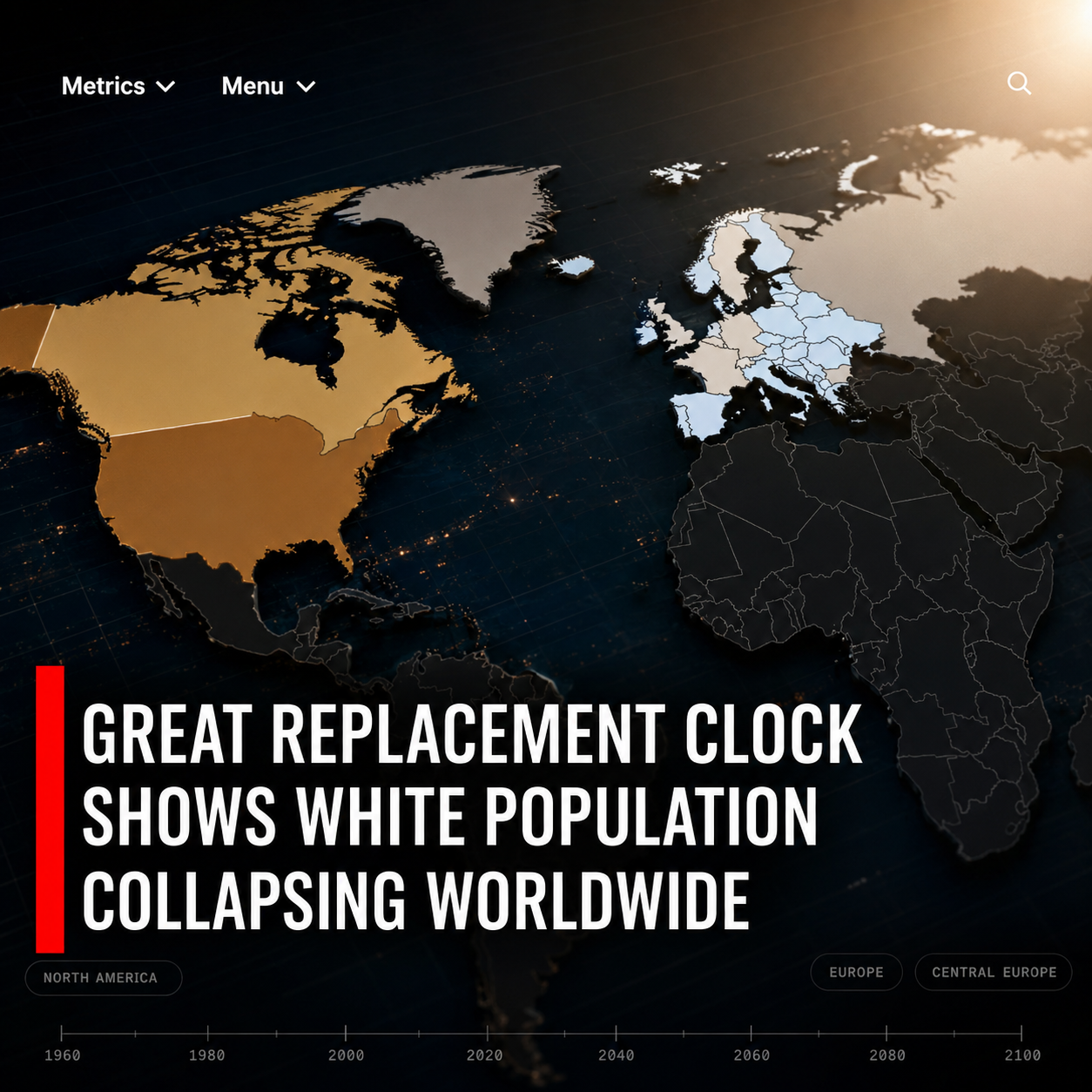
The website, known as Replacement Clock, was created by writer and researcher Leo Pier and officially went live on Friday. It presents historical demographic estimates alongside future statistical projections for the global population and for 45 individual countries, allowing users to explore how the proportion of people classified by the project as being of European descent has changed over time.
According to the project’s published estimates, people of European descent represented approximately 30.1 per cent of the world’s population in 1950. The website estimates that share has fallen to around 12.2 per cent today and projects it could decline further to about 5.8 per cent by the year 2100 if current demographic trends continue.
Pier said the idea emerged after he searched for an online resource that consolidated demographic information across Western countries but could not find one.
He said he spent roughly six months developing the platform, aiming to assemble publicly available demographic information into a single searchable database.
In announcing the project on X, Pier argued that reliable ethnic demographic information is often difficult to obtain because many countries either collect limited ethnicity data or use different statistical definitions. He cited France as one example where collecting official statistics based on ethnicity is heavily restricted.
“This project exists to close that gap,” Pier wrote.
He said the website uses what he describes as the best available demographic evidence while making its assumptions, adjustments and source material available for public scrutiny.
Pier argued that demographic composition is a legitimate matter of public interest and said the project’s methodology was intended to be transparent rather than hidden from public examination.
The launch quickly attracted attention on X after Elon Musk replied to Pier’s announcement with a single word: “interesting”. Although brief, Musk’s response significantly increased visibility for the project among his followers.
The interaction came only days after Musk again commented publicly on immigration and remigration policies, topics that have featured prominently in his recent online discussions.
Several commentators supportive of the project also welcomed its launch.
Among them was American Renaissance editor Jared Taylor, who described the website as a valuable visual representation of demographic change. The project also follows the recent release of a separate interactive demographic map published by activist group Remigration New Zealand examining changes recorded across successive New Zealand censuses.
Despite attracting interest from supporters, the website has also entered a highly contested area of public debate.
The name “Great Replacement” is closely associated with a controversial theory claiming that native European populations are being intentionally replaced through immigration and demographic change. Numerous academic researchers have described that theory as lacking evidence for claims of a coordinated replacement effort, while noting that population change itself is a measurable demographic phenomenon influenced by migration, fertility rates, ageing populations and government policy.
Demographers generally distinguish between observable demographic trends and broader political interpretations of those trends. Population statistics relating to births, deaths, migration and ancestry are routinely collected in many countries, but how those figures are interpreted remains the subject of significant political disagreement.
Countries also differ substantially in the way they classify ethnicity, ancestry and race. Some national statistical agencies collect detailed ancestry information, while others focus on nationality or country of birth. In several European countries, legal and privacy restrictions limit or prohibit the routine collection of ethnicity data, making direct international comparisons considerably more difficult.
Those methodological differences mean that any attempt to estimate long-term ethnic population shares across multiple countries necessarily depends on assumptions and modelling choices. Researchers often reach different conclusions depending on how ancestry is defined, how mixed heritage is classified and which official datasets are used.
The Replacement Clock states that its methodology and data sources are publicly available for review, allowing users to examine how the estimates were produced. Supporters argue that transparency enables independent evaluation of the figures, while critics contend that demographic projections should be interpreted cautiously because future migration, fertility and policy settings can change significantly over time.
The broader debate reflects increasing public interest in demographic change across many developed nations. Falling fertility rates, population ageing, international migration and changing patterns of cultural identity have become central issues in political discussions throughout Europe, North America and parts of the Asia-Pacific region.
Governments regularly publish projections showing future population growth, workforce participation and ageing trends to assist with planning for housing, healthcare, education and economic policy. However, projections remain forecasts rather than certainties and are periodically revised as demographic conditions evolve.
Whether viewed as a demographic research tool or a politically contentious project, the launch of Replacement Clock has clearly generated international attention. Its rapid spread across social media demonstrates how questions surrounding immigration, national identity and long-term population change continue to provoke strong public interest, while also highlighting the importance of distinguishing measurable demographic data from broader political or ideological interpretations.