Federal prosecutors have secured a major legal victory ahead of one of Australia’s most closely watched criminal trials after successfully overturning a ruling that had excluded a controversial video from evidence against two former Sydney nurses accused of threatening Israeli patients.
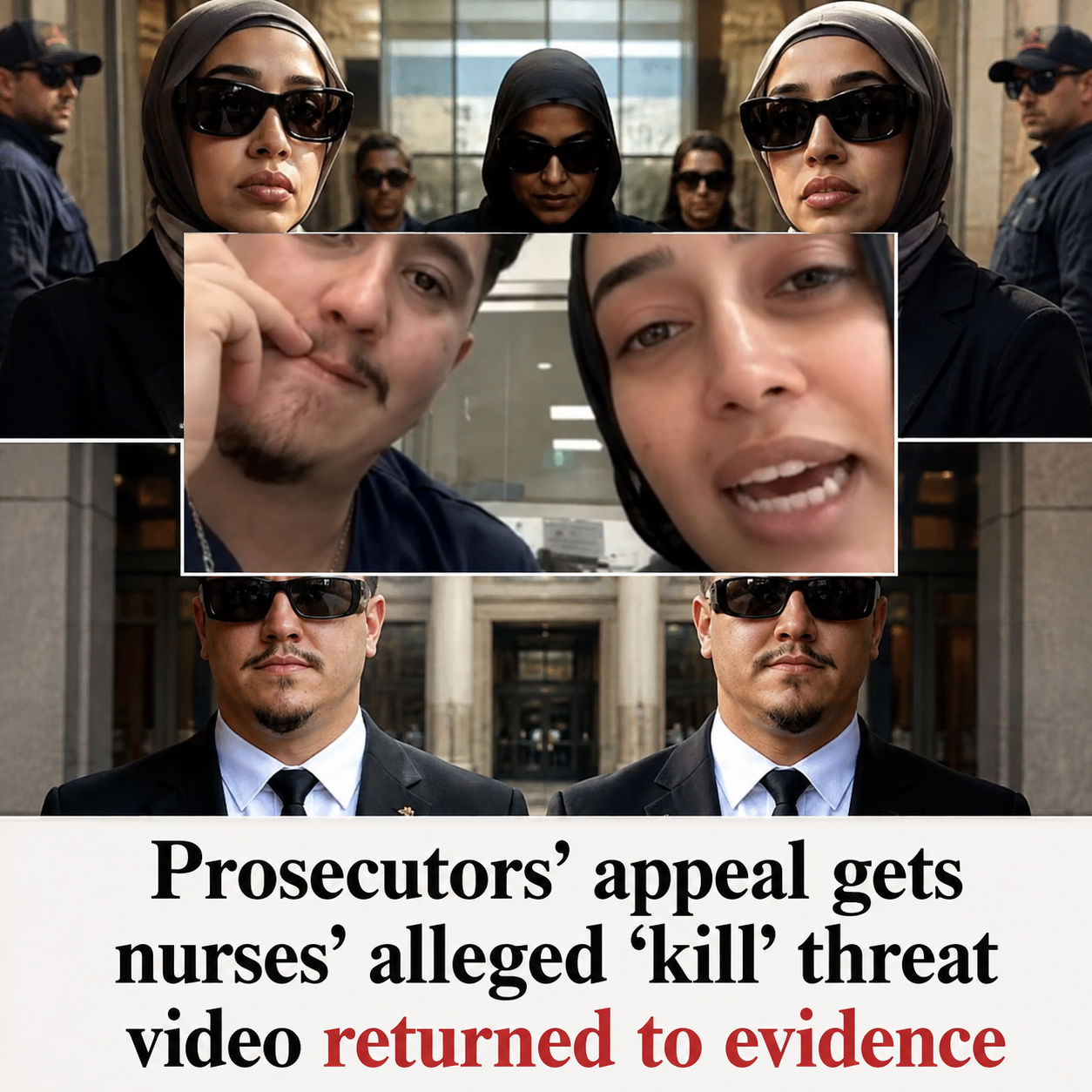
The decision means the prosecution will be permitted to present the viral footage during the upcoming criminal proceedings involving former Bankstown Hospital nurses Sarah Abu Lebdeh and Ahmad Rashad Nadir, both of whom have pleaded not guilty to the charges they face.
The ruling overturns an earlier decision by NSW District Court Judge Michael McHugh, who had determined the recording should be excluded because it was obtained without the consent of the participants, raising questions under New South Wales surveillance laws.
A significant reversal before trial
The Commonwealth Director of Public Prosecutions appealed the original evidentiary ruling, arguing the video was central to presenting the prosecution’s case fairly and completely.
The NSW Court of Criminal Appeal agreed, setting aside the earlier decision and allowing the unedited audiovisual recording to be admitted into evidence during the trial. The court has indicated that detailed reasons for its decision will be released separately.
The ruling does not determine whether either accused is guilty of any criminal offence. Instead, it concerns only whether the jury will be permitted to consider the footage alongside the other evidence presented during the trial.
How the case began
The case first attracted international attention after an online conversation between the two nurses and Israeli content creator Max Ilinsky, who is also known publicly as Max Veifer, circulated widely on social media.
During the conversation, the nurses allegedly made inflammatory remarks concerning Israeli patients while speaking through an online video-chat platform. The footage quickly generated widespread public condemnation, prompted multiple official investigations and led to criminal charges being laid.
Following the video’s publication, NSW Health confirmed that the nurses had been suspended from their positions while authorities investigated the allegations. Health officials also reviewed patient records after the video’s release and previously stated they found no evidence that any patient had been physically harmed.
The charges before the court
Both former nurses face Commonwealth criminal charges relating to the alleged online comments.
Ahmad Rashad Nadir is charged with using a carriage service to menace, harass or offend, while Sarah Abu Lebdeh faces the same allegation together with an additional charge alleging threats of violence against a group.
Both defendants have pleaded not guilty and will contest the allegations at trial.
As with every criminal prosecution in Australia, the accused are presumed innocent unless and until the prosecution proves each charge beyond reasonable doubt.
Why the video was originally excluded
The central legal dispute has never been about the content of the recording itself, but rather the way it was obtained.
Judge Michael McHugh previously ruled that the conversation had been recorded without the knowledge or consent of the participants, making the recording unlawful under relevant New South Wales legislation governing surveillance devices and private recordings.
On that basis, he concluded the footage should not be placed before a jury.
The ruling represented a potentially significant setback for prosecutors because the video formed a central part of the Commonwealth case.
Without the recording, the prosecution would likely have relied much more heavily on witness testimony, including evidence from the individual who recorded the online conversation.
The prosecution’s successful appeal
Federal prosecutors argued that excluding the footage would unfairly limit the evidence available for the jury to consider.
On appeal, the Court of Criminal Appeal agreed that the recording should be admitted, restoring what is widely regarded as the prosecution’s most significant piece of evidence.
The court also allowed prosecutors to rely on testimony from the individual who recorded the conversation, strengthening the evidentiary case ahead of trial.
The appellate ruling illustrates an important feature of Australia’s criminal justice system: decisions about the admissibility of evidence can themselves be reviewed before a trial begins if prosecutors or defendants believe an error of law has occurred.
Admissibility does not determine guilt
Legal experts frequently emphasise that evidentiary rulings should not be confused with findings about criminal responsibility.
Courts routinely decide whether particular material can be presented to a jury without expressing any view about whether the allegations themselves are true.
Even where evidence is admitted, prosecutors must still establish every element of the offences charged beyond reasonable doubt.
Likewise, the defence remains entitled to challenge the authenticity, reliability, context and interpretation of any evidence presented during the proceedings.
A case watched across Australia
The prosecution has attracted extraordinary public attention because it combines issues of alleged hate speech, healthcare ethics, antisemitism and the legal limits governing secretly recorded conversations.
The controversy also prompted broader discussion about professional standards expected of healthcare workers and the obligation to provide medical treatment without discrimination based on nationality, ethnicity, religion or other protected characteristics.
Professional regulators separately imposed restrictions preventing the nurses from practising while investigations continued, independent of the criminal proceedings.
Balancing privacy and justice
The case has also highlighted an important legal tension within Australia’s justice system.
Surveillance and privacy laws are designed to discourage unlawful recording of private conversations and to protect individual privacy.
However, courts must also consider whether excluding important evidence would undermine the administration of justice, particularly where the material is highly relevant to the issues before a jury.
Those competing public interests lay at the heart of the appeal and explain why the evidentiary dispute became almost as significant as the substantive criminal allegations themselves.
What happens next?
The criminal trial is scheduled to begin on 31 August, when prosecutors will now be able to present the reinstated video together with witness testimony and any additional evidence supporting the charges.
The defence will have the opportunity to cross-examine witnesses, challenge the interpretation of the footage and argue that the prosecution has failed to satisfy the criminal standard of proof.
Ultimately, it will be for the trial court—not the appeal judges—to determine whether the evidence establishes the accused’s guilt beyond reasonable doubt.
For now, the Court of Criminal Appeal’s decision represents an important procedural turning point rather than a final outcome. It restores a crucial piece of evidence to the prosecution’s case but leaves the central question of criminal liability to be decided during the trial itself, following the presentation of all admissible evidence and the application of Australia’s longstanding presumption of innocence.






