The criminal case against two former Bankstown Hospital nurses accused of making threatening remarks about Israeli patients has taken a dramatic turn after the New South Wales Supreme Court ruled that the central video evidence can be presented to a jury, overturning an earlier decision that had excluded the footage from trial.
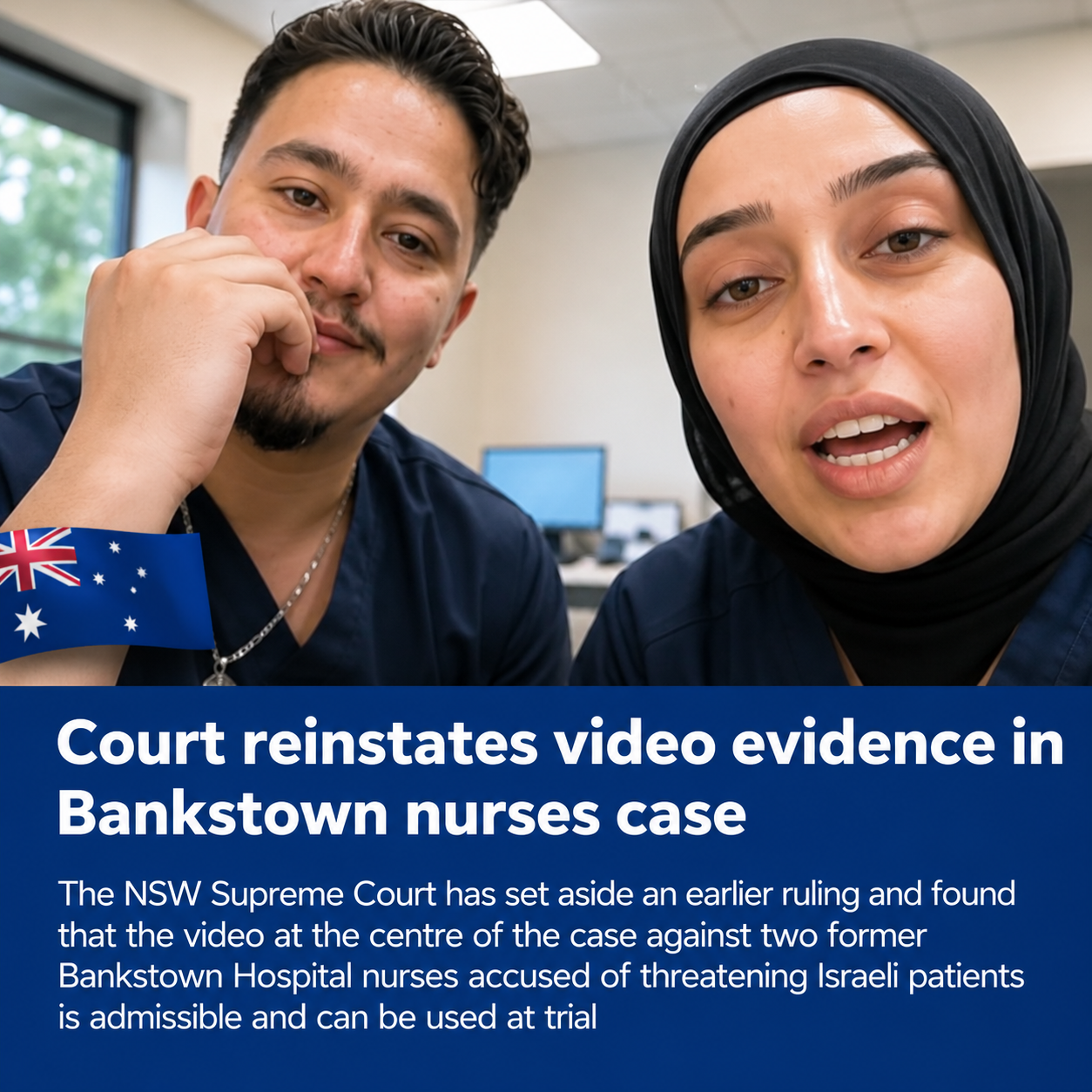
The ruling comes only weeks before former nurses Sarah Abu Lebdeh, 27, and Ahmad Rashad Nadir, 28, are due to stand trial in Sydney on criminal charges arising from a video that sparked nationwide outrage and international attention.
Both defendants have pleaded not guilty to charges of using a carriage service to menace, harass or offend. Ms Abu Lebdeh also denies an additional charge of threatening violence against a group.
The prosecution’s case centres on a video recorded during an online conversation that allegedly captured the pair making threatening comments about Israeli patients while they were employed at Bankstown Hospital in south-west Sydney. The footage was later shared publicly by Israeli content creator Max Veifer (also reported as Max Ilinski), rapidly spreading across social media and prompting widespread condemnation.
The video triggered multiple investigations earlier this year, including criminal proceedings, employment action and professional regulatory reviews. NSW Health suspended both nurses following the incident, and they have since been barred from working with National Disability Insurance Scheme (NDIS) participants for two years while separate regulatory processes continue.
Until now, however, whether the jury would ever see the video had remained uncertain.
In June, District Court Judge Michael McHugh ruled that the recording could not be admitted as evidence because it had been obtained without the knowledge or consent of the participants. Under New South Wales surveillance laws, recording private conversations without consent is generally prohibited unless a recognised legal exception applies.
The judge concluded at the time that the manner in which the footage had been obtained outweighed its evidentiary value, leading to the exclusion of both the recording and related audiovisual material from the criminal trial.
That decision represented a significant setback for prosecutors because the recording was widely regarded as the most direct evidence supporting the allegations.
The Commonwealth Director of Public Prosecutions subsequently appealed, arguing that excluding the footage would substantially weaken the prosecution’s ability to present its case to the jury.
On Friday, the NSW Supreme Court allowed that appeal, setting aside the earlier ruling and determining that the unedited audiovisual recording is admissible and may be used during the trial.
The court has indicated that detailed reasons for the decision will be published at a later date.
The ruling does not determine whether either defendant is guilty or innocent. Instead, it resolves an important procedural question concerning what evidence the jury will be permitted to consider when the trial begins.
Australian courts frequently conduct pre-trial hearings to determine whether disputed evidence should be admitted. Judges consider a range of legal factors, including relevance, reliability, fairness and whether evidence was obtained lawfully. In some circumstances, even evidence obtained improperly may still be admitted if the court determines that the interests of justice favour its inclusion.
The dispute over the Bankstown Hospital video has become one of the most closely watched evidentiary battles in recent Australian criminal proceedings because it sits at the intersection of privacy law, digital communications and criminal justice.
According to court proceedings, the recording originated from an online video-chat platform that randomly connected users. Defence lawyers argued the conversation was private and that recording and distributing it without consent breached New South Wales law.
Prosecutors, however, maintained that the footage was highly probative and should be available for a jury to assess alongside all other evidence presented during the trial.
The Supreme Court’s decision means jurors will now be able to view the complete, unedited recording rather than relying solely on witness testimony describing what allegedly occurred.
The criminal proceedings stem from an incident that attracted enormous public attention after excerpts of the conversation circulated online. The footage prompted immediate responses from political leaders, Jewish community organisations, health authorities and professional regulators.
The controversy also led to questions about patient confidence, professional ethics and standards expected of healthcare workers entrusted with caring for patients regardless of nationality, ethnicity or religion.
While the public reaction to the video has been intense, the criminal trial will focus exclusively on the evidence presented in court and whether prosecutors can prove each element of the alleged offences beyond reasonable doubt.
As in all criminal proceedings, both defendants are presumed innocent unless and until a jury returns guilty verdicts.
The upcoming trial is expected to examine not only the disputed video but also testimony from witnesses and the surrounding circumstances in which the online conversation took place.
Because the Supreme Court has now ruled the audiovisual material admissible, prosecutors are expected to rely heavily on the recording as they present their case.
The proceedings will also provide the defence with an opportunity to challenge both the interpretation of the video and the prosecution’s allegations before the jury.
The case highlights the increasingly complex legal questions surrounding digital evidence in modern criminal prosecutions. Courts are frequently required to balance privacy protections with the public interest in ensuring reliable evidence can be considered where serious criminal allegations are involved.
Advances in smartphones, livestreaming platforms and online communication have dramatically increased the amount of digital material that can potentially become evidence in criminal trials. At the same time, judges must determine whether such material has been obtained consistently with legislation governing surveillance, privacy and procedural fairness.
Legal experts have noted that disputes over the admissibility of digital recordings are becoming more common as communications increasingly occur through internet-based platforms rather than traditional face-to-face conversations.
The Supreme Court’s ruling does not establish new criminal liability, but it does ensure the jury will have access to one of the prosecution’s most significant pieces of evidence when assessing the allegations.
The trial is scheduled to commence on August 31, where a jury will hear the evidence, consider the competing arguments from both the prosecution and defence, and ultimately determine whether the charges against the two former nurses have been proven beyond reasonable doubt.






