New Zealand shoppers could soon be paying for everyday purchases using nothing more than their face or palm, as the country’s domestic payment network prepares for what could become the next major evolution in retail transactions.
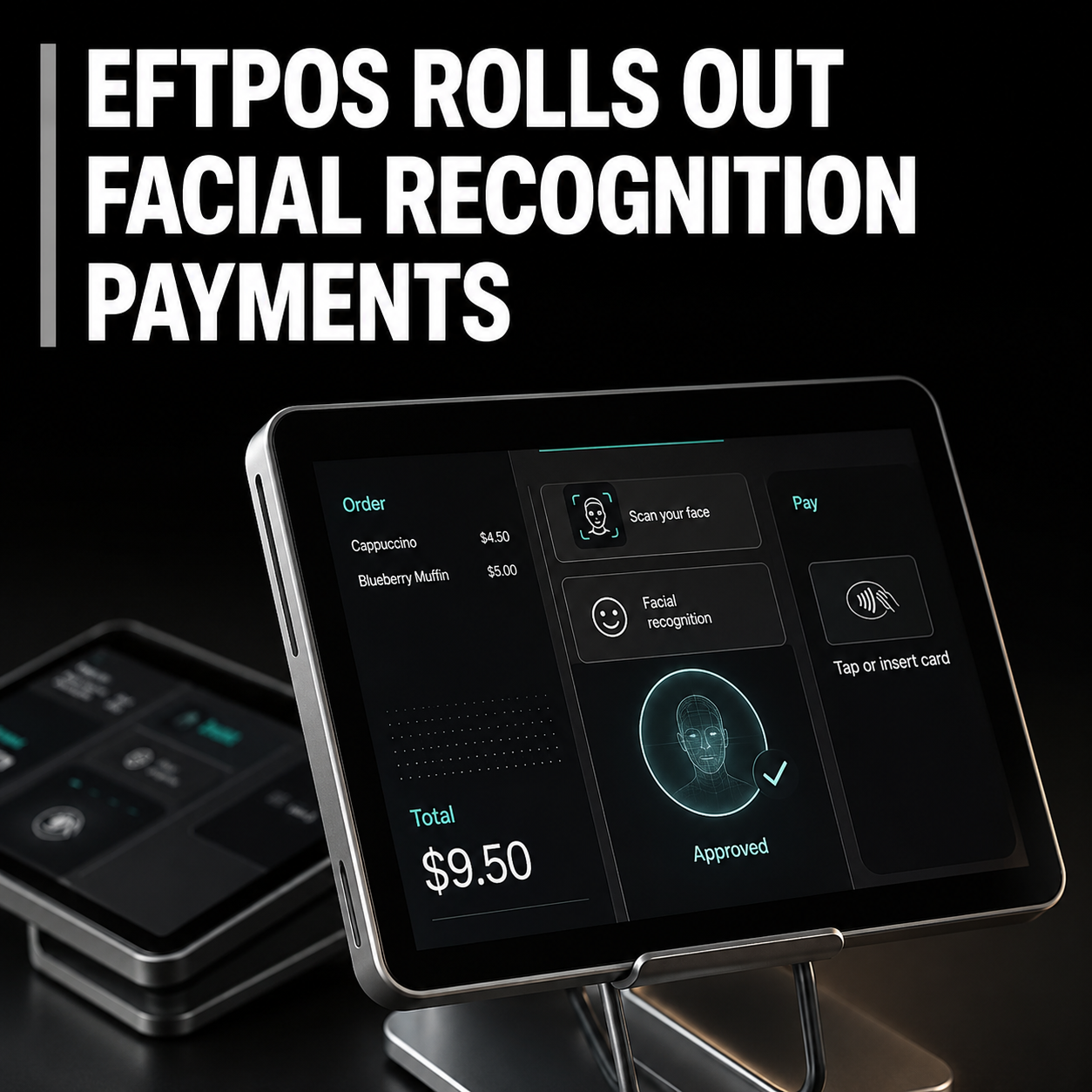
Eftpos New Zealand has announced the launch of Verifone Victa, a new generation of Android-powered payment terminals capable of supporting biometric authentication at the checkout. While the national infrastructure required for widespread biometric payments is still being developed, the company says the new hardware has already been designed to accommodate facial recognition and palm recognition technology whenever retailers are ready to adopt it.
The announcement represents a significant step towards a future where consumers may no longer need to carry physical bank cards or even smartphones to complete purchases. Instead, identity verification, payment authorisation and customer loyalty functions could all occur through a single interaction with a payment terminal.
According to Eftpos New Zealand, the Victa platform has been engineered to support secure biometric payments while also providing retailers with additional capabilities including digital identity verification, customer loyalty integration and age verification for regulated products such as alcohol and tobacco.
“The hardware is ready to support face and palm recognition at the point of sale, enabling cardless payments, seamless loyalty authentication, and age verification without physical ID,” the company said when unveiling the new platform.
Although shoppers will not immediately be able to walk into stores and pay with their face, the technology has been intentionally designed to support that capability as soon as supporting payment infrastructure becomes available throughout New Zealand.
Eftpos New Zealand described biometric payments as “the payments of tomorrow”, while emphasising that retailers investing in Victa today will already possess compatible hardware once the broader ecosystem catches up.
The launch reflects the rapid pace of innovation occurring across the global payments industry, where traditional plastic cards are increasingly being supplemented—and in some cases replaced—by digital wallets, wearable devices and biometric authentication.
Rather than requiring consumers to present a card or mobile phone, biometric payment systems rely on unique physical characteristics such as fingerprints, facial features or palm patterns to verify identity before authorising a transaction.
Supporters argue these systems have the potential to make payments faster, reduce checkout friction and improve security by relying on characteristics that are considerably more difficult to duplicate than conventional passwords or PIN numbers.
For retailers, the technology also opens opportunities to streamline multiple customer interactions that currently require separate verification processes.
Instead of presenting identification, providing loyalty program details and then completing payment individually, future biometric systems could perform each of those functions simultaneously within seconds.
That vision forms the foundation of Eftpos New Zealand’s latest payment platform.
Retail NZ Chief Executive Carolyn Young said her initial reaction upon learning about facial recognition payments was one of surprise.
Speaking to RNZ, she admitted her first thought was wondering how facial recognition could possibly identify her bank account.
However, after considering the technology further, Young said many consumers are already using biometric authentication regularly without necessarily recognising it as such.
She pointed to fingerprint authentication used on tablets and smartphones when purchasing digital content.
In those cases, consumers are not storing payment details within their fingerprint itself. Instead, biometric authentication simply confirms the identity of the authorised user before allowing payment credentials already stored on the device to be used.
Young suggested facial recognition payments represent a natural extension of technology that millions of consumers already trust every day.
Rather than introducing an entirely unfamiliar concept, biometric payment terminals expand existing authentication methods into physical retail environments.
She also highlighted the potential privacy advantages for shoppers participating in retailer loyalty programs.
Under current checkout processes, customers frequently need to verbally provide an email address or mobile phone number while standing in line so staff can locate their membership account.
Biometric authentication could eliminate that public exchange of personal information by automatically identifying the customer and linking their loyalty account as soon as the payment process begins.
Instead of verbally confirming personal details, loyalty rewards could be applied instantly in the background, creating a faster and potentially more private checkout experience.
This automation could also reduce queues during busy trading periods while lowering the administrative workload placed on retail staff.
Beyond payments, the Victa platform has been designed to perform several additional functions through software rather than requiring dedicated hardware for each task.
One of the most significant features is digital age verification.
Retailers selling age-restricted products such as alcohol or tobacco could potentially verify a customer’s eligibility electronically without requiring physical identification documents to be presented.
Eftpos New Zealand believes this approach could reduce human error while making compliance easier for businesses operating under strict regulatory requirements.
The company also says the platform can support digital identity verification, barcode scanning, customer engagement applications and retailer-specific software built around the Android operating system.
Because the platform relies heavily on software updates, businesses may continue adding new functionality over time without replacing payment terminals each time new services become available.
This approach reflects a broader shift occurring across the payments industry, where hardware increasingly serves as a flexible platform capable of evolving throughout its operational life.
Eftpos New Zealand said proof-of-concept trials have already been completed, demonstrating that the biometric capabilities can operate successfully in controlled environments. The company said retailers will be able to activate the technology when supporting infrastructure becomes available and according to their own implementation schedules.
Rather than forcing businesses to replace payment hardware every few years, the Victa platform has been designed around long-term software upgrades. New payment methods, loyalty services and identity solutions can be introduced through software updates, extending the useful life of each terminal while reducing hardware replacement costs.
The platform is also compatible with third-party applications, allowing merchants to customise the checkout experience according to their operational requirements. Businesses can integrate digital wallets, promotional campaigns, inventory tools and customer engagement applications into a single payment device.
For larger retailers, this flexibility could simplify store operations by reducing the number of standalone devices positioned at checkout counters. Instead of separate barcode scanners, loyalty terminals and payment machines, multiple functions could eventually be consolidated into a single Android-based platform.
Eftpos New Zealand said developers will also be able to create purpose-built applications that make use of the terminal’s integrated cameras, barcode scanner and processing capabilities, opening opportunities for customised retail experiences across different industries.
The company believes software-driven payment terminals will become increasingly important as consumer expectations continue evolving and digital commerce becomes more deeply integrated with physical retail stores.
Security remains one of the central considerations surrounding biometric payments.
Unlike passwords or PIN numbers, biometric characteristics cannot simply be changed if compromised. That has made privacy protections a critical component of every major biometric payment initiative introduced around the world.
Eftpos New Zealand emphasised that the Victa platform has been developed to meet the payment industry’s highest security standards while maintaining the flexibility offered by the Android operating system.
The company said the device has been designed so new capabilities can be delivered through secure software updates rather than requiring entirely new payment terminals.
Kristy Gregory, Eftpos New Zealand’s Head of Merchant Sales and Strategic Partners, sought to reassure consumers concerned about how biometric information would be managed.
She explained that biometric data would not be stored by individual retailers using the payment terminals. Instead, information would remain with the customer’s chosen digital identity or payment platform and continue to be governed by existing privacy legislation applying to those services.
Gregory acknowledged, however, that public education will play an important role in the successful adoption of biometric payments.
She said consumers will need clear explanations about how the technology works, where their information is stored and how privacy protections operate before many people feel comfortable relying on facial recognition or palm authentication for everyday purchases.
Industry observers note that consumer confidence has historically been one of the biggest challenges facing emerging payment technologies. Contactless card payments, mobile wallets and digital banking all experienced initial scepticism before gradually becoming mainstream as users became familiar with their security features and convenience.
Biometric payments are expected to follow a similar path, with adoption likely to occur gradually as consumers gain experience using the technology and retailers demonstrate that privacy safeguards operate as intended.
Globally, several technology companies and financial institutions have already begun experimenting with biometric payment systems. Facial recognition, fingerprint authentication and palm recognition technologies are increasingly being tested in supermarkets, convenience stores and transport networks as businesses look for faster and more seamless payment experiences.
Supporters argue that biometric authentication may eventually reduce payment fraud by making it significantly more difficult for criminals to use stolen cards or compromised account credentials. Because biometric identifiers are unique to each individual, they can provide an additional layer of security when combined with encrypted payment systems and digital identity platforms.
Privacy advocates, however, continue to stress the importance of strong regulation, transparent governance and informed consumer consent whenever biometric information is collected or processed. They argue that maintaining public trust will be just as important as technological capability if biometric payments are to achieve widespread acceptance.
For New Zealand retailers, the arrival of the Victa platform represents an opportunity to prepare for technologies that may become commonplace over the coming decade without immediately changing existing checkout procedures. Businesses can deploy compatible hardware today while enabling new features progressively as customer demand and supporting infrastructure evolve.
Although facial recognition payments are not yet available nationwide, Eftpos New Zealand’s latest announcement signals that the industry is preparing for a future in which wallets, physical identification cards and even smartphones may no longer be essential for completing everyday purchases.
If biometric payment infrastructure continues to mature alongside robust privacy protections and consumer confidence, New Zealand could become one of the early adopters of checkout systems where a simple glance at a terminal—or the placement of a palm—completes an entire retail transaction in seconds.






