Victoria’s Labor government has been thrust into one of the most dramatic leadership crises in its modern history after Ben Carroll informed Premier Jacinta Allan that he will contest the leadership should the party move to a formal ballot.
The development marks a decisive escalation in the internal conflict that has engulfed the Victorian Labor Party, with growing numbers of MPs questioning whether the government can recover politically under Allan’s leadership ahead of the next state election.
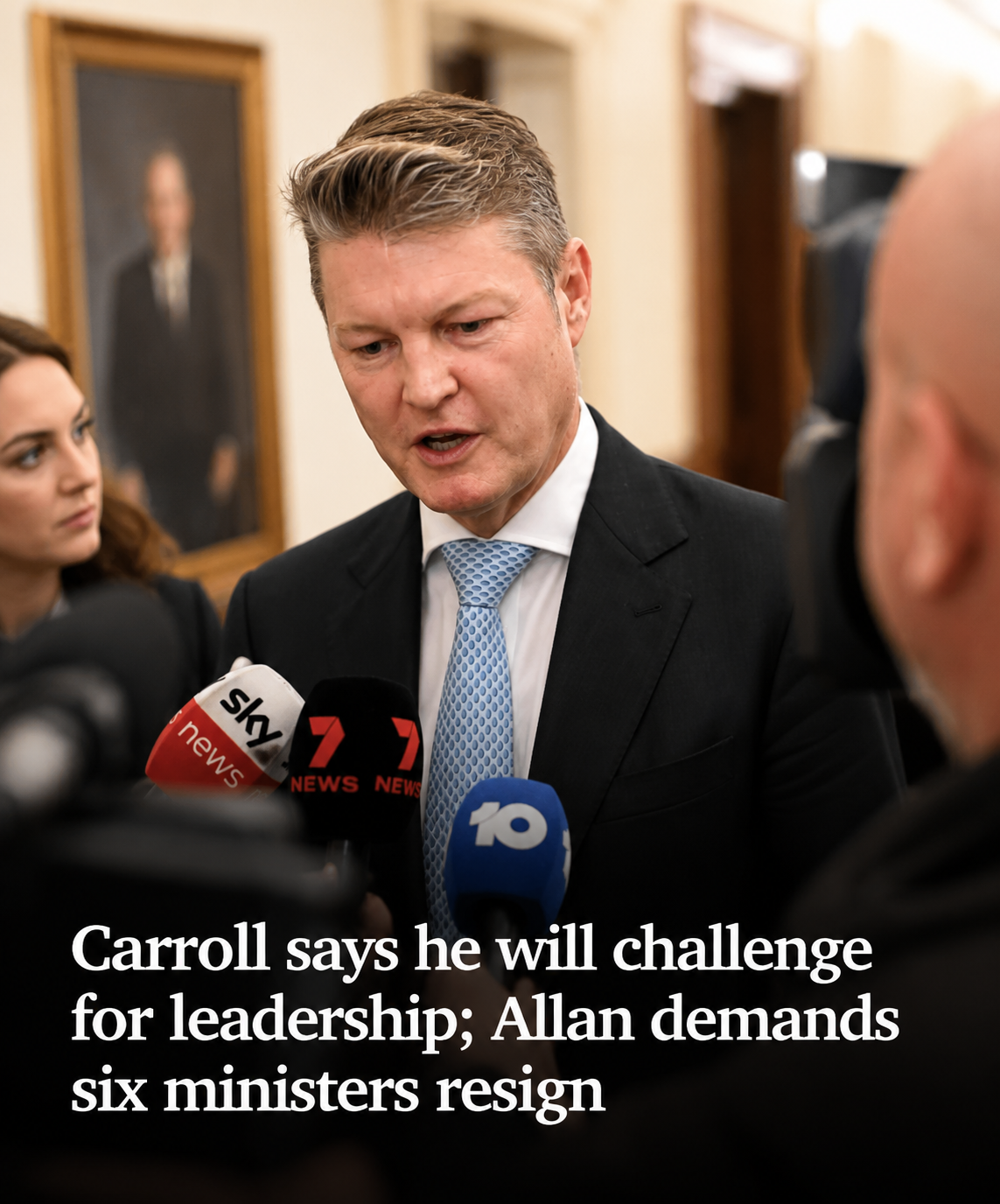
According to reports, Carroll personally advised Allan that he would stand against her if a leadership contest became unavoidable, ending days of speculation over whether he would emerge as the alternative candidate capable of uniting the increasingly divided parliamentary party.
The announcement came as senior Labor figures gathered for what may prove to be one of the most consequential cabinet meetings in recent Victorian political history.
Rather than focusing on government policy or legislative priorities, the meeting was overshadowed by mounting uncertainty over Allan’s political future and widespread expectations that a leadership spill could soon take place.
Several reports described the atmosphere inside the cabinet room as sombre and deeply uncomfortable.
One attendee reportedly compared the mood to “a funeral”, illustrating the extraordinary tension that has developed inside a government that only months ago insisted it remained united behind its leader.
The final cabinet meeting before the anticipated leadership showdown was reportedly marked by difficult exchanges between Allan and several senior ministers as concerns about Labor’s electoral prospects continued to dominate internal discussions.
Although the Victorian Premier has publicly maintained her determination to continue leading the government, pressure has intensified following a series of disappointing opinion polls and growing concern among Labor MPs about retaining office at the next election.
Many within the party fear that unless decisive action is taken quickly, Labor could face one of its most difficult electoral contests in more than a decade.
For Ben Carroll, the decision to openly declare his willingness to challenge represents a significant political moment.
As one of Labor’s most senior figures and a long-serving minister, Carroll has often been viewed as a potential future Premier.
Until now, however, he had largely avoided publicly fuelling speculation about his leadership ambitions.
By informing Allan directly that he would contest the leadership if required, Carroll has effectively positioned himself as the principal alternative should caucus members decide a change is necessary.
The move also signals to undecided MPs that a credible successor is prepared to assume the state’s highest political office immediately.
Leadership spills within Australian political parties typically occur when parliamentary members conclude that replacing the leader offers the best chance of improving electoral performance or restoring internal stability.
Unlike general elections, these contests are decided by members of the parliamentary party rather than the broader public.
If a majority of Labor MPs ultimately support a new leader, the successful candidate automatically becomes Premier because Labor currently forms government in Victoria.
That reality means internal party dynamics can reshape the state’s political leadership without a statewide election being held.
Jacinta Allan assumed the premiership after Daniel Andrews unexpectedly resigned in 2023, inheriting a government that had already spent nearly a decade in office.
While she pledged continuity alongside renewal, her administration has faced persistent challenges including cost-of-living pressures, budget deficits, major infrastructure expenditure, housing affordability and declining public confidence in several aspects of government performance.
Opinion polling over recent months has increasingly suggested Labor faces a difficult electoral environment.
Although governments frequently experience fluctuations in popularity during a parliamentary term, several recent surveys have reportedly heightened concerns among Labor MPs that the party risks suffering substantial losses if current trends continue.
Those anxieties have fuelled speculation that a leadership change could provide an opportunity to reset the government’s political narrative before voters return to the polls.
Supporters of Allan argue that replacing another Premier so close to an election could create further instability and reinforce perceptions of division.
They contend that governments rarely benefit from prolonged internal conflict and that policy delivery should remain the priority.
Backers of Carroll, however, believe fresh leadership could provide Labor with an opportunity to reconnect with voters and demonstrate that the party has listened to growing public dissatisfaction.
The contrasting views reflect the difficult calculation confronting Labor MPs as they weigh loyalty to the incumbent leader against concerns about the party’s long-term electoral prospects.
Political leadership contests are often shaped not only by public opinion but also by internal assessments of campaign strategy, caucus unity and the confidence of parliamentary colleagues.
For Carroll, declaring his intentions removes much of the uncertainty that had surrounded the succession debate.
It also places additional pressure on MPs who had been waiting to see whether an alternative candidate would formally emerge before making their own decisions.
Should a spill motion proceed, every Labor member of Parliament will face a consequential choice that could determine not only the party’s future but also the direction of the Victorian Government over the remainder of the parliamentary term.
Beyond the immediate leadership question, the unfolding contest also carries broader implications for Victorian politics.
The Opposition will undoubtedly seek to portray the turmoil as evidence that Labor has become distracted by internal power struggles rather than governing the state.
Labor, meanwhile, faces the challenge of containing divisions while convincing voters that whichever leader ultimately emerges is capable of providing stable and effective government.
History shows that leadership changes can sometimes revitalise governments facing electoral difficulty, but they can also deepen instability if factional tensions remain unresolved.
Whether Carroll’s candidacy ultimately strengthens Labor’s position or exposes further fractures will depend largely on how the parliamentary caucus responds in the days ahead.
For now, Victoria finds itself awaiting what could become one of the defining political moments of the state’s current parliamentary term, with the future of Jacinta Allan’s premiership hanging on the decisions of her own colleagues.
The prospect of a leadership challenge has also intensified scrutiny of Labor’s internal factional dynamics, which have historically played a significant role in determining the party’s leadership outcomes.
Although Victorian Labor has generally maintained greater stability than some interstate branches in recent years, the combination of declining opinion polling and growing caucus unrest appears to have accelerated discussions that only weeks earlier remained largely behind closed doors.
Political observers note that once a credible challenger publicly signals a willingness to stand, momentum inside parliamentary parties can shift rapidly.
MPs who had previously remained publicly loyal often begin reassessing their positions as they consider both the government’s electoral prospects and their own political futures.
For Jacinta Allan, the coming days are expected to be critical.
If she can demonstrate that she continues to command majority support within the parliamentary party, the immediate threat to her leadership could subside.
However, should enough MPs conclude that electoral recovery requires new leadership, a formal spill would become increasingly difficult to avoid.
Leadership contests in Australian politics frequently unfold over a matter of days rather than weeks, with behind-the-scenes negotiations often determining the outcome before any official ballot is held.
Senior ministers, factional organisers and influential backbench MPs typically spend this period canvassing support, attempting either to consolidate backing for the incumbent or persuade colleagues that change offers the best path forward.
Reports surrounding the latest cabinet meeting suggest many ministers entered the room fully aware that decisions made over the following 24 to 48 hours could reshape the Victorian Government.
The description of the meeting as feeling “like a funeral” has become symbolic of a government confronting the possibility that one political era may be drawing to a close.
Several commentators have suggested the atmosphere reflected not only uncertainty over Allan’s future but also concern among ministers who have served together throughout much of Labor’s decade-long period in office.
Leadership transitions can be personally difficult within long-serving governments, where ministers have often worked closely together for many years despite political disagreements.
Nevertheless, Australian political history demonstrates that parliamentary parties are ultimately driven by one overriding consideration: electoral survival.
When MPs believe a leadership change may improve the party’s chances of retaining government, longstanding personal relationships can quickly become secondary to political calculations.
For Ben Carroll, any successful leadership bid would immediately present both opportunities and significant challenges.
A new Premier would inherit responsibility for addressing Victoria’s economic pressures, continuing major infrastructure projects, managing the state’s finances and rebuilding public confidence before the next election.
Carroll would also need to demonstrate that his leadership represents more than simply a change of personality.
Voters typically expect a new Premier to introduce a distinct governing style and, in many cases, a revised policy agenda that clearly differentiates the administration from its predecessor.
Recent comments from Carroll have suggested he understands that expectation.
He has increasingly emphasised integrity, accountability and government renewal, signalling that any administration led by him would seek to project a noticeably different political image.
Whether those messages resonate with Victorian voters remains uncertain.
Political resets can sometimes improve a government’s standing, but history also shows that changing leaders alone does not automatically reverse entrenched public dissatisfaction.
Ultimately, voters tend to judge governments on their management of everyday issues including the cost of living, housing affordability, health services, transport, education and economic opportunity.
Any incoming leader would therefore have only a limited period to convince the electorate that Labor deserves another term in office.
For the Liberal-National Opposition, the unfolding events present an opportunity to argue that Labor has become consumed by internal conflict after more than a decade in government.
Opposition figures are expected to continue portraying the leadership turmoil as evidence of a government distracted from governing at a time when Victorians are facing significant financial and social pressures.
At the same time, Labor strategists are likely to argue that leadership renewal demonstrates the party’s willingness to respond to changing political circumstances rather than ignore growing public concern.
How that argument is received may prove decisive in determining whether a leadership transition ultimately strengthens or weakens Labor’s electoral position.
Should a spill proceed, the parliamentary caucus will gather to vote by secret ballot, with the successful candidate immediately becoming Leader of the Victorian Labor Party.
Because Labor currently holds government, that individual would also be commissioned by the Governor of Victoria to serve as Premier.
If Allan instead retains the confidence of her colleagues, she would remain Premier and likely seek to draw a line under the internal unrest while refocusing attention on government policy.
Regardless of the immediate outcome, the events surrounding Carroll’s declaration have already become one of the defining political stories of the year in Victoria.
The image of ministers leaving a cabinet meeting described as feeling “like a funeral” has underscored the extraordinary level of tension within the state’s governing party and highlighted just how quickly political fortunes can change.
With speculation continuing to intensify, all attention now turns to Labor’s parliamentary caucus, where the decisions made behind closed doors are expected to determine not only the future of Jacinta Allan’s leadership but also the direction of Victoria’s government heading into the next state election.






