Victoria has entered a new political era after Ben Carroll was sworn in as the state’s 50th Premier, promising to turn the page on the Labor government’s recent troubles while insisting his leadership will not simply be a continuation of the administrations led by Daniel Andrews and Jacinta Allan.
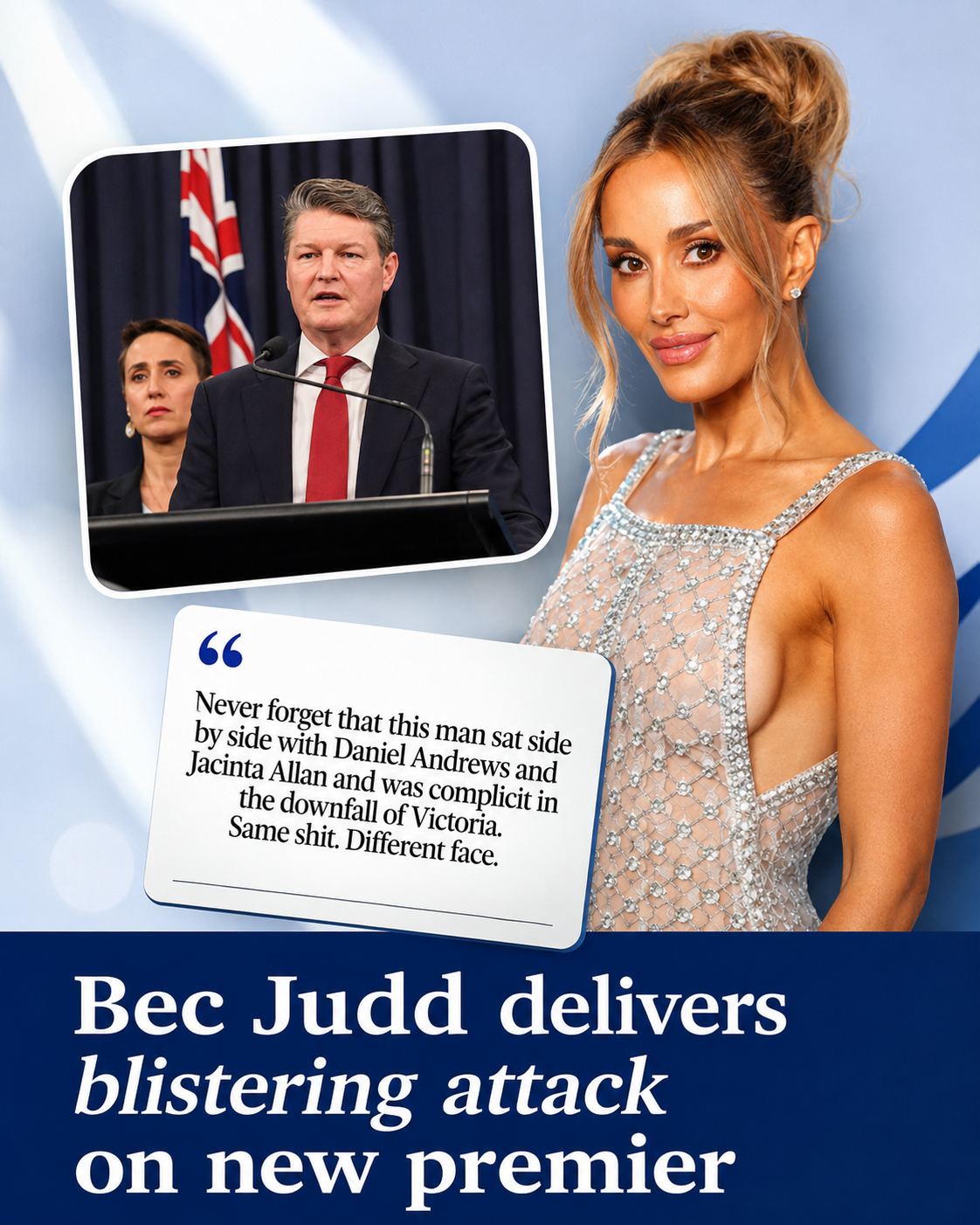
Within hours of taking office, however, Carroll’s message of renewal collided with fierce criticism from one of Victoria’s most outspoken public figures, as media personality Bec Judd accused the new Premier of attempting to distance himself from a government he helped lead for years.
Carroll was elected unopposed by Labor’s parliamentary caucus following the leadership transition that ended Jacinta Allan’s time as Premier. His elevation marks another significant chapter in Victoria’s political landscape after more than a decade of Labor governments under Andrews and Allan.
Appearing before the media for the first time as Premier, Carroll delivered a carefully crafted message designed to reassure Victorians that a change in leadership would also bring a change in governing style.
“I am not Daniel Andrews. I am not Jacinta Allan,” he declared.
The statement immediately became the defining headline of his first day in office.
Rather than defending every aspect of Labor’s record, Carroll acknowledged that many Victorians wanted something different and attempted to position himself as the leader capable of restoring confidence without abandoning Labor’s broader agenda.
His comments were widely interpreted as an effort to separate his premiership from two leaders whose governments became increasingly divisive during their later years in office.
Daniel Andrews remains one of the most influential figures in modern Victorian politics.
During almost nine years as Premier, Andrews oversaw major transport and infrastructure projects while leading the state’s response to the COVID-19 pandemic. His government won multiple elections comfortably, but it also became one of the most polarising administrations in Australia’s recent political history.
Supporters credit Andrews with transforming Victoria through large-scale investment in roads, rail, hospitals and education.
Critics, however, argue his government left behind soaring public debt, major project cost overruns, growing bureaucracy and declining public confidence in state institutions.
Jacinta Allan inherited both the achievements and the political baggage when she replaced Andrews as Premier.
Although Allan promised stability, her government struggled to reverse growing dissatisfaction over housing affordability, cost-of-living pressures, infrastructure spending, taxation and concerns surrounding Victoria’s financial position.
Against that backdrop, Carroll’s opening remarks appeared designed to acknowledge that simply continuing with the same political messaging would not be enough to rebuild public trust.
One of his first major policy announcements reinforced that intention.
Carroll pledged to establish a Royal Commission into Victoria’s building industry, signalling what he described as a commitment to stronger accountability and transparency.
Royal Commissions are Australia’s most powerful form of public inquiry.
They possess broad investigative powers, including the authority to compel witnesses, require documents, examine evidence under oath and make recommendations for legislative or regulatory reform.
Although the full terms of reference have yet to be released, Carroll said the inquiry would seek to restore confidence in an industry that has faced ongoing scrutiny over governance, compliance and public confidence.
For a new Premier, announcing a Royal Commission on day one sends a clear political signal.
It demonstrates an intention to project decisive leadership while showing voters that difficult issues will not simply be deferred.
Whether the inquiry ultimately produces meaningful reform remains to be seen, but the announcement ensured Carroll’s first day was defined by action rather than symbolism alone.
Even before details of the inquiry emerged, however, attention shifted toward an entirely different political story.
Bec Judd launched a blistering criticism of Carroll’s attempt to portray himself as a fresh start for Victoria.
Posting on social media, Judd argued the new Premier could not distance himself from the governments led by Andrews and Allan because he had spent years serving as a senior minister within the same administration.
She accused Carroll of being complicit in what she described as the “downfall of the state”, rejecting any suggestion that simply changing the person occupying the Premier’s office represented genuine political renewal.
Her criticism quickly attracted widespread attention online, reflecting her growing profile as one of Victoria’s most recognisable public commentators outside formal politics.
Although widely known through fashion, television and business, Judd has increasingly spoken out on public policy issues affecting Victoria.
Over recent years she has frequently criticised the state government over taxation, planning decisions, crime, infrastructure, transport, public spending and broader concerns about Victoria’s economic direction.
Her comments often generate significant debate because they resonate with some voters who believe the state’s finances and public services have deteriorated despite years of large-scale government investment.
At the same time, critics argue Judd’s views reflect a particular political perspective and should be considered alongside a broader range of opinions within the Victorian community.
That contrast illustrates the challenge Carroll now faces.
Winning the Labor leadership was the relatively straightforward part of the transition.
Convincing Victorians that his government represents meaningful change may prove considerably more difficult.
Unlike an opposition leader entering office after defeating an incumbent government, Carroll inherits both the achievements and the liabilities accumulated during more than a decade of continuous Labor rule.
His ministerial career makes that balancing act even more complicated.
Before becoming Premier, Carroll served in several senior portfolios, building a reputation inside Labor as an experienced administrator and one of the party’s emerging leaders.
Supporters point to that experience as evidence he understands government and can deliver stability during a politically sensitive period.
Opponents argue the same experience makes it impossible for him to claim he represents a genuine break from the past.
Political leadership changes often create opportunities to reset public expectations.
Australian political history includes numerous examples where incoming premiers and prime ministers attempted to redefine their governments through symbolic early announcements and changes in tone.
However, history also suggests that sustained improvements in public confidence depend less on rhetoric than on measurable policy outcomes.
For Carroll, that means his first one hundred days are likely to receive extraordinary scrutiny.
Voters will be watching to see whether the promised Royal Commission proceeds quickly, whether cost-of-living concerns are addressed more aggressively and whether the government adopts a noticeably different style of decision-making from previous administrations.
The Opposition is also expected to test Carroll’s claim that he represents change while highlighting his years inside the very government he now seeks to distinguish himself from.
Labor, meanwhile, hopes the leadership transition will provide an opportunity to reconnect with voters before the next state election by demonstrating greater responsiveness and accountability.
Whether that strategy succeeds remains uncertain.
Changing leaders can alter public perceptions in the short term, but long-term political fortunes are generally determined by economic conditions, public service performance and voter confidence rather than personalities alone.
The intensity of the reaction to Carroll’s opening statement nevertheless illustrates how politically significant the transition has become.
His declaration that he is “not Daniel Andrews” and “not Jacinta Allan” was intended to reassure voters looking for a fresh approach.
Instead, it immediately prompted debate over whether genuine renewal is possible when a new leader emerges from the same government that has shaped Victoria’s policies for more than a decade.
For now, Ben Carroll begins his premiership carrying both the advantages of Labor’s long experience in government and the burden of its accumulated controversies.
His promise to chart a different course has already become one of the defining political stories in Victoria, while the sharp response from Bec Judd demonstrates that many voters—and many critics—will judge the new Premier not by his opening words, but by whether his government delivers results that genuinely distinguish it from the administrations that came before.






