Victoria’s Labor government has been thrown into its most serious leadership crisis since coming to power more than a decade ago, with Deputy Premier Ben Carroll declaring he will challenge Premier Jacinta Allan after concluding she no longer commands the confidence of the parliamentary caucus.
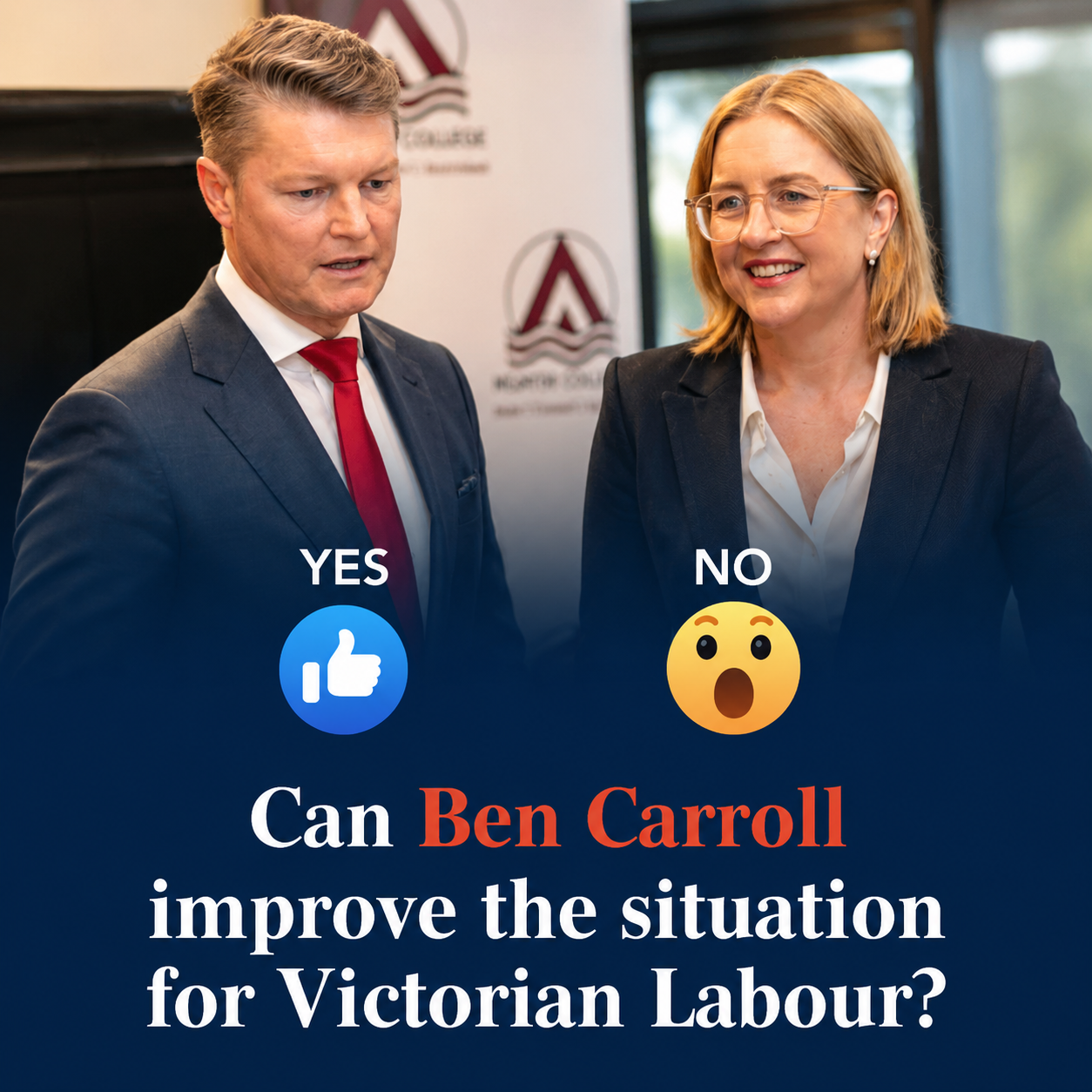
The dramatic escalation follows intense internal discussions within the Victorian Parliamentary Labor Party, culminating in senior MPs from multiple factions informing Ms Allan that they believed she had lost majority support among colleagues and should step aside before the state’s November election.
Rather than resigning, the Premier has vowed to contest any leadership ballot, setting up the possibility of a prolonged internal contest at a time when Labor is already facing significant electoral pressure.
The extraordinary confrontation represents one of the most significant internal challenges faced by a sitting Victorian premier in recent years and has exposed deep divisions within a government now entering the final months of its third term.
Ben Carroll confirmed that he had decided to nominate for the party leadership after being approached by colleagues who believed a change was necessary before voters head to the polls.
According to Mr Carroll, discussions across multiple factions convinced him that the Premier no longer retained majority support within caucus.
He subsequently met with Ms Allan to advise her personally that he intended to seek the leadership if a ballot proceeded.
The announcement marked a dramatic reversal from earlier public declarations in which Mr Carroll had repeatedly insisted he remained loyal to the Premier.
Only weeks earlier, the Deputy Premier had publicly dismissed speculation about challenging Ms Allan, arguing that the government should remain focused on governing rather than internal politics.
The latest developments indicate that internal pressure has intensified considerably as concern grows over Labor’s electoral prospects.
Reports from within the party suggest MPs from both Labor’s Left and Right factions concluded that retaining the current leadership posed an increasing political risk ahead of the state election.
Several ministers and backbench MPs reportedly participated in a cross-factional delegation that informed Ms Allan her position had become untenable.
Such cooperation between normally competing internal factions highlights the depth of concern that has emerged within Victorian Labor.
Despite those calls, Ms Allan has made clear she has no intention of voluntarily stepping aside.
Instead, she formally advised the Victorian Labor Party that she would stand as a candidate in any leadership election, ensuring the contest will proceed if enough MPs move against her.
Her decision significantly increases the likelihood of a contested leadership process rather than an orderly transition.
Under Victorian Labor rules, a contested leadership election can involve both the parliamentary caucus and rank-and-file party members, potentially extending the process over several weeks.
That timetable presents a significant challenge for a government attempting to prepare for an election while simultaneously managing an internal leadership dispute.
The unrest has been building for months.
Labor MPs have privately expressed concern about declining public support, weak opinion polling and growing dissatisfaction over several major policy issues confronting the government.
Among the most politically damaging controversies has been criticism surrounding alleged corruption linked to Victoria’s massive infrastructure program, commonly referred to as the “Big Build”.
Opposition parties have repeatedly called for stronger investigations into allegations involving construction projects, while some Labor MPs have argued the government has failed to respond forcefully enough to public concerns.
Questions surrounding integrity have combined with broader economic pressures affecting Victorian households.
Rising living costs, housing affordability, government debt and infrastructure spending have all become increasingly prominent election issues.
Some Labor MPs reportedly fear that voters now associate many of those challenges directly with Ms Allan’s leadership.
Recent opinion polls have also fuelled nervousness inside government ranks.
Several surveys have suggested Labor risks losing substantial numbers of seats at the upcoming election, with the Coalition improving its position while One Nation has also recorded stronger levels of support than in previous Victorian contests.
Those polling figures have intensified debate over whether changing leaders could improve Labor’s electoral prospects before campaigning officially begins.
Mr Carroll is widely viewed within Labor as a senior figure capable of appealing across factional lines.
A long-serving MP representing the electorate of Niddrie, he has held several ministerial portfolios and currently serves as Deputy Premier.
Supporters argue his lower public profile compared with Ms Allan could provide an opportunity for the government to reset its political agenda and distance itself from controversies associated with recent years.
Others, however, warn that replacing a premier only months before an election carries significant risks of its own.
Leadership instability can reinforce perceptions of division while limiting the government’s ability to focus on policy announcements and campaigning.
Those competing calculations have left Victorian Labor deeply divided over the best path forward.
For Ms Allan, the challenge is not only political but also personal.
Having succeeded Daniel Andrews as Premier in 2023, she inherited responsibility for one of Australia’s largest state governments while overseeing major infrastructure projects, economic recovery efforts and increasingly complex fiscal pressures.
Supporters argue many of the issues now confronting the government began long before she assumed the premiership and cannot fairly be attributed solely to her leadership.
Supporters of the Premier also argue that changing leaders so close to an election could create further uncertainty and provide additional opportunities for the opposition to portray Labor as unstable.
Nevertheless, the apparent collapse in caucus support has dramatically altered the political equation.
In Westminster systems such as Victoria’s, premiers govern only while they retain the confidence of both Parliament and, critically, their own parliamentary party.
If a majority of Labor MPs conclude that another leader offers a better chance of retaining government, leadership challenges can occur regardless of the timing within an electoral cycle.
That convention has shaped numerous leadership changes across Australian politics over the past two decades, affecting both Labor and Coalition governments at state and federal level.
The latest developments therefore fit within a broader history of Australian political parties replacing leaders in response to deteriorating polling or internal dissatisfaction.
Unlike a general election, however, a party-room ballot focuses entirely on the confidence of parliamentary colleagues rather than the wider electorate.
If enough caucus members support Mr Carroll, he could become Premier without Victorians voting until the next scheduled state election.
That possibility has intensified public interest in the internal dynamics of Victorian Labor.
Political observers note that leadership contests often reflect a combination of electoral strategy, policy disagreements, factional relationships and perceptions about a leader’s ability to communicate with voters.
In the current case, reports suggest many MPs became increasingly concerned that Labor’s electoral position had weakened to the point where maintaining the existing leadership posed unacceptable risks.
While individual MPs have publicly offered differing explanations, several recurring themes have emerged.
Among them are concerns about the government’s economic management, persistent cost-of-living pressures, rising public debt associated with major infrastructure projects, and declining confidence reflected in opinion polling.
Questions surrounding integrity and governance have also featured prominently following ongoing public debate regarding Victoria’s extensive infrastructure program.
Although the government has consistently defended its management of those projects, opposition parties have continued using the issue to challenge Labor’s record ahead of the election.
For Ben Carroll, securing the leadership would represent the most significant political promotion of his career.
Having entered Parliament in 2012, he has served in several ministerial portfolios including Public Transport, Roads, Education and WorkSafe before becoming Deputy Premier.
Within Labor, he is generally regarded as a pragmatic figure with strong organisational support and relationships extending across multiple factions.
Those qualities are believed to have contributed to growing calls from colleagues for him to contest the leadership.
Even if Mr Carroll ultimately prevails, however, significant challenges would remain.
Any new leader would inherit responsibility for preparing Labor’s election campaign while attempting to reunify a parliamentary party that has publicly exposed internal divisions.
Rebuilding voter confidence after a highly visible leadership contest would also become an immediate priority.
For Jacinta Allan, the coming hours represent perhaps the most consequential period of her political career.
Since succeeding Daniel Andrews in 2023, she has repeatedly insisted she remains focused on governing rather than internal party politics.
Her decision to contest any leadership ballot demonstrates a determination to defend her position despite mounting pressure from colleagues.
Whether that resolve proves sufficient will depend entirely upon the views of Labor MPs rather than public opinion alone.
The leadership contest also carries implications extending beyond Victoria.
State governments are frequently viewed as indicators of broader political sentiment, particularly when federal elections are approaching or national political parties seek to assess voter priorities.
A change of leadership in Australia’s second-most populous state would inevitably attract attention from political strategists across the country.
Meanwhile, the Victorian Coalition is expected to closely monitor developments while continuing to argue that Labor has become distracted by internal conflict instead of governing.
Opposition leaders have consistently maintained that the government should focus on addressing housing affordability, health services, cost-of-living pressures and economic management rather than leadership disputes.
Political analysts caution, however, that leadership changes do not always produce lasting electoral benefits.
History shows some governments have recovered after replacing their leader, while others have found that internal instability further weakened public confidence.
Ultimately, the success or failure of any leadership transition depends on whether voters perceive the change as genuine renewal rather than political expediency.
As Victorian Labor prepares for what could become one of its most consequential caucus meetings in years, attention remains fixed on whether Jacinta Allan can retain the confidence of her parliamentary colleagues or whether Ben Carroll will secure sufficient support to become the state’s next Premier.
Whatever the outcome, the leadership battle has already become one of the defining political stories of the year and is likely to shape the trajectory of Victorian politics as the state moves towards its next election.






