One Nation leader Pauline Hanson has suffered another significant legal defeat after the Full Federal Court unanimously dismissed her appeal against a landmark ruling that found she breached Australia’s Racial Discrimination Act 1975 during a highly publicised social media exchange with Greens deputy leader Mehreen Faruqi.
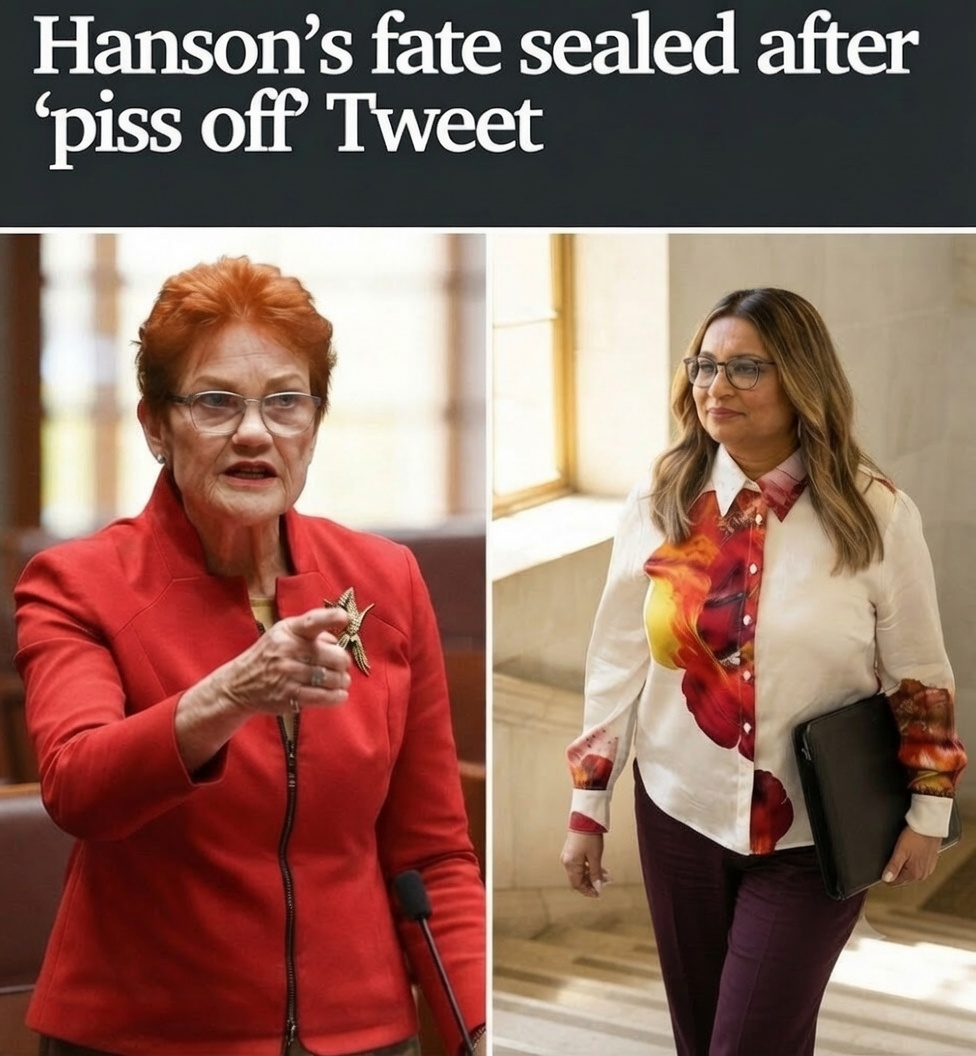
The judgment confirms an earlier Federal Court ruling that Senator Hanson unlawfully engaged in racially discriminatory conduct when she told Senator Faruqi to “pack your bags and piss off back to Pakistan” following an online dispute in September 2022.
The unanimous decision represents another major legal milestone in one of Australia’s most closely watched political cases, reinforcing the operation of Section 18C of the Racial Discrimination Act while once again placing the relationship between free political speech and racial discrimination laws under national scrutiny.
The controversy originated on the day Queen Elizabeth II died.
As Australians reacted to news of the monarch’s passing, Greens senator Mehreen Faruqi posted a message expressing sympathy for those mourning the Queen while also criticising Britain’s colonial legacy.
In her statement, Senator Faruqi said she extended condolences to people grieving the Queen but could not personally mourn “the leader of a racist empire built on stolen lives, land and wealth of colonised people.”
The comments immediately attracted widespread political attention and prompted sharply divided public reactions.
Supporters defended Senator Faruqi’s right to criticise the history of the British Empire, while opponents argued the timing of the remarks was inappropriate during a period of national mourning.
Among the strongest responses came from Pauline Hanson.
The One Nation leader criticised Senator Faruqi’s comments before highlighting that the Greens senator had migrated to Australia, obtained citizenship, entered Parliament and benefited from opportunities available in the country.
Senator Hanson concluded her response by writing: “It’s clear you’re not happy, so pack your bags and piss off back to Pakistan.”
The exchange rapidly spread across social media and quickly became one of Australia’s most discussed political controversies of 2022.
Rather than remaining an online political dispute, however, the matter soon became the subject of Federal Court proceedings.
Senator Faruqi commenced legal action alleging that Senator Hanson’s comments breached Section 18C of the Racial Discrimination Act because they targeted her race, colour and national or ethnic origin.
She argued that telling a migrant or Australian from a minority background to “go back” to another country was a well-established racist trope that questioned a person’s right to belong in Australia.
Following an extensive hearing, Justice Angus Stewart delivered judgment in November 2024, concluding that Senator Hanson had contravened the legislation.
The trial judge found that race and ethnic origin were substantial reasons for the publication of the social media post and that the statement was reasonably likely to offend, insult, humiliate or intimidate because of those protected characteristics.
Justice Stewart rejected arguments that the exchange should simply be viewed as robust political disagreement, determining instead that the language crossed the legal threshold established under Australia’s anti-discrimination laws.
Only weeks after that decision, Senator Hanson lodged an appeal with the Full Federal Court.
Her legal team argued the original judgment had incorrectly interpreted the legislation and failed to give sufficient weight to Australia’s implied constitutional freedom of political communication.
The appeal was heard before Justices Melissa Perry, Geoffrey Kennett and Elizabeth Bennett during a three-day hearing.
On Monday, the Full Court unanimously dismissed Senator Hanson’s appeal, finding no legal error in the original judgment.
The judges concluded that remarks directed at one individual because of race may also perpetuate harmful stereotypes affecting broader racial and ethnic communities.
According to the judgment, Senator Hanson’s attempt to distinguish between criticism of Senator Faruqi personally and criticism based upon her ethnic origin could not succeed.
The court held that one of the reasons for publishing the post was Senator Faruqi’s race, colour and national or ethnic origin, bringing the conduct within the scope of Section 18C.
The judges also considered constitutional arguments concerning political communication.
While acknowledging that Australian democracy depends upon robust and sometimes confrontational political debate, the Full Court concluded that such protections do not automatically invalidate laws enacted to prohibit racial discrimination.
The decision therefore reinforces previous judicial authority recognising that Australia’s constitutional system is capable of protecting political communication while also permitting Parliament to legislate against unlawful racial discrimination.
Outside court, Senator Faruqi welcomed the outcome, describing the unanimous judgment as an important victory extending beyond her own circumstances.
She said the ruling was significant for Australians who had experienced racism or been told they did not belong because of their ethnic or cultural background.
“Today’s win is for every single person out there who has been told to go back to where you came from,” Senator Faruqi said after the judgment.
She also argued that hate speech should not be confused with free speech and warned against allowing racism to become normalised in Australia’s public discourse.
Senator Faruqi said she remained prepared to defend the judgment if Senator Hanson decided to continue pursuing the matter through Australia’s highest court.
Following the Full Federal Court’s decision, Pauline Hanson expressed disappointment with the outcome but indicated she had not yet exhausted all legal avenues.
In a statement released after the judgment, the One Nation leader confirmed that her legal advisers would carefully examine the court’s reasons before deciding whether to seek special leave to appeal to the High Court of Australia.
“My legal team and I will now closely review the decision in the coming days, with a view to commencing an appeal in the High Court of Australia,” Senator Hanson said.
She also argued that the litigation reflected what she believes is an increasingly restrictive environment for public debate in Australia.
According to Senator Hanson, anti-discrimination laws and evolving social expectations have discouraged many Australians from expressing their personal political views for fear of causing offence or becoming the subject of legal action.
That argument mirrors a debate that has persisted in Australian politics for more than a decade regarding the appropriate scope of Section 18C of the Racial Discrimination Act 1975.
Section 18C makes it unlawful to publicly engage in conduct that is reasonably likely to offend, insult, humiliate or intimidate another person because of their race, colour, or national or ethnic origin.
Supporters of the provision argue that it provides an important safeguard against racial vilification and helps reinforce Australia’s commitment to multiculturalism by protecting vulnerable communities from discriminatory public conduct.
Critics, however, have consistently maintained that the wording of the legislation may place unnecessary constraints on freedom of political expression and public discussion.
Successive Coalition governments considered reforms to Section 18C, proposing amendments intended to strengthen protections for freedom of speech while maintaining safeguards against racial discrimination.
Those proposals ultimately did not proceed, leaving the legislation substantially unchanged.
The Hanson-Faruqi litigation has therefore become one of the most prominent modern examples of how Australian courts apply Section 18C in disputes involving elected representatives and political communication.
In its judgment, the Full Federal Court also clarified an important legal principle extending beyond the immediate dispute.
The judges rejected the proposition that a statement directed at one person could not simultaneously affect others sharing the same racial or ethnic background.
Instead, the court concluded that racially based remarks may reinforce harmful stereotypes affecting broader communities, even where only one individual is directly targeted.
Legal practitioners say that reasoning is likely to influence future cases involving allegations of racial discrimination under Commonwealth law.
The judgment also addressed Australia’s implied constitutional freedom of political communication.
While recognising the importance of vigorous political debate—including language that may sometimes be harsh, provocative or offensive—the judges concluded that constitutional protection is not unlimited.
They found that Parliament is entitled to enact laws pursuing legitimate objectives such as preventing racial discrimination, provided those laws remain compatible with Australia’s constitutional system of representative government.
For Senator Faruqi, the outcome represents both a personal legal victory and a broader affirmation of the principle that Australians should not have their place in society questioned because of their race or ethnic heritage.
Throughout the proceedings, she maintained that telling migrants or Australians from minority backgrounds to “go back” to another country carries a long history of racial exclusion and cannot simply be characterised as ordinary political rhetoric.
The case has attracted sustained national attention because it involves two high-profile senators whose political positions frequently clash on issues including immigration, multiculturalism, constitutional reform and Australia’s national identity.
Although those broader political disagreements formed the backdrop to the original social media exchange, the Federal Court’s role was confined to determining whether the language used breached Australia’s anti-discrimination legislation.
By unanimously dismissing the appeal, the Full Federal Court confirmed that the original trial judge had correctly interpreted and applied the law.
Whether the litigation continues now depends on Senator Hanson’s decision regarding the High Court.
Unlike appeals heard by the Full Federal Court, parties seeking to bring matters before the High Court must first obtain special leave to appeal.
Special leave is granted only in a limited number of cases that raise significant questions of legal principle or matters of national importance.
If the High Court declines to hear the case, the Full Federal Court’s unanimous judgment will stand as the final legal determination of the dispute.
If special leave is granted, however, Australia’s highest court would have the opportunity to further clarify the relationship between Section 18C and the implied constitutional freedom of political communication.
Regardless of whether another appeal proceeds, the litigation has already become one of the most significant racial discrimination cases involving serving federal parliamentarians in recent Australian history.
It has reinforced the legal responsibilities attached to public statements made by elected officials while also reigniting a wider national conversation about where Australia should draw the line between robust political debate and unlawful racial discrimination.
The parties are expected to return to court at a later date to determine the issue of legal costs, bringing another chapter to a case that has remained at the centre of Australian political and legal debate since the original exchange on social media in 2022.






