A new political poll has delivered one of the most extraordinary scenarios seen in Australian politics in recent decades, suggesting Pauline Hanson’s One Nation could emerge as a decisive force in the next federal parliament if current voting trends continue.
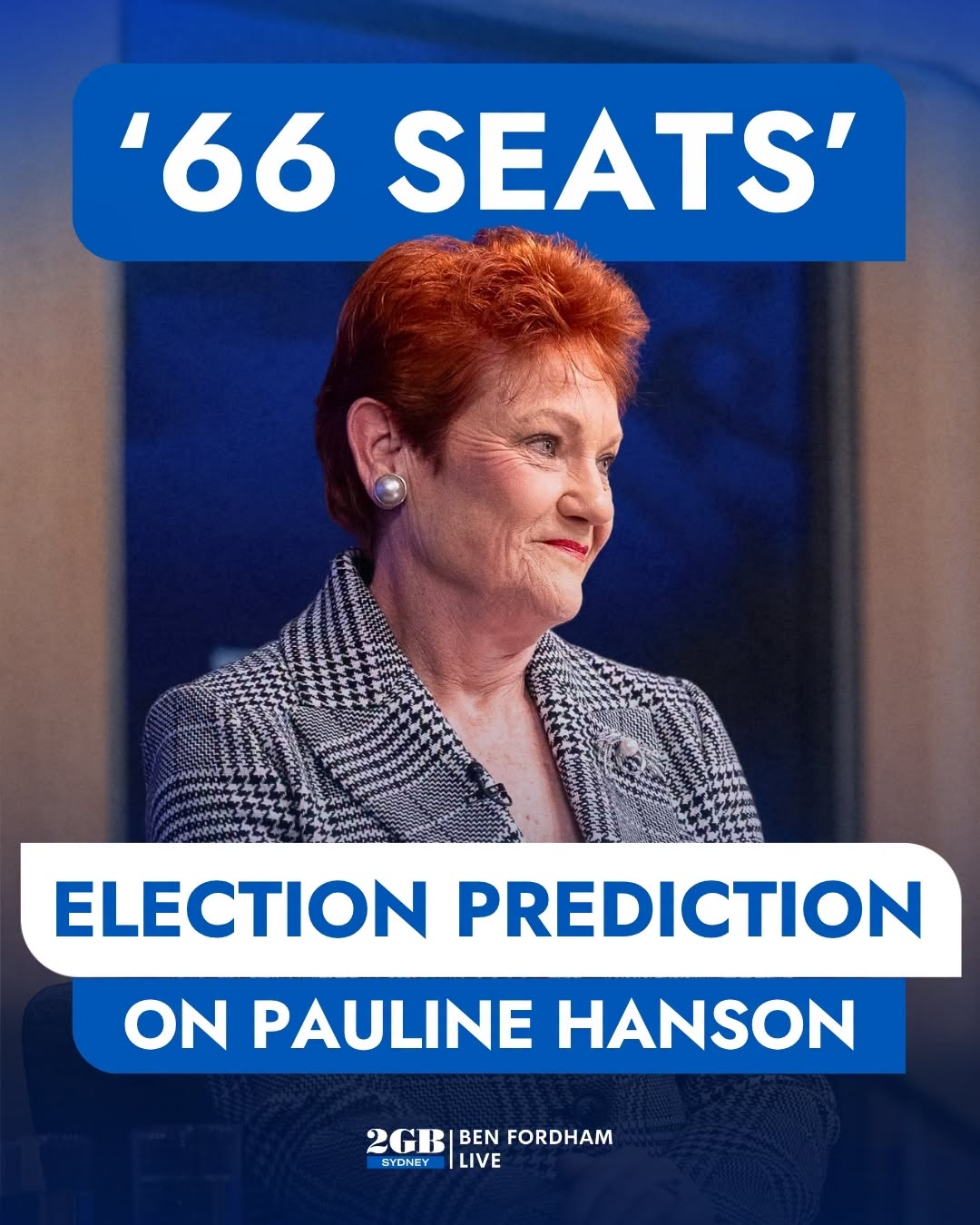
The latest modelling from DemosAU projects One Nation could secure between 53 and 66 seats in the House of Representatives should Australians head to the polls today. At the upper end of that projection, the party would become one of the largest political forces in the country and, together with the Coalition, could theoretically command enough seats to form government.
The headline figure immediately captured national attention, not simply because of its size but because it challenges assumptions that have shaped Australian federal politics for generations.
Australia has traditionally been governed by either Labor or the Liberal-National Coalition, with minor parties generally influencing legislation through the Senate rather than threatening to dominate the House of Representatives. The latest DemosAU modelling suggests that dynamic may no longer be as stable as many assumed.
DemosAU research director George Hasanakos described the findings as evidence of a rapidly changing political landscape.
“They could form a government,” Hasanakos said while discussing the upper end of the projection, referring to the possibility of One Nation working alongside the Coalition should neither major party secure an outright majority.
While such a scenario remains hypothetical, it reflects growing voter dissatisfaction with Australia’s traditional political establishment and the increasing willingness of Australians to consider alternatives outside Labor and the Coalition.
The polling is based on Multilevel Regression and Poststratification (MRP), a statistical technique that has become increasingly influential in modern election forecasting. Rather than relying solely on national voting intention, MRP combines thousands of survey responses with demographic and geographic information to estimate how individual electorates could vote.
According to DemosAU, the modelling is based on more than 9,000 interviews conducted over several weeks, allowing researchers to estimate voting behaviour across all 150 House of Representatives seats.
The model estimates One Nation’s primary vote at around 30 per cent nationally, placing it ahead of both Labor and the Coalition. Labor is projected to receive approximately 26 per cent, while the Coalition sits near 21 per cent.
Although primary vote figures do not directly determine election outcomes under Australia’s preferential voting system, they provide an indication of the remarkable shift occurring among voters frustrated with the political status quo.
For Labor, the findings are particularly concerning.
The Albanese Government has spent much of its second term attempting to address cost-of-living pressures through tax changes, housing initiatives and targeted relief measures. However, inflation, elevated mortgage repayments and persistent affordability challenges continue to dominate public debate.
Polling suggests these economic concerns are becoming increasingly influential in determining voting behaviour, particularly in outer metropolitan suburbs and regional communities where household budgets remain under pressure.
Many of these electorates have historically alternated between Labor and the Coalition. Increasingly, however, they appear willing to consider One Nation as an alternative protest vote.
Housing affordability remains one of the defining issues shaping political sentiment.
Australia continues to experience strong population growth while housing supply has struggled to keep pace. Property prices remain historically elevated in many capital cities, rental vacancy rates remain exceptionally tight, and younger Australians continue reporting declining confidence that home ownership will become achievable.
Combined with rising grocery bills, electricity prices, insurance premiums and healthcare costs, these pressures have fuelled broader dissatisfaction with both major parties.
One Nation has attempted to position itself as the primary political vehicle for voters who believe successive governments have failed to address these challenges.
Pauline Hanson has increasingly focused her public messaging on everyday household costs, migration policy, energy affordability and regional economic development, broadening the party’s appeal beyond its traditional support base.
Recent opinion polling from multiple organisations has shown One Nation recording some of its strongest national support since the party’s establishment in the late 1990s.
The DemosAU projection represents the most ambitious seat forecast yet produced from that broader polling trend.
Regional Queensland remains One Nation’s strongest heartland, but the modelling indicates the party has expanded well beyond its historical base.
Support is now projected across significant parts of regional New South Wales, Western Australia, Tasmania and numerous outer suburban electorates around Brisbane, Sydney, Melbourne, Perth and Adelaide.
These are communities where rapid population growth, infrastructure pressures and housing affordability concerns have combined to create fertile political ground for parties campaigning against the political establishment.
The Coalition also faces difficult questions arising from the latest modelling.
Although the Liberal and National parties remain Australia’s largest conservative political force collectively, polling suggests they continue to lose support to One Nation across several electorates that were once considered relatively secure.
This presents a strategic dilemma.
Attempting to reclaim conservative voters by adopting tougher positions on issues such as migration or energy risks alienating moderate urban supporters. At the same time, failing to respond could allow One Nation to continue expanding into traditional Coalition territory.
Opposition Leader Angus Taylor has previously rejected suggestions of a formal coalition agreement with Pauline Hanson. Nevertheless, should a future parliament produce no clear majority, political negotiations between parties and independents would inevitably become central to government formation.
That possibility alone demonstrates how significantly Australia’s electoral landscape has evolved.
Only a decade ago, projections suggesting One Nation could potentially influence the formation of government would have been viewed as highly improbable. Today, while still controversial, they are increasingly part of mainstream political discussion.
Despite the headline-grabbing figures, political analysts caution that the DemosAU projection should not be interpreted as a prediction that One Nation will necessarily win 66 seats at the next federal election.
Election modelling is designed to estimate what could happen if current voting intentions remained unchanged and if Australians voted immediately. In reality, election campaigns often reshape public opinion, particularly during the final weeks before polling day.
Leadership debates, major policy announcements, economic developments and unexpected political events can all influence undecided voters. Australian elections have repeatedly demonstrated that momentum can shift significantly during an official campaign.
Another important consideration is Australia’s preferential voting system.
Unlike many democracies where the candidate with the highest vote wins outright, Australia’s House of Representatives uses full preferential voting. Voters rank every candidate on the ballot paper, and if no candidate receives more than 50 per cent of first preferences, the lowest-polling candidates are progressively eliminated while their preferences are redistributed until one candidate secures a majority.
This system means that a party’s national primary vote, while politically significant, does not automatically translate into parliamentary seats.
Preference flows have historically played a decisive role in determining election outcomes. Labor and the Coalition have often benefited from preferences distributed by smaller parties, while independents have occasionally prevailed after receiving strong preference support despite trailing on first preferences.
How One Nation performs under this system remains one of the biggest unknowns heading into the next election.
If the party attracts substantially higher primary votes across dozens of electorates, it may no longer rely as heavily on preference flows as it has in previous elections. However, where contests remain close, the way preferences are allocated between Labor, the Coalition, the Greens and independent candidates could ultimately decide many seats.
Candidate quality may also become increasingly important.
Building national support is one challenge; fielding experienced local candidates capable of running effective electorate campaigns is another. Major parties benefit from longstanding campaign infrastructure, volunteer networks and established local organisations developed over many decades.
For any rapidly expanding political party, recruiting credible candidates across every electorate represents a significant organisational test.
Political history suggests this is often where emerging parties encounter their greatest difficulties. Strong polling does not always translate into electoral success if campaign resources cannot be effectively deployed across a large number of seats simultaneously.
Nevertheless, there are several reasons why analysts believe the political environment today differs markedly from previous election cycles.
Cost-of-living pressures remain at the forefront of voter concerns. While inflation has moderated from its peak, many Australian households continue to experience financial strain as mortgage repayments, rents, insurance premiums and utility bills remain significantly higher than they were only a few years ago.
Housing affordability has also become a defining issue across much of the country.
The median price of homes in many capital cities has continued to outpace wage growth, leaving younger Australians increasingly concerned about entering the property market. At the same time, record-low rental vacancy rates have placed additional pressure on tenants, particularly in major metropolitan areas.
Migration policy has emerged as another politically sensitive issue.
Australia recorded historically strong net overseas migration following the reopening of international borders after the pandemic. While business groups have argued migration is essential to address workforce shortages, critics contend that rapid population growth has intensified pressure on housing supply, infrastructure and public services.
One Nation has consistently argued that migration levels should be significantly reduced, a position the party says would help ease demand in the housing market and reduce pressure on essential services.
Energy policy remains another point of political division.
Labor continues to pursue its transition towards lower-emissions electricity generation, arguing renewable investment will improve long-term energy security while reducing emissions. One Nation has instead advocated expanded support for traditional energy sources alongside increased investment in nuclear power, arguing this approach would better protect manufacturing and lower electricity costs.
These policy differences help explain why the party has gained support among some regional communities and industrial workers concerned about employment and energy prices.
The latest polling also reflects a broader international trend.
Across many established democracies, traditional centre-left and centre-right parties have experienced declining levels of voter loyalty as economic uncertainty, social change and dissatisfaction with political institutions encourage greater support for minor parties and populist movements.
Australia has historically been more resistant to this trend than many comparable countries because compulsory voting and preferential voting tend to favour larger parties. Even so, recent federal elections have seen the crossbench steadily expand, with independents and smaller parties winning an increasing number of seats.
If One Nation were to substantially increase its parliamentary representation, it would represent one of the most significant political realignments in modern Australian history.
For Labor, the implications would be profound.
The government would likely face renewed scrutiny over its handling of economic management, housing affordability, taxation and migration. A further decline in support across outer suburban and regional electorates could fundamentally reshape Labor’s electoral strategy ahead of future campaigns.
The Coalition would confront equally significant questions.
Should One Nation continue attracting conservative voters in large numbers, Liberal and National Party strategists may need to reassess policy priorities, campaign messaging and preference arrangements to remain competitive in key marginal electorates.
For Pauline Hanson, meanwhile, the polling represents another indication that One Nation has evolved beyond its traditional identity as a protest party.
Whether the party ultimately converts rising public support into parliamentary seats will depend on candidate selection, campaign execution, policy credibility and the unpredictable dynamics of a federal election campaign.
Importantly, no election date has yet been announced, meaning considerable time remains for public opinion to change. Economic conditions may improve or deteriorate, government policy could shift, and opposition parties will continue refining their election platforms before Australians next head to the ballot box.
For that reason, most election experts view polling as a snapshot rather than a forecast.
Even so, the DemosAU modelling has added fresh momentum to debate about whether Australia’s long-established two-party system is entering a period of lasting transformation.
Regardless of where individual voters stand politically, the figures illustrate a broader message: a growing share of Australians appear increasingly willing to look beyond the traditional parties in search of alternatives they believe better reflect their priorities.
Whether that sentiment ultimately reshapes the composition of the next Parliament remains uncertain, but the latest polling ensures that Pauline Hanson and One Nation will remain firmly at the centre of Australia’s political conversation in the months ahead.






