A heated television exchange between ABC 7.30 presenter Sarah Ferguson and One Nation MP Barnaby Joyce has continued to generate discussion well beyond the original interview, prompting renewed debate about journalistic style, political interviewing and perceptions of media impartiality in Australia.
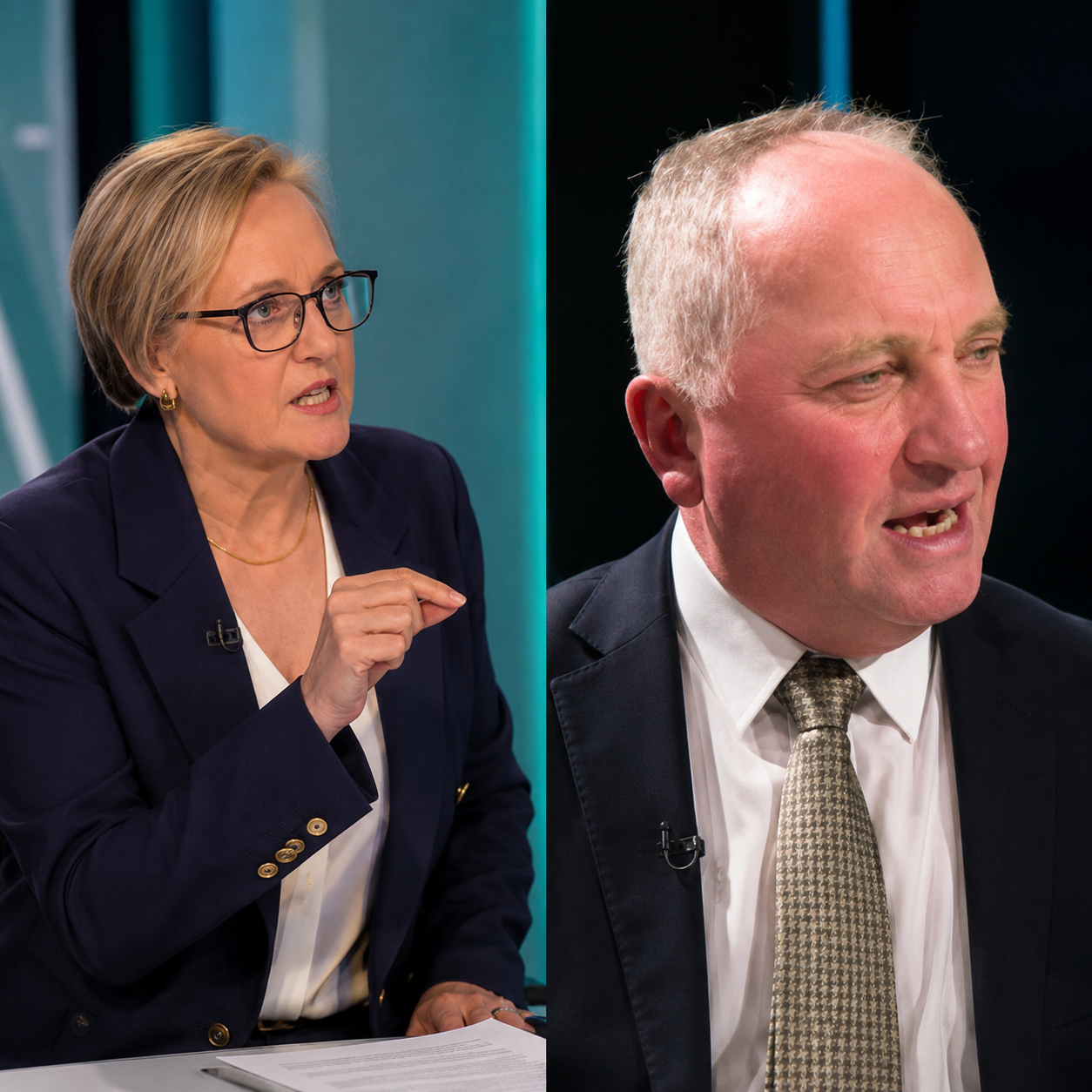
The interview attracted widespread attention after Mr Joyce briefly interrupted his response to discipline his dog during the live conversation before objecting to Ms Ferguson’s request that he continue answering her question.
While the exchange itself lasted only moments, it quickly spread across Australian and international media, with commentators offering sharply differing interpretations of both participants’ conduct.
Among the most detailed responses was a commentary by columnist Gerard Henderson, who argued the central issue was not Mr Joyce’s reaction to his dog but rather what he described as the interviewing style adopted by Ms Ferguson throughout the discussion.
According to Mr Henderson, the interview reflected a broader pattern in which prominent conservative politicians receive more aggressive treatment during televised interviews than politicians from other parts of the political spectrum.
He argued that interruptions and forceful questioning formed the most notable aspect of the exchange and suggested viewers should focus on the conduct of the interview rather than the brief incident involving the dog.
The original interview centred on Mr Joyce’s political decision to join One Nation and questions surrounding comments made by the party and its leadership.
During the discussion, Ms Ferguson asked whether Mr Joyce was comfortable with the direction in which One Nation was heading and whether joining the party aligned him with positions that critics regarded as intolerant or racially divisive.
As Mr Joyce attempted to answer, he paused to call out to his dog before apologising for the interruption.
Ms Ferguson responded by encouraging him to return to the interview, saying, “Don’t worry about the dog. Just answer the question.”
Mr Joyce objected to what he considered an unnecessarily abrupt response and warned that the interview would not continue constructively if the discussion became discourteous.
The exchange rapidly circulated online, generating extensive commentary across social media platforms, television programs and newspaper opinion pages.
Supporters of Ms Ferguson argued she was simply attempting to keep the interview focused and ensure questions were answered directly.
Others viewed her approach as unnecessarily confrontational and said interviewers should allow greater flexibility during unexpected interruptions, particularly in remote interviews conducted outside formal studio settings.
Mr Henderson’s commentary falls clearly into the latter category.
He argued that forceful interviewing has become a defining characteristic of Ms Ferguson’s approach when questioning senior conservative political figures and suggested this creates an appearance of unequal treatment.
As examples, he referred to previous interviews involving Coalition politicians including Angus Taylor and Matt Canavan.
Supporters of Ms Ferguson reject that criticism, arguing she applies rigorous questioning to political leaders regardless of party affiliation and that holding elected representatives accountable is a central responsibility of public-interest journalism.
The debate highlights broader questions that have surrounded political interviewing for many years.
Journalists conducting interviews with senior politicians must balance competing priorities: testing public claims, challenging inconsistencies, allowing interviewees sufficient opportunity to explain their positions and maintaining respectful but effective conversations.
Where that balance should be drawn has long divided audiences, politicians and media commentators.
Some viewers regard persistent interruptions as evidence of robust accountability journalism, while others believe repeated interjections reduce opportunities for meaningful public discussion.
The differing reactions to the Ferguson–Joyce interview illustrate how strongly opinions can vary depending on expectations of political journalism.
Mr Henderson also referred to subsequent public discussion about whether the dog had barked during the interview, noting that both Ms Ferguson and ABC broadcaster Hamish Macdonald later discussed the incident publicly.
He questioned why anyone would believe Mr Joyce had reason to invent the interruption and argued the issue itself had become a distraction from the broader discussion surrounding interviewing standards.
Beyond the interview, Mr Henderson’s commentary expanded into a wider critique of media coverage involving One Nation leader Pauline Hanson, mining executive Gina Rinehart and reporting by several Australian media organisations.
He argued that certain reporting reflected editorial attitudes towards conservative political figures while suggesting comparable treatment would be unlikely if the subjects involved politicians from the political left.
Those observations represent the author’s opinion and form part of a broader argument regarding perceptions of political balance within sections of Australia’s media landscape.
Questions concerning media impartiality have remained a recurring feature of Australian public debate for decades.
Public broadcasters, commercial media organisations and newspaper publishers are regularly scrutinised by audiences across the political spectrum, with criticism often coming simultaneously from opposing ideological viewpoints.
Some commentators argue this reflects healthy democratic accountability, while others believe it demonstrates increasing political polarisation in the way journalism is interpreted by different sections of the community.
The Ferguson–Joyce interview has become another example of how a relatively brief television exchange can evolve into a much broader national conversation about media standards, political communication and public expectations of journalists interviewing elected representatives.
The broader discussion also raises questions about how political interviews should be conducted in an era when short video clips can dominate public attention long after the original policy discussion has faded from view.
Communications experts have noted that viral moments often shape public perceptions more powerfully than lengthy exchanges about legislation or government policy.
In this case, a brief disagreement over an interruption involving Mr Joyce’s dog became the defining image of an interview that had primarily focused on his decision to join One Nation and defend the party’s political direction.
Media analysts frequently observe that confrontational interviewing styles can produce compelling television, but they also carry the risk that the exchange itself becomes the story rather than the issues under discussion.
Supporters of assertive interviewing argue politicians should expect persistent questioning when confronted with controversial decisions or statements.
Critics counter that repeated interruptions may prevent audiences from hearing complete answers and ultimately reduce the value of political interviews as a source of public information.
The disagreement surrounding the Ferguson–Joyce interview illustrates that both perspectives continue to attract significant public support.
Mr Henderson’s article extended beyond the interview itself to examine what he believes is a broader pattern within sections of Australia’s media industry.
He criticised coverage of One Nation leader Pauline Hanson, arguing that some reporting focused excessively on personality and symbolism rather than policy substance.
He also questioned editorial decisions involving coverage of mining executive Gina Rinehart, suggesting certain comments and images broadcast during political programs would not have been used if they had involved prominent women from the political left.
These observations formed part of Mr Henderson’s wider argument that some conservative public figures receive a level of editorial scrutiny and criticism that differs from the treatment afforded to others.
Such claims have long been disputed by journalists and media organisations, which generally maintain that editorial decisions are based on news value, public interest and the conduct of interview subjects rather than political ideology.
The commentary also revisited debates surrounding former Prime Minister Malcolm Turnbull, media coverage of News Corp and the publication of the book Getting Murdoched, with Mr Henderson expressing disagreement with arguments that Rupert Murdoch’s media organisations were primarily responsible for Mr Turnbull’s loss of the Liberal leadership in 2018.
Instead, he argued that internal political dynamics, declining electoral performance and leadership tensions within the Liberal Party provided more substantial explanations for the change in leadership.
The article further examined the state funeral held for veteran broadcaster Derryn Hinch, questioning the Victorian Government’s decision to grant him that honour while also revisiting longstanding controversies surrounding aspects of his journalism and public advocacy.
Mr Henderson contrasted tributes celebrating Mr Hinch’s campaigning work with criticism of decisions that led to contempt of court convictions and broader debate about the consequences of high-profile media interventions during criminal proceedings.
In another section, the commentary addressed historical claims concerning Australia’s political leadership before the Second World War.
Mr Henderson challenged arguments suggesting former Prime Minister Robert Menzies should be viewed primarily through the lens of appeasement during the 1930s, contending that Labor leader John Curtin also supported policies aimed at avoiding war before the conflict ultimately began.
He argued that historical assessments should take account of the broader international context and the positions adopted by political leaders across many Western democracies during that period.
Those historical interpretations remain the subject of continuing academic debate, with historians offering differing assessments of the decisions made by Australian governments and opposition leaders before the outbreak of World War II.
Taken together, Mr Henderson’s commentary reflects a consistent argument that contemporary political reporting should distinguish more clearly between rigorous scrutiny and perceived editorial advocacy.
Whether readers agree with that assessment or not, the article demonstrates how a single televised interview can become the starting point for much broader debates about journalism, political communication, historical interpretation and public confidence in Australia’s media institutions.
The Ferguson–Joyce exchange has therefore evolved beyond an isolated on-air disagreement into a wider conversation about the expectations Australians place on journalists, politicians and publicly funded broadcasters when discussing contentious political issues.
As media organisations continue adapting to an environment shaped by social media, viral clips and rapidly changing news cycles, debates over interviewing style, impartiality and editorial judgment are likely to remain central to public discussion.
Ultimately, the lasting significance of the interview may lie less in the brief interruption involving a barking dog than in the continuing questions it has generated about how political journalism should balance robust accountability, fairness and respectful engagement in an increasingly polarised media landscape.






