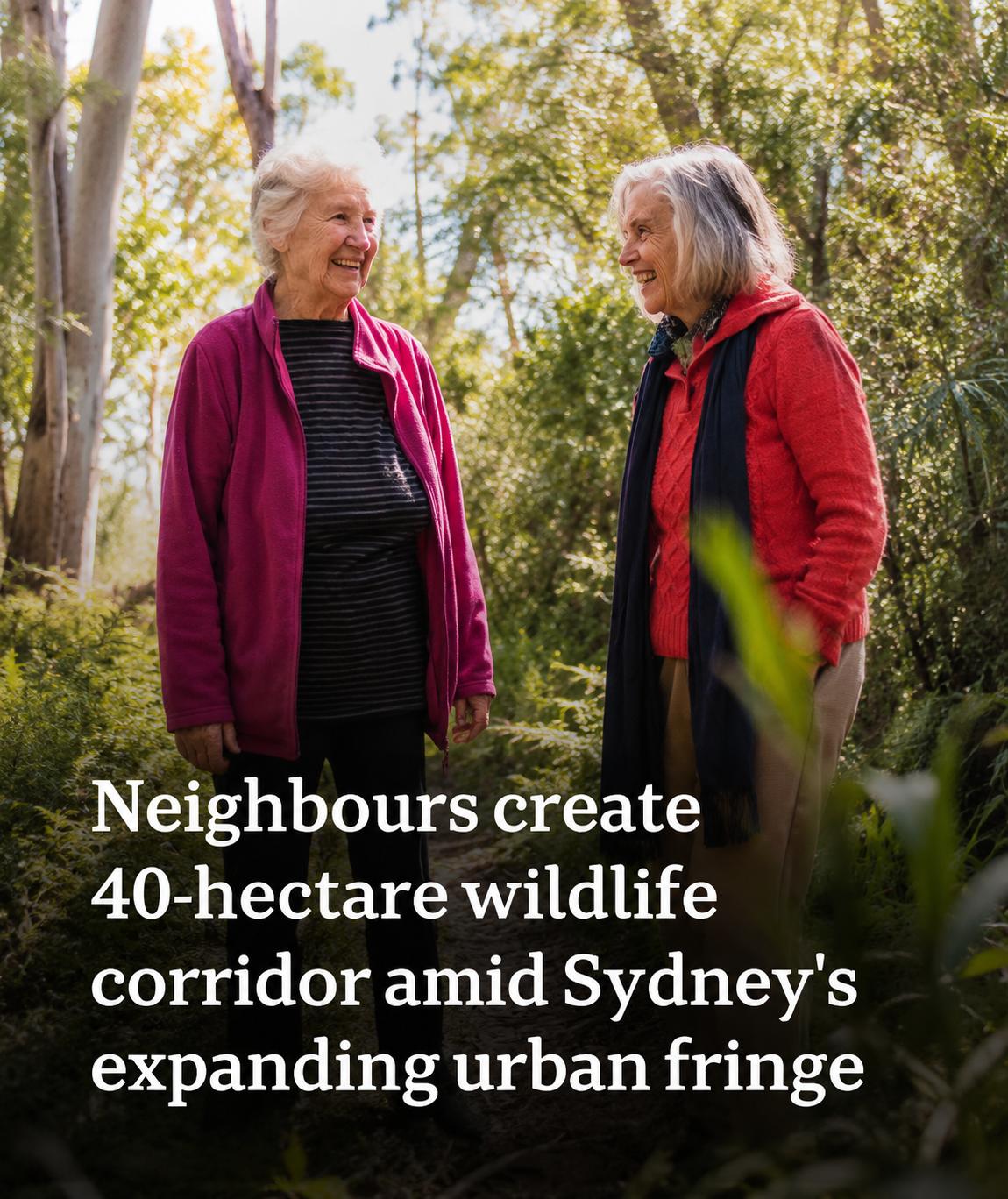
For years, Lesley Hulbert measured the health of the bush behind her Kurrajong Heights home not by scientific surveys but by its sounds.
Before the devastating Black Summer bushfires of 2019 and 2020, gang-gang cockatoos called through the forest canopy, koalas occasionally wandered nearby and wallabies regularly appeared around the property bordering one of New South Wales’ largest national park systems.
Then the fires came.
For months, flames burned only minutes from her home in Sydney’s north-west, transforming familiar bushland into a landscape of smoke and uncertainty. As the fires continued, the wildlife that had become part of everyday life seemingly vanished.
“The bush went quiet,” Ms Hulbert recalled.
In the years since, nature has slowly begun to recover. Possums and wallabies have returned, their movements captured by trail cameras installed near a small pond built by Ms Hulbert and her husband. Native birds have gradually reappeared, offering hope that the local ecosystem is healing.
Today, however, Ms Hulbert fears a different threat could undo that recovery.
Instead of bushfires, she worries that expanding residential development along Sydney’s growing urban fringe could permanently fragment wildlife habitat surrounding the Hawkesbury region.
Determined to protect what remains, she and several neighbouring landholders have joined forces to establish a 40-hectare wildlife corridor linking the Blue Mountains and Wollemi national parks—two of Australia’s most significant conservation areas.
The privately managed corridor has become an example of how local communities are stepping in to preserve habitat where public conservation land alone cannot maintain ecological connectivity.
“Even the people who live here don’t know what we’ve got,” Ms Hulbert said.
The corridor combines several neighbouring rural properties into one connected landscape where native vegetation is protected, invasive weeds are removed and wildlife can continue moving between larger bushland reserves.
One of the largest contributors is local resident Polly Bennett, whose property contains approximately 30 hectares of Sydney Turpentine-Ironbark Forest—an endangered ecological community that has largely disappeared across metropolitan Sydney following decades of clearing.
Rather than clearing the land, Ms Bennett has focused on restoring native vegetation while preserving mature trees that provide nesting hollows for birds and shelter for mammals.
“It’s our biodiversity. That’s our web of life,” she said.
The participating landholders formalised their conservation efforts through the Community Environment Network’s Land for Wildlife program, which assists private property owners with habitat restoration, ecological advice and long-term conservation planning.
Although participation does not transfer ownership or create a national park, it encourages landholders to voluntarily manage their land for conservation outcomes while retaining private property rights.
Wildlife corridors have become an increasingly important conservation strategy across Australia as urban expansion, agriculture and infrastructure divide once-continuous habitats into isolated patches.
For species such as koalas, movement between populations is critical for maintaining genetic diversity, finding food and escaping threats including bushfires, drought and disease.
Without connected habitat, isolated populations become increasingly vulnerable to local extinction.
The Kurrajong Heights corridor sits within a strategically important landscape because it helps connect habitat surrounding Wollemi National Park with the adjoining Blue Mountains National Park, both recognised internationally for their biodiversity and World Heritage values.
Conservationists say private land located between protected reserves often becomes the missing link that allows wildlife to move safely across the broader landscape.
That need has become even more urgent following the Black Summer bushfires, which burned millions of hectares across south-eastern Australia and severely affected populations of koalas, glossy black cockatoos, gang-gang cockatoos and numerous other native species.
Although many ecosystems have shown remarkable resilience since the fires, scientists warn recovery can take decades and depends heavily on suitable habitat remaining connected.
Residents fear that continued development around Kurrajong Heights could gradually sever those connections.
Only a short drive from the newly established wildlife corridor, a 40-hectare residential development recently cleared mature habitat trees to create eight rural residential lots.
The project was originally approved in 2010 and included a koala habitat assessment stating there was no evidence of koalas occupying the site.
Long-time local resident Stephanie Clay disputes that conclusion.
Having lived near the development for several years, she says local residents have long recognised the surrounding bushland as koala habitat.
She believes community knowledge available at the time should have prompted closer ecological investigation before development proceeded.
Nearby, another long-standing proposal has generated fresh concern among conservation groups.
The proposed Island Oasis tourism precinct covers approximately 126 hectares and remains under assessment as a State Significant Development.
Plans include clearing a 100-metre buffer around sections of the development, raising concerns about further habitat fragmentation despite the project’s original planning approval dating back to 1989.
Planning documents indicate the approval has remained valid because sufficient physical work was undertaken on the site’s access road within the timeframe required under development consent.
That situation highlights one of the complexities facing rapidly growing regions around Sydney.
Development approvals granted decades ago can remain legally active, even where environmental knowledge and conservation priorities have changed substantially since the original assessments were completed.
Hawkesbury City Council says it is currently preparing a koala management strategy designed to better understand where koala populations are established and where future habitat protection may be required.
However, council also notes that once a development consent has been lawfully activated, there is generally no legal mechanism allowing approval to be withdrawn simply because environmental priorities have evolved.
Environmental groups argue that this legal reality makes voluntary conservation efforts by private landholders increasingly important.
Stephanie Carrick from the Sydney Basin Koala Network says the Kurrajong Heights initiative provides far more than simply preserving patches of bushland.
She describes the corridor as an ecological lifeline that allows koalas and many other native species to move safely between the Blue Mountains and Wollemi national parks, particularly during periods of drought, bushfire recovery and seasonal breeding.
According to conservationists, the Kurrajong district has long been recognised as an important movement corridor for koalas travelling across the western Sydney landscape.
Wildlife monitoring has previously documented koalas travelling from Kurrajong towards Glenbrook in the Lower Blue Mountains, demonstrating the importance of maintaining connected habitat across privately owned land.
Unlike national parks, much of the land between these larger conservation reserves remains in private ownership, meaning the future of wildlife connectivity often depends on decisions made by individual landholders.
Ms Carrick said initiatives such as the Kurrajong Heights corridor demonstrate how local communities can make a meaningful contribution to conservation without waiting for governments to purchase additional land.
“The area here is largely privately owned, so landholders coming together to protect it is an incredible gift to koalas and other wildlife like endangered gang-gang cockatoos who nest in the hollows,” she said.
Mature eucalyptus trees scattered throughout the corridor are particularly valuable because they contain natural hollows that take decades, and often centuries, to develop.
These hollows provide nesting sites for gang-gang cockatoos, parrots, owls, possums, gliders and numerous other native animals that cannot survive without suitable tree cavities.
Once removed, such habitat cannot be quickly replaced, making the protection of mature forest one of the highest priorities for conservation managers.
The corridor also supports native understory vegetation that provides food resources for insects, reptiles, small mammals and birds, creating a more resilient ecosystem capable of recovering after natural disturbances.
Scientists increasingly emphasise that biodiversity conservation is not solely about protecting individual species but preserving the ecological relationships between plants, animals, fungi and waterways that sustain entire landscapes.
As climate change increases the frequency of extreme weather events, connected habitat is expected to become even more important.
Wildlife corridors allow animals to relocate when local conditions become unsuitable, helping populations adapt to changing temperatures, prolonged droughts and more frequent bushfires.
They also reduce the likelihood of animals crossing busy roads or entering urban areas where collisions with vehicles, domestic pets and other human-related threats become more common.
For communities living along Sydney’s expanding fringe, balancing housing demand with environmental protection has become one of the defining planning challenges of recent decades.
Greater Sydney continues to experience strong population growth, increasing pressure for new housing, infrastructure and tourism developments on the city’s outer edges.
While development provides homes and economic opportunities, conservation groups argue that careful planning is essential to ensure expansion does not permanently isolate important wildlife populations.
The Kurrajong Heights project illustrates how conservation and private land ownership can work together rather than exist in opposition.
Participating landholders continue using and managing their properties while voluntarily committing to practices that enhance biodiversity, including controlling invasive weeds, protecting native vegetation and avoiding unnecessary clearing.
Their efforts complement the surrounding national parks by strengthening ecological links that public conservation land alone cannot provide.
For Ms Hulbert, the motivation remains deeply personal.
After witnessing the silence that followed the Black Summer bushfires, she hopes future generations will continue hearing gang-gang cockatoos in the forest, spotting wallabies at dusk and knowing koalas still move through the landscape surrounding Kurrajong Heights.
She believes protecting those natural connections today offers the best chance of ensuring the bush remains alive tomorrow.
As Sydney continues expanding towards its forested outskirts, the 40-hectare wildlife corridor stands as a reminder that some of Australia’s most important conservation work is taking place not only inside national parks, but also on privately owned land where neighbours have chosen to protect the landscape they share with native wildlife.