Prime Minister Anthony Albanese has come under renewed political pressure after declaring the Australian Labor Party is “more democratic and more diverse than ever”, with critics arguing the remarks were poorly timed amid mounting debate over political donations, cost-of-living pressures and Labor’s broader legislative agenda.
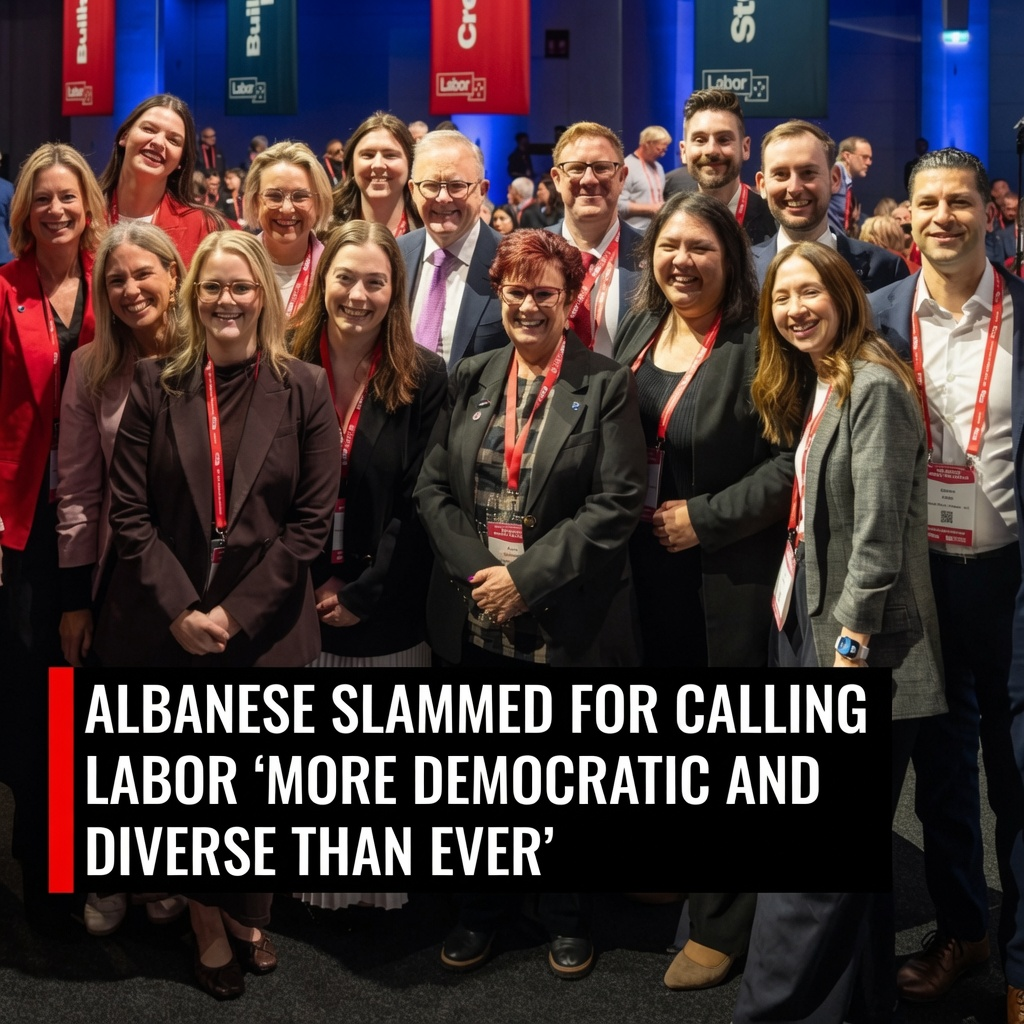
Mr Albanese made the comments while attending Labor’s 50th National Conference in Adelaide, where he celebrated the party’s newest parliamentary representatives and described the movement as continuing to evolve with modern Australia.
Sharing photographs from the conference, including images alongside MPs elected at the 2025 federal election, the Prime Minister wrote that Labor remained “more democratic and more diverse than ever” as it continued working to deliver change for Australians.
The message was intended to highlight the party’s changing parliamentary representation and its broader commitment to reflecting Australia’s multicultural society.
Instead, it quickly became the focus of criticism from political opponents and many social media users who questioned whether the government’s recent decisions matched the democratic values promoted in the Prime Minister’s statement.
Much of the criticism centred on Labor’s decision to introduce new prohibited hate organisation laws and reforms aimed at strengthening protections against hate speech and extremist activity.
Some critics argued those measures had gone too far, particularly following the government’s decision to prohibit the registration of the White Australia Party under Australia’s updated electoral framework.
Supporters of the legislation, however, have maintained that the measures target organisations promoting racial hatred or extremist ideologies rather than limiting legitimate democratic participation.
The differing interpretations have fuelled an increasingly heated political debate over where Australia should draw the line between protecting freedom of political expression and preventing organisations considered fundamentally incompatible with democratic values.
The controversy surrounding the Prime Minister’s comments has also been amplified by a separate political issue that has attracted significant public attention during recent weeks.
Earlier reports revealed Mr Albanese attended a private Labor fundraising dinner hosted by businessman Felix Lee at the Point Piper mansion known as Mandalay.
The event itself was lawful and formed part of Labor’s fundraising activities. However, it attracted widespread attention after media reports linked the property to an earlier Australian Taxation Office security claim arising from a long-running civil tax dispute involving Felix Lee’s father, billionaire businessman Phillip Dong Fang Lee.
There is no allegation that Felix Lee engaged in wrongdoing in relation to his father’s tax affairs, nor has any allegation been made that the Prime Minister acted unlawfully by attending the dinner.
Nevertheless, critics have questioned whether senior political leaders should exercise greater caution when attending exclusive fundraising events hosted by wealthy business figures whose families have previously been involved in significant regulatory disputes.
The Prime Minister’s Office has consistently maintained that Labor complies with Australia’s political donation laws and disclosure requirements.
Political donations above legislated thresholds are reported through the Australian Electoral Commission under the Commonwealth disclosure framework, although those disclosures are not published immediately after fundraising events.
The delay between fundraising and public disclosure has itself become a recurring source of debate, with integrity advocates calling for more timely reporting of major political donations.
Criticism of the Prime Minister’s latest comments has not been limited to questions surrounding fundraising.
Many online responses focused instead on the continuing cost-of-living pressures facing Australian households.
Mortgage repayments remain significantly higher than they were only a few years ago, while many Australians continue to face elevated electricity prices, insurance premiums, grocery costs and rental expenses.
Although inflation has eased from its peak, many families argue their household budgets remain under considerable pressure.
Against that backdrop, some critics suggested the Prime Minister’s message celebrating Labor’s diversity appeared disconnected from the financial challenges confronting many voters.
Others questioned whether internal party democracy within Labor reflects the broader electorate, pointing to the influential role played by affiliated unions during National Conference.
Under Labor’s organisational structure, affiliated unions hold voting rights alongside rank-and-file party members when determining platform positions and constitutional matters.
Supporters argue this model reflects Labor’s historic relationship with Australia’s trade union movement and gives working Australians a direct voice in party policy.
Critics contend the arrangement gives organised unions disproportionate influence over binding policy decisions compared with ordinary party members or the wider electorate.
That debate has existed for decades and resurfaced following the Prime Minister’s remarks about Labor’s democratic credentials.
The conference itself considered a wide range of policy issues extending beyond internal organisational matters.
Delegates debated housing affordability, climate policy, tax reform, Australia’s strategic relationships, higher education, industrial relations and several constitutional amendments affecting the party’s future platform.
Labor leaders presented the conference as evidence of a party willing to debate policy openly while adapting to changing social and economic conditions.
Opposition figures have argued that public confidence depends less on conference speeches than on government performance across key areas including living standards, economic management and transparency.
The latest dispute illustrates how political messaging can rapidly become intertwined with broader public concerns.
A statement intended to celebrate party diversity has instead become another focal point in ongoing arguments over government accountability, political fundraising and the pressures facing Australian households.
Political communication often succeeds or fails on context rather than wording alone. While Mr Albanese’s statement focused on Labor’s internal evolution, many Australians interpreted it through the lens of current economic conditions and the controversies dominating national headlines.
The Prime Minister has consistently argued that his government is delivering reforms aimed at easing long-term pressures on households, including housing initiatives, energy bill relief, expanded Medicare funding and industrial relations changes designed to improve wages.
Labor also points to declining inflation, moderating interest rate expectations and continued employment growth as evidence that its economic agenda is beginning to produce results.
However, opinion polling has repeatedly shown that many Australians remain more concerned about their immediate household finances than broader economic indicators. Rising mortgage repayments, rental costs, grocery prices and insurance premiums continue to dominate voter priorities across much of the country.
For that reason, critics argued the Prime Minister’s message celebrating Labor’s diversity did little to address the issues many voters currently regard as most urgent.
The reaction on social media reflected those frustrations, although online commentary should not necessarily be viewed as representative of broader public opinion. Political posts routinely attract highly engaged supporters and opponents whose views may not reflect the wider electorate.
Even so, the volume of responses ensured the Prime Minister’s comments became part of a broader political discussion extending well beyond Labor’s National Conference.
The fundraising controversy involving Felix Lee also continued to generate attention.
Although no evidence has emerged suggesting the dinner influenced government decisions or breached Australia’s political donation laws, opponents have argued the event illustrates why greater transparency around political fundraising remains necessary.
Labor has rejected suggestions of impropriety, maintaining that fundraising events are conducted in accordance with Australian law and that all reportable donations will be disclosed through the existing Australian Electoral Commission process.
Political fundraising remains common practice across Australia’s major parties. Labor, the Coalition and other political organisations all rely on combinations of public funding, membership revenue and private donations to finance election campaigns and party operations.
Debate continues, however, over whether current disclosure rules provide voters with sufficiently timely information regarding major political contributions and fundraising activities.
Integrity advocates have long argued for faster disclosure requirements, suggesting that donations should become publicly available much sooner than under the existing reporting timetable.
The issue has become increasingly significant as campaign spending has grown and political fundraising has become more sophisticated.
Questions surrounding transparency are not unique to Labor. Coalition governments have also faced scrutiny over donations, fundraising dinners and relationships with major supporters while in office, illustrating that concerns about political finance extend across Australia’s political system.
The latest criticism therefore sits within a much broader debate about public trust in democratic institutions.
Supporters of the Prime Minister argue that Labor’s parliamentary team is demonstrably more diverse than previous generations, citing increased representation of women, multicultural Australians, First Nations members and younger MPs.
They also point to internal party elections, policy debates and conference voting processes as evidence that Labor remains a democratic political organisation operating under an established constitutional framework.
Critics respond that diversity within parliamentary representation is separate from questions about political accountability, economic performance and transparency. They argue voters ultimately judge governments less by internal party structures than by outcomes affecting everyday Australians.
Those competing perspectives are likely to continue shaping political debate as Parliament resumes and attention returns to issues including housing affordability, taxation, energy prices, national security and cost-of-living pressures.
Labor’s National Conference was intended to project unity following the party’s election victory and to establish priorities for the government’s next term. Instead, discussion surrounding the event has been overshadowed by arguments over political donations, democratic accountability and public confidence.
Whether that controversy proves short-lived or develops into a more significant political issue will depend largely on future disclosures relating to fundraising activities and the government’s ability to refocus public attention on its legislative agenda.
For Anthony Albanese, the immediate challenge is less about defending a single social media post than convincing Australians that the government’s priorities remain aligned with the concerns of households facing ongoing financial pressure.
As debate continues over political transparency, democratic participation and the role of private fundraising in modern elections, the Prime Minister’s remarks have become another reminder that political messaging is often judged not only by what is said, but by the circumstances in which it is delivered.






