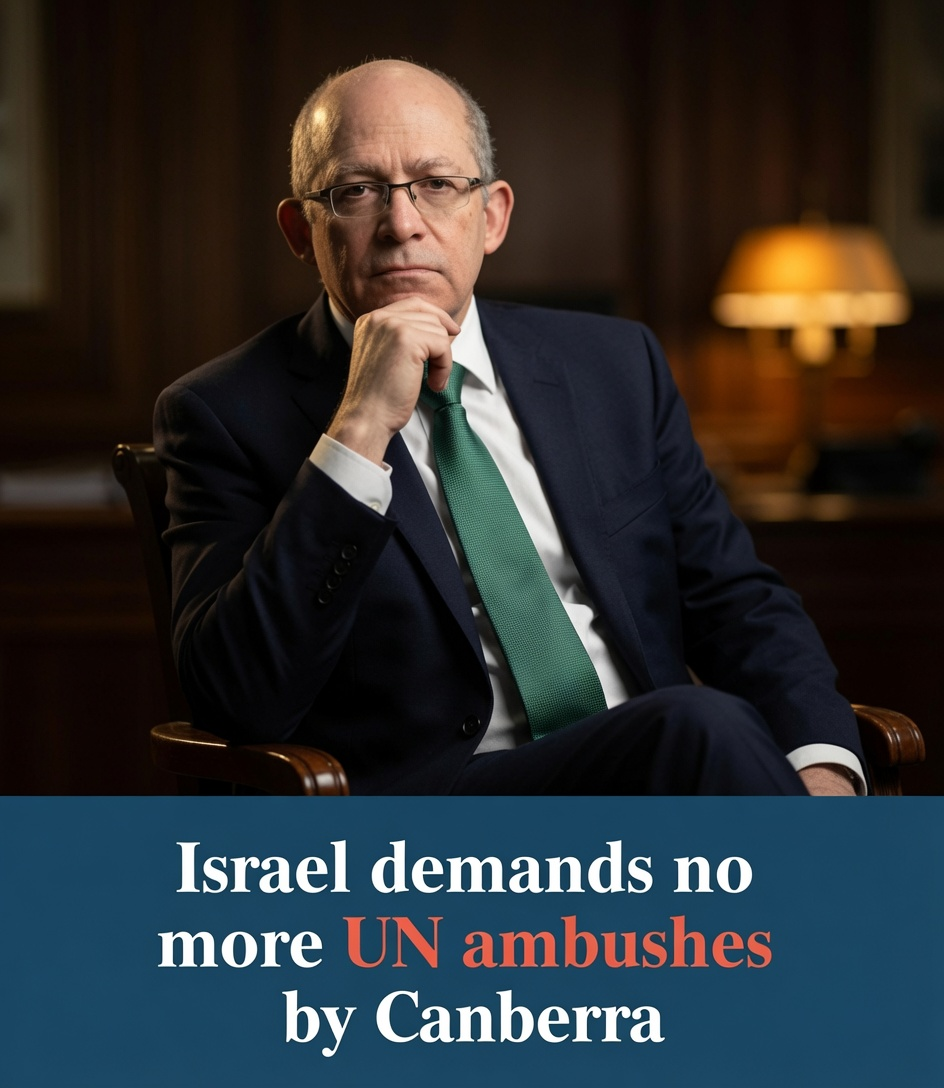
Israel has publicly urged Australia to take what it describes as a more balanced approach to the Israeli–Palestinian conflict, warning that continued support for international measures viewed as hostile to Israel could place further strain on the diplomatic relationship between Canberra and Jerusalem.
The unusually direct intervention came after the Australian Labor Party released a draft national platform ahead of its national conference in Adelaide, where delegates are expected to debate and vote on the party’s future policy positions.
In a detailed public statement, Israel’s embassy in Canberra argued that several proposed policy changes place disproportionate responsibility for the conflict on Israel while giving insufficient attention to the actions of Hamas, the Palestinian Authority and other Palestinian actors.
Among the concerns raised by the embassy are draft commitments opposing Israeli settlement activity in the West Bank, stronger support for proceedings before the International Criminal Court (ICC) and the International Court of Justice (ICJ), criticism of settler violence, and language relating to Israel’s military actions in Gaza. The embassy contends that these positions fail to reflect the broader security context or adequately acknowledge Hamas’ role in the ongoing conflict.
Israeli officials also argued that Australia’s repeated support for resolutions critical of Israel at the United Nations has contributed to deteriorating bilateral relations.
According to the embassy, if Australia wishes to strengthen diplomatic ties, it should adopt a more impartial voting record in international forums rather than supporting what Israel describes as one-sided initiatives against the Jewish state.
The intervention is notable because foreign governments rarely comment publicly on the internal policy platform of Australia’s governing party before it has been formally adopted.
In its statement, however, the embassy stressed that while the platform remains a draft document, it believed several elements warranted public response because they could influence Australia’s future foreign policy.
“Several elements of the draft platform risk placing responsibility for the conflict on one party while giving insufficient attention to the decisions, conduct and continuing obligations of the Palestinian leadership and terrorist organisations such as Hamas,” the embassy said.
The proposed platform significantly expands Labor’s position compared with previous versions.
In addition to reaffirming support for a two-state solution, the draft expresses opposition to what it describes as illegal Israeli settlement activity and settler violence in the occupied West Bank. It also supports international legal mechanisms examining alleged breaches of international law during the conflict.
The embassy argues that the legal status of settlements should be resolved through direct negotiations between Israelis and Palestinians rather than being predetermined through international declarations. It also maintains that the ICC and ICJ have demonstrated institutional bias against Israel and should not be treated as impartial arbiters of the conflict.
The latest disagreement comes against the backdrop of increasingly strained relations between the Albanese Government and Israeli Prime Minister Benjamin Netanyahu’s administration.
Australia formally recognised the State of Palestine in 2025 alongside several other Western nations, while repeatedly calling for an immediate ceasefire, expanded humanitarian assistance into Gaza and renewed efforts towards a negotiated two-state solution.
Israeli leaders criticised those decisions, arguing they rewarded Hamas following the October 2023 terrorist attacks and reduced incentives for negotiated peace.
The draft Labor platform has also generated debate within Australia.
Jewish organisations and supporters of Israel have expressed concern that the proposed wording softens previous expectations that Hamas be disarmed and that the Palestinian Authority undertake governance reforms before Palestinian statehood advances further.
Some Labor members and pro-Palestinian advocacy groups, however, argue the revised language more accurately reflects Australia’s obligations under international law and the humanitarian consequences of the conflict in Gaza.
Foreign Minister Penny Wong has sought to distinguish between the party’s internal policy discussions and the government’s official foreign policy.
She has reiterated that Australia continues to support a negotiated two-state solution, recognises Israel’s right to exist in peace and security, condemns Hamas’ terrorist attacks, and supports the protection of civilians in accordance with international humanitarian law.
Under Australia’s system of government, party platforms provide guidance for future policy but do not automatically become government policy. Decisions on foreign affairs remain the responsibility of Cabinet and ministers, although party platforms often influence long-term policy direction.
The current debate therefore carries political significance even though the platform has not yet been formally adopted.
Australia and Israel have maintained diplomatic relations since 1949 and cooperate across a wide range of areas, including trade, scientific research, education, defence technology and intelligence sharing.
Despite periodic disagreements over Middle East policy, successive Australian governments from both major parties have generally supported Israel’s security while also backing the long-standing international objective of achieving a negotiated two-state solution.
In recent years, however, Australia’s voting record at the United Nations has shifted on some resolutions concerning the Israeli–Palestinian conflict, drawing criticism from Israeli officials while earning support from countries advocating greater international scrutiny of Israeli policies in the occupied Palestinian territories.
The Israeli embassy has also linked broader diplomatic tensions to rising concerns about antisemitism within Australia, arguing that political rhetoric surrounding the conflict can have domestic consequences for Jewish communities.
Australian governments have consistently condemned antisemitism as well as Islamophobia and have called for respectful public debate as conflict in the Middle East continues to affect community relations at home.
Labor delegates are expected to consider the draft platform during the party’s national conference later this week.
Whether amendments are adopted remains uncertain, but the outcome will be closely watched not only within Australian politics but also by foreign governments seeking to understand the future direction of Canberra’s Middle East policy.
For Israel, the current dispute is about more than individual policy proposals. It reflects broader concerns that Australia’s diplomatic position has shifted away from what Jerusalem considers a historically balanced relationship.
For the Albanese Government, meanwhile, the challenge remains balancing Australia’s long-standing support for Israel’s security with its commitment to international law, humanitarian principles and a negotiated resolution to one of the world’s most enduring conflicts.






