Prime Minister Anthony Albanese has reignited his long-running political battle with One Nation leader Pauline Hanson, arguing that Australia’s multicultural identity and strong diplomatic relationships across Asia are strategic assets that become especially important during periods of international instability.
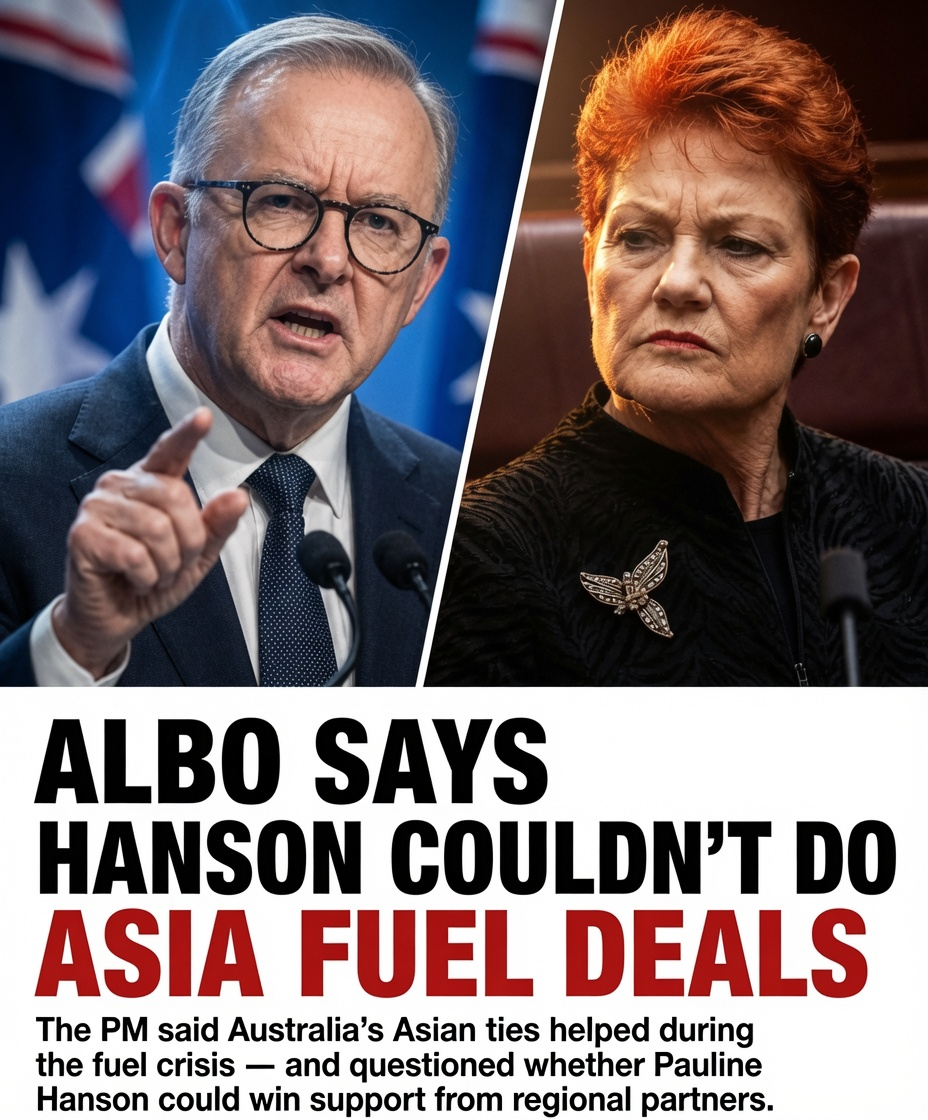
Speaking during the Western Sydney Leadership Dialogue Airport City Summit on 3 July, Mr Albanese linked Australia’s recent fuel security challenges to its ability to work closely with neighbouring countries, before questioning whether Senator Hanson could successfully negotiate with the same regional partners if placed in a similar position.
The remarks immediately injected foreign policy into Australia’s domestic political debate, with the Prime Minister suggesting that previous comments made by Hanson about multiculturalism and Asian communities could undermine Australia’s credibility during sensitive international negotiations.
While Labor argues the comments highlight the practical importance of diplomacy and regional trust, supporters of One Nation are likely to view them as another politically motivated attack aimed at discrediting the minor party ahead of future parliamentary contests.
Addressing business and community leaders in Western Sydney, Albanese praised Australia’s diverse population as one of the country’s greatest economic and diplomatic strengths.
He argued that diaspora communities create valuable commercial and cultural links throughout Asia, making it easier for Australia to build partnerships and respond when international crises threaten vital supply chains.
The Prime Minister referred to the recent overseas conflict that disrupted global fuel markets and created uncertainty around supplies of jet fuel and other petroleum products entering Australia.
According to Albanese, those relationships became particularly valuable as the government worked with regional partners to maintain supplies during a period of heightened geopolitical tension.
He then turned his attention to the political opposition.
Questioning whether Pauline Hanson or what he described as the “chaotic conglomeration” opposing Labor could successfully approach governments including Singapore, Malaysia, Brunei, China, Japan and South Korea for assistance, Albanese said he believed many leaders in those countries would remember previous remarks Hanson had made about them.
The comments represent one of the Prime Minister’s strongest personal criticisms of the One Nation leader since the federal election and continue Labor’s broader argument that Australia’s international reputation is closely connected to domestic political rhetoric.
The exchange also reflects the government’s effort to frame multiculturalism not simply as a social policy but as an economic and strategic advantage.
Throughout his address, Albanese argued Australia’s diverse communities strengthen trade, investment and diplomatic engagement by providing cultural understanding and personal connections across the Indo-Pacific region.
Fuel security has become an increasingly prominent issue following months of instability in global energy markets.
Australia remains heavily dependent on imported refined fuels, making uninterrupted shipping routes and reliable regional partnerships critical during periods of international conflict.
In recent months the Albanese Government has implemented a National Fuel Security Plan while negotiating additional supply arrangements and extending temporary fuel excise relief as global uncertainty affected energy markets.
Government officials have repeatedly argued that maintaining close relationships with neighbouring countries forms part of Australia’s broader resilience strategy.
Singapore, in particular, plays an important role as one of the region’s major refining and fuel distribution hubs, while Japan and South Korea remain significant economic and strategic partners.
Trade Minister Don Farrell previously said Australia had worked closely with Singapore and other regional partners to strengthen fuel supply arrangements during the recent crisis.
Labor contends that these partnerships demonstrate why diplomacy, international engagement and mutual trust remain essential components of national security alongside military capability and domestic infrastructure.
The Prime Minister used Western Sydney itself as an example of Australia’s multicultural success, pointing to communities with heritage spanning every region of the world.
He argued these connections help Australian businesses expand overseas while also improving government-to-government relationships during difficult periods.
During the summit discussion, Albanese also referenced Australia’s national football team as an example of modern multicultural Australia, saying people from different cultural backgrounds collectively represent the country on the world stage.
For One Nation supporters, however, the Prime Minister’s comments are likely to reinforce concerns that Labor frequently seeks to portray the party as beyond the political mainstream.
Pauline Hanson has built much of her political career around calls for tighter immigration controls, stronger border security and greater emphasis on what she describes as Australian cultural values.
She has also remained a vocal critic of aspects of multiculturalism, positions that have generated both strong support among parts of the electorate and sustained criticism from opponents over many years.
Those earlier comments have frequently resurfaced during political debates involving Australia’s relationships with Asian nations and migrant communities.
Critics argue they risk damaging Australia’s international reputation, while Hanson and her supporters maintain they simply reflect legitimate concerns about national identity, immigration policy and social cohesion.
The Prime Minister’s latest remarks place those longstanding disagreements back at the centre of public debate.
They also arrive during a period when questions surrounding Australia’s resilience have extended beyond traditional defence issues to include supply chains, energy security and economic partnerships throughout the Indo-Pacific.
Australia’s reliance on imported fuel has long been identified as a strategic vulnerability by defence analysts and successive governments.
While domestic production contributes to national supply, a significant proportion of refined petroleum products still arrives via international shipping networks, making cooperation with regional partners especially important during disruptions.
The Albanese Government has sought to increase national fuel resilience through additional stockholdings, new financing arrangements and closer cooperation with industry while encouraging Australians to avoid unnecessary fuel purchases during periods of heightened uncertainty.
Whether the Prime Minister’s criticism of Hanson resonates politically is likely to depend on how voters interpret the broader issue.
Supporters of Labor may see the comments as highlighting an unavoidable reality of international diplomacy—that successful negotiations depend upon trust, credibility and long-term relationships.
Supporters of One Nation, meanwhile, may argue Albanese was using a national security discussion to score partisan political points rather than engaging with substantive policy differences.
The exchange illustrates how Australia’s debates over immigration, multiculturalism and national identity increasingly intersect with questions of economic resilience and foreign policy.
Rather than remaining separate issues, they are becoming intertwined as governments seek to navigate a rapidly changing strategic environment across the Indo-Pacific.
For now, the Prime Minister’s remarks have added another chapter to the long-running political rivalry between Labor and One Nation, while also highlighting the central role that Australia’s regional relationships continue to play in everything from trade and investment to fuel security and national resilience.






