A 15-year-old Muslim student from Brisbane has offered a deeply personal account of her meeting with One Nation leader Pauline Hanson, saying she never expected to change the senator’s political views but hoped to achieve something she believed was equally important — to be seen as a person before being judged by appearances.
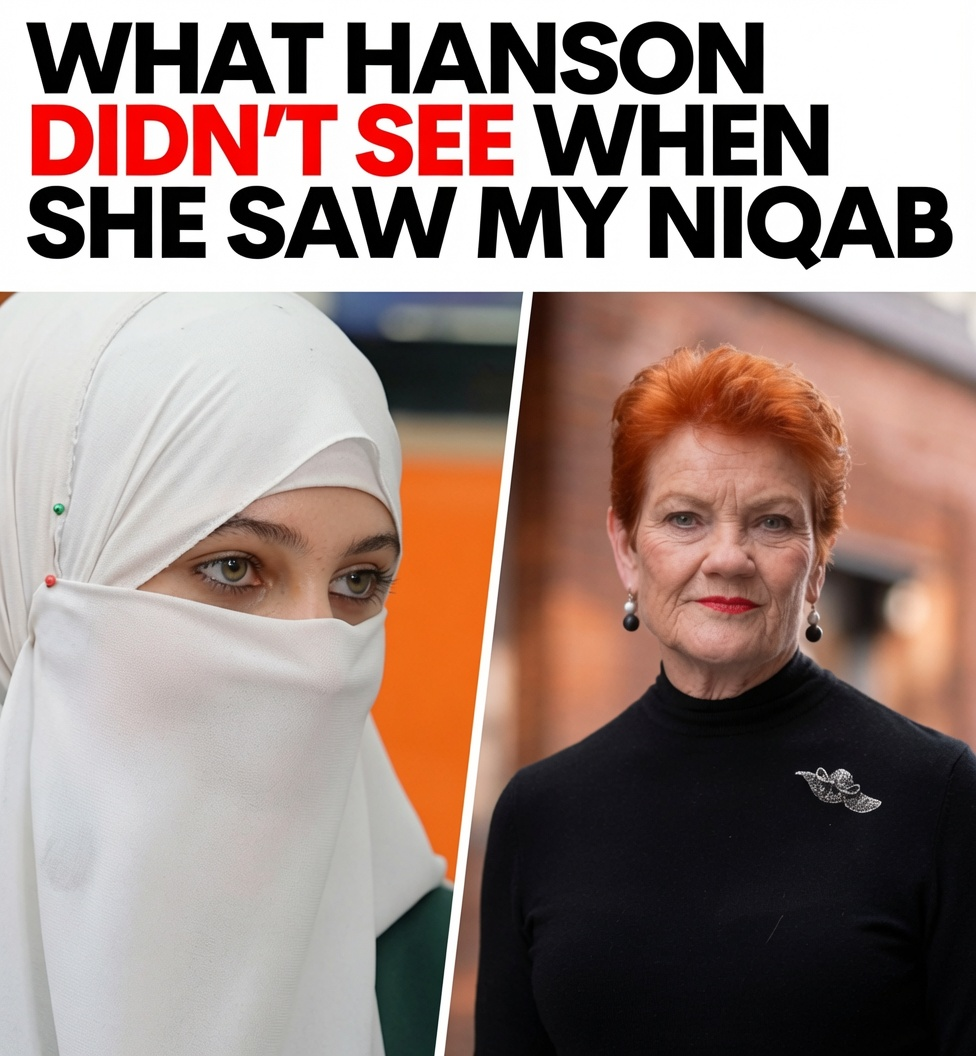
Writing after the encounter, Nabiha, a Year 10 student at the Islamic College of Brisbane, described the conversation as a rare opportunity for two Australians with very different backgrounds to speak directly to one another rather than through political debate or media commentary.
Her reflections come as immigration, multiculturalism and religious identity continue to dominate political discussion across Australia, with Pauline Hanson remaining one of the country’s most outspoken critics of high immigration and certain expressions of religious and cultural identity.
Rather than focusing on the political disagreements that emerged during the discussion, Nabiha said the meeting reminded her of the importance of genuine human interaction.
She recalled her first impression of Hanson as someone who appeared tense before the conversation had even begun, leading her to wonder whether the senator had already formed conclusions about the people she was about to meet.
Despite recognising the significant differences in their views, the student said she remained grateful for the opportunity.
She noted that while most Australians know who Pauline Hanson is, very few young Muslim Australians have the chance to sit across the table from her and engage in a respectful, face-to-face conversation.
For Nabiha, the experience was never about trying to persuade Hanson to abandon her political beliefs.
Instead, she said her goal was much simpler.
She wanted the senator to meet her as an individual before forming judgments based solely on outward appearance.
That desire became particularly significant when the discussion turned to the niqab she wears.
Nabiha acknowledged that the face covering is often the first thing people notice about her. However, she argued that it represents only one small part of her identity and says little about her ambitions, interests or contributions to Australian society.
Beyond her faith, she describes herself as an ordinary Australian student whose daily life revolves around schoolwork, preparing for examinations, working with classmates and planning for the future.
She also has a passion for science and technology.
Nabiha explained that robotics has become one of her greatest interests, leading her to participate in competitions across Queensland and other parts of Australia.
Through those events she has developed skills in engineering, programming and collaborative problem-solving while working alongside students from diverse cultural and religious backgrounds.
More recently, she was selected to participate in ShakthiSAT, an international initiative bringing together approximately 1,200 girls from around the world to collaborate on the development and eventual launch of a satellite.
For Nabiha, experiences like these have reinforced a simple belief.
Scientific research, engineering and innovation evaluate people according to their ideas, preparation and willingness to contribute rather than their religion, ethnicity or appearance.
She argues that Australia should aspire to embrace the same principle more broadly.
In her reflections, Nabiha suggested that Muslim women frequently become subjects of political discussion without being invited to participate in those conversations themselves.
She said debates about clothing, religious practice and cultural identity often lead people to make assumptions about Muslim women without taking the time to understand their individual experiences.
According to Nabiha, those assumptions overlook the complexity of people’s lives.
She describes herself not only as someone who wears a niqab, but also as a student fascinated by technology, someone hoping to contribute to Australia’s future through science and innovation, and a young Australian who is proud of both her faith and her country.
She rejects the suggestion that those identities are incompatible.
Instead, she believes her religious beliefs and her Australian identity complement one another rather than existing in conflict.
The account offers a perspective rarely heard in Australia’s broader political debates surrounding multiculturalism.
For decades, questions relating to immigration, religious expression and cultural integration have generated strong opinions across the political spectrum.
One Nation has consistently advocated for lower immigration levels, stronger cultural integration and restrictions on face coverings in certain public settings. Pauline Hanson has previously argued that visible expressions of religious identity can present challenges for social cohesion and national security, positions that have attracted both support and criticism.
Supporters of Hanson’s views argue that open debate about immigration and integration is essential for maintaining social cohesion and ensuring newcomers embrace Australia’s democratic values and institutions.
Critics, however, contend that broad political rhetoric can unintentionally reinforce stereotypes affecting Australians who have lived their entire lives within the country and actively contribute to their communities.
Nabiha’s reflections do not attempt to resolve those wider policy disagreements.
Instead, they focus on the importance of personal interaction in challenging assumptions.
She wrote that it is easy to fear or misunderstand people who remain strangers, but much harder to reduce someone to a stereotype after sharing a conversation and hearing their personal story.
The student acknowledged she does not know whether the meeting changed Hanson’s opinions.
Only the senator herself could answer that question, she wrote.
Nevertheless, Nabiha expressed hope that, even briefly, Hanson saw more than a religious garment.
She hoped the senator instead recognised a young Australian with ambitions extending far beyond politics — someone passionate about robotics, fascinated by space exploration and determined to contribute positively to Australia’s future through science and innovation.
Her reflections also highlight the growing participation of young Muslim Australians in science, technology, engineering and mathematics (STEM) education.
Across Australia, schools, universities and industry organisations have invested in programs encouraging greater participation by girls and students from diverse backgrounds in STEM disciplines, recognising both the economic importance of developing technical skills and the value of broadening participation in innovation.
Educational initiatives increasingly seek to demonstrate that scientific achievement is not limited by gender, ethnicity or religious background, but depends instead on curiosity, creativity and sustained effort.
Nabiha’s own experience reflects that broader trend.
By describing her interests in robotics, engineering and satellite technology alongside her religious identity, she presents an example of how multiple aspects of personal identity can coexist without contradiction.
Ultimately, her reflections are less about politics than about human connection.
Rather than asking readers to agree with any particular policy position, she argues for something more fundamental: the willingness to look beyond first impressions and recognise the individual behind the label.
Whether or not her meeting with Pauline Hanson altered anyone’s political views, Nabiha believes it demonstrated the value of respectful conversation between people whose experiences, beliefs and perspectives may differ dramatically.
In a political climate often shaped by slogans and social media exchanges, her account suggests that genuine face-to-face dialogue can sometimes achieve something public debate alone cannot — allowing people to see one another as individuals before reducing one another to symbols.






