Australia’s debate over artificial intelligence has expanded beyond technology and into one of the country’s most contentious policy battles: how to generate enough electricity to power the next generation of AI infrastructure.
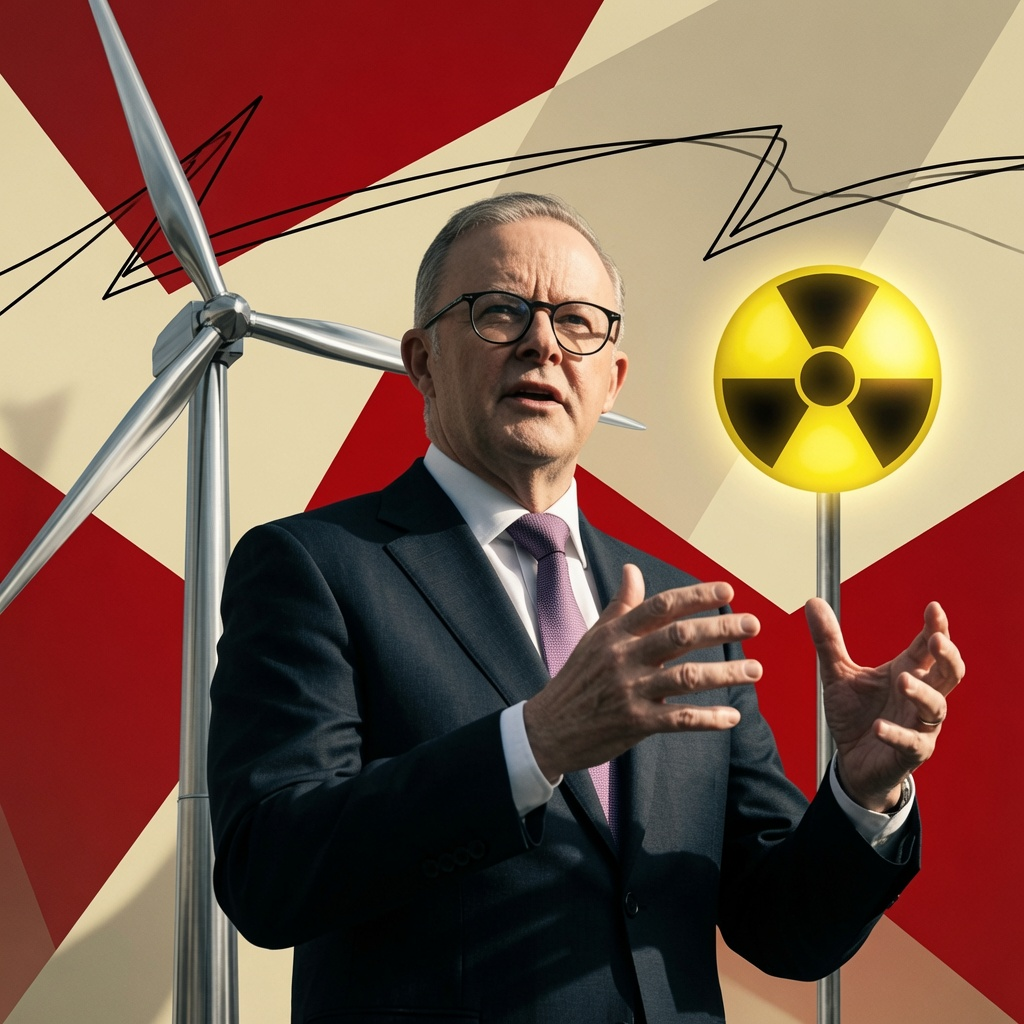
The Albanese Government has rejected suggestions that nuclear power will play any role in supplying Australia’s rapidly expanding data centre sector, insisting that major technology companies investing locally are instead planning projects built around renewable energy.
The comments come despite some of the world’s largest technology companies—including Amazon, Microsoft, Google and Meta—actively investing in nuclear energy projects in the United States as AI dramatically increases electricity demand.
Speaking on Sky News Sunday Agenda, Assistant Minister for Science, Technology and the Digital Economy Andrew Charlton said there were currently no proposals from major data centre operators seeking nuclear power in Australia.
“There are no proposals from these large data centre operators for nuclear power,” Mr Charlton said.
Instead, he argued developers were planning facilities powered through combinations of solar, wind and firming technologies capable of providing reliable electricity.
“They are all putting proposals based on renewables, a range of solar and wind.”
Mr Charlton dismissed claims that Australia’s AI ambitions required nuclear generation, arguing the discussion should remain focused on actual investment proposals rather than hypothetical projects.
“There are no proposals, no suggestions for nuclear energy,” he said.
“I’d rather talk about commercial reality rather than commercial irrelevancy.
“These nuclear proposals do not exist. All of the data centres that are coming in are proposing to do firmed renewables that will meet their energy needs.”
The remarks reinforce the Albanese Government’s broader AI strategy unveiled this week, which combines support for AI investment with new national standards governing the construction and operation of large data centres.
Under the new framework, Australia will establish an Office of AI inside the Department of the Prime Minister and Cabinet to coordinate AI policy across government. Large data centres will also face mandatory requirements covering electricity supply, water efficiency, grid impacts and infrastructure costs. The government says future facilities will need to underwrite new electricity generation, pay their own connection costs and avoid pushing higher energy prices onto households. Legislation is expected to follow after consideration by National Cabinet.
The energy question has become increasingly significant because AI infrastructure consumes enormous amounts of electricity.
According to Mr Charlton, Australian data centres currently account for around two per cent of national electricity consumption, but demand could triple within the next decade as artificial intelligence becomes embedded throughout the economy.
International forecasts similarly expect global electricity consumption from data centres to approximately double by 2030 as AI systems become larger and more computationally intensive.
This explosive growth has forced governments and technology companies worldwide to reconsider how reliable, low-emissions electricity can be delivered around the clock.
Unlike conventional commercial buildings, hyperscale data centres operate continuously and cannot tolerate extended power interruptions.
That requirement has helped drive renewed interest overseas in nuclear generation alongside natural gas, geothermal energy and advanced battery technologies.
In the United States, several of the world’s largest technology companies have already signed agreements supporting nuclear energy.
Amazon, Microsoft, Google and Meta have each announced partnerships involving existing reactors, advanced nuclear technologies or small modular reactor development as they seek secure, long-term electricity supplies for expanding AI operations.
The United States Department of Energy has argued nuclear generation is particularly well suited to hyperscale computing because of its ability to provide continuous electricity capable of meeting the extremely high reliability standards required by modern data centres.
Those developments have become central to Australia’s domestic political debate.
Deputy Liberal leader Jane Hume argued the government’s position ignores the direction being taken internationally by the same companies now investing billions of dollars into artificial intelligence.
She said major hyperscale operators overseas were increasingly embracing advanced nuclear technologies, including small modular reactors.
“Hyperscalers like Amazon and Meta and Google are setting up overseas, but using small modular nuclear reactors and even micro modular nuclear reactors,” Ms Hume said.
“Now, they’re not even allowed to do that here because there’s a moratorium on nuclear.
“Of course, the Coalition would like that moratorium lifted so that we can bring more energy into the grid.”
The Coalition has consistently argued nuclear generation should become part of Australia’s long-term electricity mix, particularly as demand from industry, electrification and artificial intelligence continues growing.
Labor maintains renewable energy supported by storage, transmission upgrades and other firming technologies can deliver reliable electricity without introducing nuclear power.
The disagreement reflects broader differences between the major parties over Australia’s future energy system rather than simply AI policy.
Despite those political divisions, Australia remains one of the world’s most attractive destinations for new data centre investment.
Industry rankings placed Australia second globally behind only the United States for data centre investment attractiveness in 2024, reflecting its political stability, legal system, skilled workforce and close strategic relationship with major Western allies.
Australia’s membership of the Five Eyes intelligence partnership with the United States, United Kingdom, Canada and New Zealand has also strengthened confidence among global cloud providers handling sensitive government and enterprise information.
Successive Australian governments have actively promoted additional investment in digital infrastructure as cloud computing and AI become increasingly important across the economy.
Prime Minister Anthony Albanese has personally promoted Australia as an AI investment destination during visits to the United States while the government has negotiated agreements with major technology companies including Microsoft and Anthropic to support AI development under Australian regulatory settings.
However, enthusiasm for attracting investment has been accompanied by growing scrutiny over the environmental and infrastructure consequences of large-scale AI expansion.
Modern hyperscale data centres require vast quantities of electricity, extensive cooling systems and suitable industrial land, prompting concerns about pressure on electricity networks, water resources and surrounding communities.
The government’s new AI framework attempts to address those concerns by requiring future projects to contribute directly to new energy infrastructure rather than relying solely on existing generation capacity.
National standards are also expected to cover water efficiency and site selection while preserving land needed for housing development.
Alongside infrastructure reforms, the Albanese Government has introduced broader AI governance measures covering copyright protection and national standards for artificial intelligence.
The framework rejects proposals that would have allowed AI developers broader exemptions to use copyrighted Australian material for training large language models without permission.
Instead, the government says Australian creators should retain control over how their work is used by AI systems while establishing nationally consistent standards governing AI deployment.
The Office of AI will coordinate implementation across government agencies as Australia seeks to balance investment, innovation, public confidence and national security.
Beyond energy policy, experts continue debating wider implications of AI including cybersecurity, workforce disruption, productivity gains and sovereign technological capability.
Rapid advances in generative AI have intensified concerns over future white-collar employment while also creating new opportunities across research, healthcare, manufacturing, education and professional services.
For Australia, the immediate challenge lies in ensuring sufficient infrastructure exists to support that transformation without undermining electricity reliability or significantly increasing costs for households and businesses.
Whether renewable generation alone can satisfy those demands—or whether future governments eventually reconsider Australia’s longstanding prohibition on nuclear power—appears likely to remain one of the country’s defining technology and energy policy debates.






