Denmark is preparing to extend its ban on full-face Islamic veils into schools and universities, with Prime Minister Mette Frederiksen arguing that educational institutions should prioritise democratic values over religious customs as the country continues its long-running campaign against what it describes as “parallel societies”.
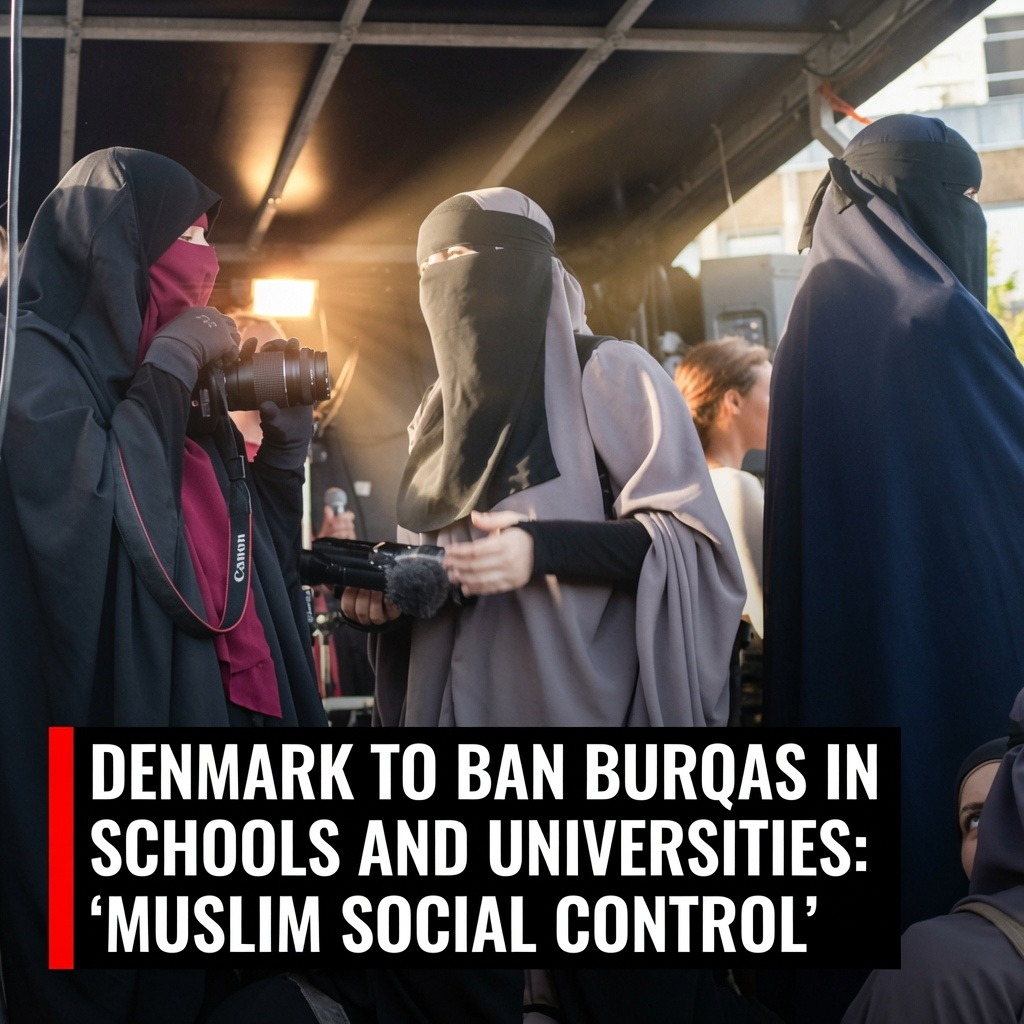
The proposal would broaden Denmark’s existing restrictions on face-covering garments such as the burqa and niqab, which have already been prohibited in most public spaces since 2018. If approved, students would also be prevented from wearing the garments in schools, colleges and universities.
Speaking to Danish media, Ms Frederiksen said educational institutions should remain places where students participate equally in learning rather than environments where religious or cultural pressures shape behaviour.
“There are gaps in the legislation that allow Muslim social control and oppression of women at educational institutions in Denmark,” the Prime Minister said.
She added that while individuals are free to practise their religion, democratic principles must take precedence within public education.
“You have the right to be a person of faith and practise your religion, but democracy takes precedence.”
“You’re welcome to have your religion, but when you’re at school, you’re there to be at school and take part in your education.”
The Danish Immigration and Integration Ministry confirmed that legislation will be introduced as part of a broader package aimed at strengthening efforts against what the government calls “parallel societies” and “negative social control”. The measures are expected to be debated in parliament later this year.
The proposal follows recommendations from the Commission for the Forgotten Women’s Struggle, which argued that stronger measures are needed to protect women and girls from coercive social practices within some minority communities.
Denmark first introduced its nationwide face-covering ban in 2018 after years of political debate. The legislation prohibits garments that conceal the face in public places, including burqas and niqabs, while allowing exemptions for weather conditions, health reasons, occupational safety and traditional costumes.
Repeat breaches of the law can attract fines of up to 10,000 Danish kroner.
Although the original legislation covered public streets, transport and government buildings, schools and universities were not explicitly included, creating what Ms Frederiksen now describes as an unintended loophole.
Beyond extending the veil ban, the Prime Minister has also called for prayer rooms to disappear from Danish educational institutions.
Rather than seeking a formal legal prohibition, she has asked Education Minister Mattias Tesfaye and Higher Education Minister Christina Egelund to work with schools and universities to phase them out voluntarily.
According to Ms Frederiksen, dedicated prayer facilities can become places where students experience religious pressure rather than inclusion.
She argued that such spaces risk becoming a breeding ground for discrimination and social control instead of promoting equal participation in campus life.
The latest announcement forms part of a much broader shift in Danish immigration policy that has developed over the past decade.
Despite leading a centre-left Social Democratic government, Ms Frederiksen has adopted some of Europe’s toughest immigration and integration policies, arguing that generous welfare systems depend upon successful integration and shared democratic values.
The government has repeatedly maintained that immigration policy is not solely about border control but also about preserving social cohesion.
One of Denmark’s most controversial initiatives has been its legislation targeting so-called “parallel societies”.
Under Danish law, neighbourhoods where more than half of residents are classified as having non-Western backgrounds and where social indicators such as unemployment, low education levels or crime exceed national thresholds may be designated as parallel societies.
Authorities are then given powers to reduce concentrations of public housing, alter tenancy arrangements and introduce additional integration measures.
Supporters argue the policy prevents long-term segregation, while critics contend it disproportionately targets immigrant communities.
Several legal challenges alleging racial discrimination remain before the courts.
The government’s latest proposal continues this broader philosophy by seeking to reduce what ministers describe as visible symbols of social separation inside educational institutions.
The move also follows recent comments by Danish Immigration Minister Morten Bødskov, who announced plans to prohibit the Muslim call to prayer from loudspeakers on mosques.
Mr Bødskov argued that Islam was occupying too much public space and said amplified calls to prayer should not become a normal feature of Danish cities.
He stated that Denmark should not resemble countries where public religious broadcasting dominates neighbourhood life, saying such practices had no place in Denmark’s public sphere.
Those comments sparked renewed debate over the balance between religious freedom and national identity.
Supporters of the government’s approach argue that Denmark has every right to define the cultural norms governing public institutions.
They contend that educational settings should encourage open interaction between students and teachers, something they believe is incompatible with full-face coverings that obscure facial expressions and communication.
Critics, however, argue that expanding clothing restrictions risks limiting personal freedoms without addressing the underlying causes of social isolation.
Human rights organisations, including Amnesty International, have previously criticised Denmark’s face-covering ban, arguing that women should retain the right to choose how they dress and express their religious beliefs.
Opponents also argue that relatively few women in Denmark wear the burqa or niqab, meaning the practical impact of the proposed expansion could be limited while its symbolic significance remains substantial.
The debate reflects wider trends across Europe, where governments have adopted varying approaches to religious dress in public life.
France implemented one of Europe’s earliest nationwide bans on face-covering veils in public places in 2011.
Belgium followed with similar restrictions, while Austria and Switzerland have also introduced bans covering various public settings.
Norway, meanwhile, prohibited face coverings in educational institutions in 2018, making Denmark’s latest proposal consistent with policies already operating elsewhere in the Nordic region.
European governments have generally justified such measures on grounds including security, communication, gender equality and social integration, while opponents continue to argue they disproportionately affect a very small number of Muslim women.
The issue remains politically sensitive because it sits at the intersection of religious liberty, women’s rights, multiculturalism and immigration policy.
For Denmark’s Social Democratic government, the proposal also illustrates how immigration has reshaped traditional political divisions.
While centre-left parties in many European countries have historically defended multicultural policies, Denmark’s Social Democrats have increasingly embraced stricter immigration controls in response to sustained public concern over integration.
That strategy has helped distinguish Denmark from several neighbouring countries by combining relatively generous welfare policies with firm expectations regarding cultural integration.
The government argues that newcomers should enjoy full religious freedom while also accepting that public institutions operate according to democratic norms rather than religious customs.
Whether parliament ultimately approves the latest proposal remains to be seen, but the announcement signals that Denmark intends to continue tightening its integration policies as debate over immigration, identity and social cohesion continues across Europe.






