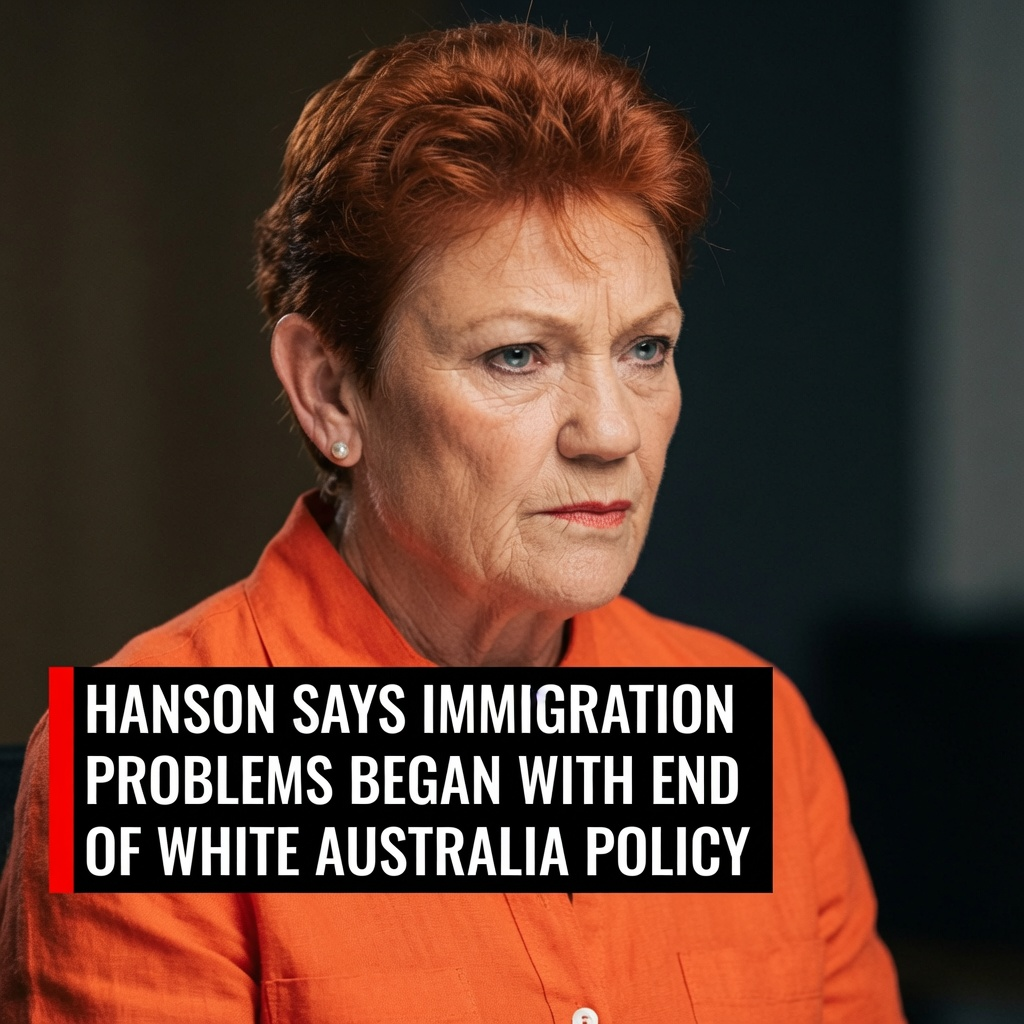
One Nation leader Pauline Hanson has sparked fresh political controversy after linking Australia’s modern immigration challenges to the abolition of the White Australia Policy, while also alleging that fraud within the National Disability Insurance Scheme (NDIS) is particularly prevalent in some Muslim-majority communities.
The comments were made during an hour-long podcast recorded in Britain with far-right activist Tommy Robinson, whose real name is Stephen Yaxley-Lennon. The interview was filmed during Hanson’s recent UK visit and has since triggered criticism from political opponents, renewed scrutiny of her immigration platform and another debate about Australia’s multicultural identity.
During the discussion, Robinson questioned Hanson about Australia’s changing population and asked how communities from Pakistan, Somalia and other countries had become established despite what he described as Australia’s historically strong immigration controls.
Hanson replied that the turning point came after 1973, when the Whitlam government removed the remaining elements of the White Australia Policy.
“Well it started in 1973 … they opened up and got rid of the White Australian Policy then they started bringing in the different migrants,” she said.
She contrasted post-war European migrants with more recent arrivals, arguing that earlier generations from countries including Italy, Germany and Poland had integrated by learning English, finding work and assimilating into Australian society.
According to Hanson, many of those migrants arrived with very little but built successful lives without relying heavily on government assistance.
She then claimed that Australia’s migration profile had shifted over subsequent decades, alleging that some newer arrivals came primarily to access Australia’s welfare system or benefits available through the NDIS.
The White Australia Policy itself refers to a collection of immigration laws introduced following Federation in 1901 that were designed to restrict non-European migration. The policy was progressively dismantled after World War II before the Whitlam Government formally removed its remaining discriminatory provisions in 1973 as Australia moved towards an official multicultural immigration framework.
The exchange became even more contentious when Robinson asked whether data existed showing the nationality or religion of people allegedly abusing the NDIS.
Hanson responded that while Australians from many backgrounds committed fraud, she believed abuse was particularly noticeable in some Muslim communities.
“A lot of them are ripping the system off… a lot from the Muslim areas,” she said, before adding that she was “not just going to pick them out” because Australians from other backgrounds were also involved.
She further claimed that it was “quite known” that certain Muslim-majority neighbourhoods had unusually high numbers of people accessing the scheme.
The National Disability Insurance Scheme, introduced in 2013, provides funding for Australians living with permanent and significant disabilities. It has expanded rapidly over the past decade and now supports hundreds of thousands of participants while costing taxpayers more than $50 billion annually.
As the scheme has grown, governments of both political persuasions have increased efforts to combat fraud, organised crime infiltration and unethical provider behaviour.
Investigations over recent years have uncovered criminal syndicates exploiting weaknesses in the system through false invoicing, fake participants, forged documentation, inflated claims and money laundering operations.
Authorities have conducted numerous raids across several states, with organised crime groups among those accused of targeting the scheme. However, officials have consistently warned that fraud occurs across diverse communities and business sectors rather than being attributable to any single religious or ethnic group.
Health and NDIS Minister Mark Butler rejected Hanson’s broader claims, saying he had never received advice suggesting particular religions or nationalities were disproportionately represented among people committing NDIS fraud.
His response reflects the government’s position that while fraud remains a serious issue requiring tougher enforcement, allegations targeting entire communities require supporting evidence.
The debate comes as the federal government continues implementing reforms intended to improve oversight of NDIS providers, strengthen compliance powers and reduce organised exploitation of the scheme. Parliamentary inquiries have recently examined additional measures including stronger whistleblower protections, enhanced auditing and tougher penalties for fraudulent operators.
Hanson’s interview also extended beyond immigration and disability policy.
She revealed she had developed a friendship with former prime minister Tony Abbott and suggested her daughter, Lee Hanson, could eventually become leader of One Nation if she earned the support of party members.
The comments have fuelled renewed discussion about succession planning within the party, which remains closely associated with its founder nearly three decades after entering federal politics.
Perhaps equally controversial was Hanson’s decision to appear alongside Tommy Robinson.
Robinson is one of Britain’s most polarising political figures and has accumulated a lengthy criminal record that includes convictions for assault, fraud, harassment, contempt of court and other offences over many years. He has become internationally recognised for his campaigns against Islamic extremism and immigration but is also widely criticised for inflammatory rhetoric and associations with the far right.
Hanson has defended meeting Robinson, arguing that understanding social issues overseas can help inform debates about Australia’s future migration policies.
Her visit to Robinson’s hometown of Luton featured in promotional material for an upcoming television documentary, where she suggested the city demonstrated what Australia should avoid becoming if migration policies were not tightened.
Political opponents, however, have argued that Robinson’s criminal history and extremist reputation undermine the credibility of any association.
Criticism came from across the political spectrum, with Labor ministers and Greens representatives accusing Hanson of promoting divisive narratives about migrants and Muslims without substantiating her claims.
The controversy arrives during a period when immigration has once again become one of Australia’s defining political issues.
Strong population growth following the pandemic, housing affordability pressures, infrastructure demand and concerns about public services have intensified debate over migration levels.
Major parties continue to differ over how quickly permanent migration should expand, while One Nation has sought to position itself as advocating significantly lower immigration and stronger assimilation requirements.
Supporters of Hanson’s approach argue Australia needs stricter border controls, tougher citizenship expectations and greater scrutiny of government spending.
Critics counter that broad claims linking crime, welfare abuse or social problems to particular communities risk unfairly stigmatising millions of law-abiding Australians and undermine social cohesion.
The interview has also revived discussion about Australia’s multicultural model, which replaced assimilation-based policies during the latter half of the twentieth century.
Successive governments have generally maintained that multiculturalism has delivered significant economic, cultural and social benefits while recognising that immigration policy, border security and integration remain legitimate areas for political debate.
For Hanson, whose political career has frequently centred on migration, national identity and cultural integration, the latest controversy reinforces themes she has promoted since entering Parliament in the 1990s.
Whether the remarks strengthen support among One Nation’s core voter base or further alienate moderate Australians remains to be seen, but they have once again placed immigration, multiculturalism and the future direction of Australia’s social policies firmly back at the centre of national political discussion.






