Australia’s richest property developer, Harry Triguboff, has again reignited one of the country’s most contentious debates, arguing that higher immigration, easier access to finance and stronger support for investors are essential if Australia’s housing market is to avoid a prolonged downturn.
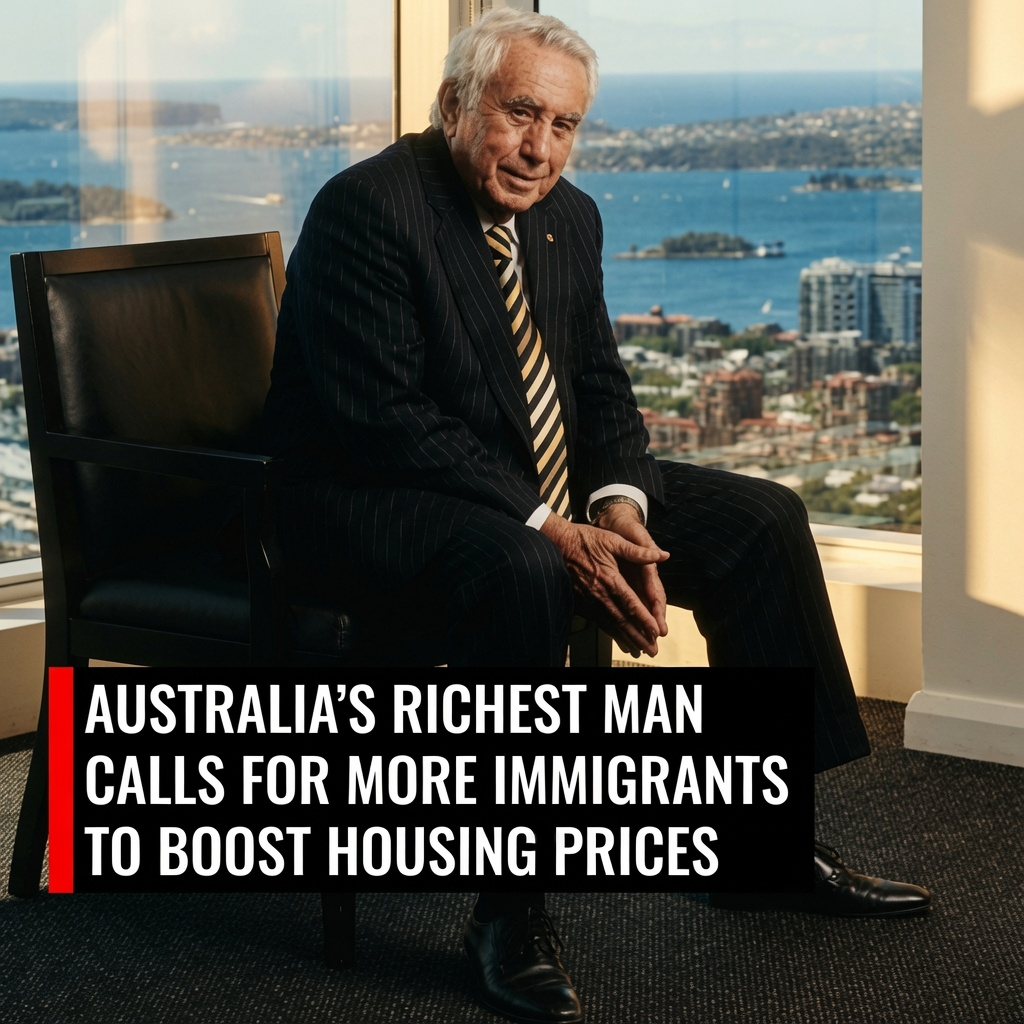
The 93-year-old founder and managing director of Meriton said Australia “needs migrants” and warned that falling property prices could have wider economic consequences if governments fail to encourage investment and new housing demand.
Speaking through comments published on Meriton’s website, Triguboff argued the country was facing what he described as a “catastrophe in real estate”, blaming restrictive lending policies, slowing property prices and policy uncertainty for weakening buyer confidence.
“This country must grow. It’s too big to be left in its present state,” he said.
“To develop we need more people but we argue who should come.”
His latest intervention comes as housing affordability, migration and housing supply remain among the most politically sensitive issues facing Australia following several years of exceptionally strong population growth.
Triguboff believes migration should form part of the solution rather than being viewed as the cause of Australia’s housing pressures.
He dismissed concerns that migrants would struggle to integrate into Australian society, arguing that newcomers have historically mixed well with local communities provided Australia continues selecting migrants carefully.
Beyond immigration, the billionaire also called for significant changes to Australia’s lending environment.
He argued many prospective buyers are delaying purchases because they expect prices to fall further, while banks have become too conservative when assessing mortgage applications.
According to Triguboff, this combination creates a dangerous cycle.
If buyers believe homes will become cheaper tomorrow, they postpone purchasing today. As demand weakens, developers slow construction, confidence falls and broader economic activity suffers.
He claimed Meriton display centres continue attracting large numbers of prospective buyers, but many ultimately choose not to commit because finance is difficult to obtain.
“The banks must give loans otherwise both the banks and the buyers go broke,” he said.
Triguboff also argued Australia should become more attractive to overseas investors, saying foreign buyers must be able to earn reasonable returns if the country expects them to continue investing in residential developments.
He pointed to previous investment waves from China and Japan, suggesting both groups ultimately experienced disappointing returns and therefore became less willing to invest in Australian projects.
His comments reflect a long-held position.
Over recent years Triguboff has repeatedly argued that Australia requires stronger population growth alongside faster planning approvals and increased housing construction.
In previous public appearances he has maintained that immigration itself is not responsible for the housing crisis, arguing instead that governments have failed to ensure enough homes are built to accommodate a growing population.
The Meriton founder has spent decades building apartment towers across Sydney, Brisbane and the Gold Coast.
His company says it has completed more than 80,000 apartments, making it Australia’s largest apartment developer. Alongside apartment sales, Meriton also owns thousands of rental properties, providing the business with recurring rental income during weaker property cycles.
That business model means the health of Australia’s residential property market is directly linked to the company’s long-term performance.
Triguboff’s latest comments therefore attracted attention not only because of his status as one of Australia’s wealthiest business figures, but also because his commercial interests are closely tied to property values and apartment demand.
The debate surrounding immigration and housing has become increasingly complex over recent years.
Australia recorded historically high levels of net overseas migration after international borders reopened following the COVID-19 pandemic, with population growth placing additional pressure on rental markets already experiencing low vacancy rates.
Many economists agree that strong migration increases demand for housing in the short term because new arrivals require somewhere to live immediately.
At the same time, migration also expands the workforce, increases consumer spending and supports economic growth.
Whether migration ultimately improves or worsens housing affordability largely depends on how quickly new homes can be delivered.
Housing experts have consistently argued that Australia’s planning systems, labour shortages, infrastructure constraints and rising construction costs have limited the pace of new housing supply.
When housing construction fails to keep up with population growth, increased competition for available homes can contribute to higher rents and elevated purchase prices.
That broader supply problem has become a central focus of housing policy across both federal and state governments.
The Albanese government has introduced a range of measures intended to accelerate housing delivery while working with states to increase long-term housing supply.
At the same time, governments continue facing pressure to balance economic growth with community concerns over affordability, congestion and infrastructure capacity.
Triguboff believes governments should focus less on limiting migration and more on removing barriers that prevent developers from building additional housing.
He has previously criticised lengthy planning approval processes, arguing excessive regulation slows construction and ultimately makes homes more expensive.
His latest remarks also included criticism of what he described as outdated regulations, particularly in New South Wales, while praising Queensland for taking a more practical approach to development discussions.
The property market itself has experienced mixed conditions over the past year.
Higher interest rates reduced borrowing capacity for many households, while affordability constraints have limited buyer activity across several major cities.
Although some markets have shown resilience, developers continue monitoring consumer confidence closely as financing costs remain significantly higher than during the ultra-low interest rate period earlier this decade.
For apartment developers, demand is influenced not only by owner-occupiers but also by investors seeking rental returns.
Strong rental demand has supported parts of the apartment market, although elevated construction costs continue affecting the financial viability of many new projects.
Industry groups have argued that unless more projects become commercially attractive, Australia may struggle to deliver enough housing to meet future population growth.
Critics, however, argue increasing migration before significantly expanding housing supply risks placing additional pressure on affordability.
Some economists have suggested migration settings and housing construction should be better coordinated so population growth aligns more closely with the capacity to build homes, schools, transport infrastructure and essential services.
Others note that housing affordability is influenced by multiple factors including taxation, interest rates, planning rules, land availability, infrastructure investment, labour shortages and investor behaviour rather than migration alone.
That means no single policy is widely regarded as a complete solution.
Triguboff’s latest intervention nevertheless reinforces the continuing divide over how Australia should respond to one of its biggest economic challenges.
Supporters argue sustained migration is essential for economic growth, workforce expansion and supporting an ageing population.
Opponents counter that housing supply must first increase substantially before population growth accelerates further.
As governments continue searching for policies capable of improving affordability without slowing economic growth, the discussion is unlikely to fade.
For Triguboff, the answer remains straightforward: encourage investment, build more homes, approve developments faster and welcome more migrants.
Whether policymakers embrace that approach—or continue pursuing a more cautious balance between population growth and housing affordability—will remain one of Australia’s defining policy debates in the years ahead.






