Victoria’s Big Build corruption crisis has entered dangerous new territory for the Allan government, with a former senior public servant alleging officials were pressured over a subcontractor that had fallen out with the CFMEU.
The allegation is serious because it goes beyond claims of bikies, underworld figures and corrupt union officials infiltrating construction sites.
It raises a more direct question about government.
Were decisions on taxpayer-funded Victorian projects influenced by the industrial demands of a union whose construction division was later placed into administration amid extraordinary allegations of criminal infiltration and corruption?
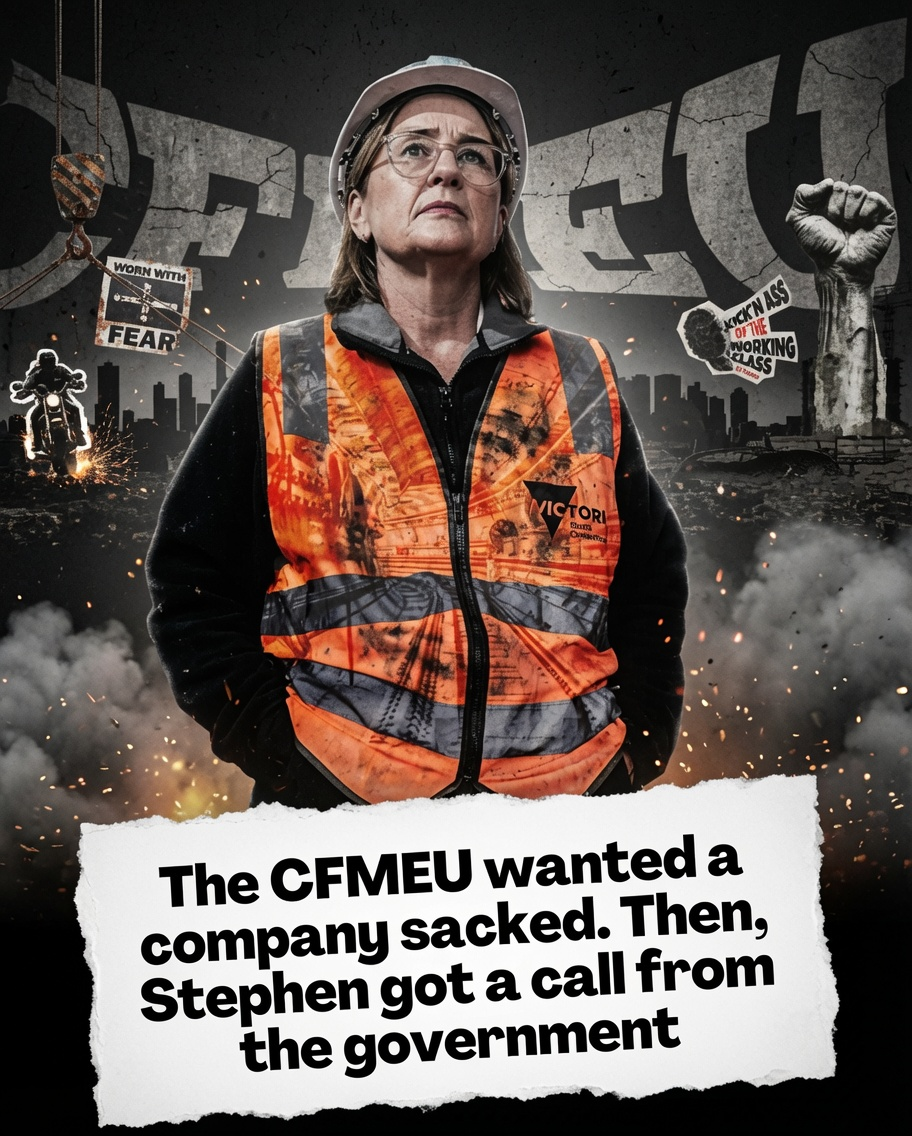
Former Victorian Health Building Authority executive director Stephen King says public servants came under pressure to remove a plastering company from the $320 million redevelopment of the Royal Victorian Eye and Ear Hospital after the contractor fell out of favour with the CFMEU.
King’s account has reportedly been supported by two other former officials.
Premier Jacinta Allan has rejected the suggestion her government directed the removal of the subcontractor and disputed the broader characterisation of events.
The allegations have not been tested by a royal commission or resulted in a judicial finding against the Premier.
But they arrive after months of increasingly disturbing revelations about Victoria’s construction industry and the state’s multibillion-dollar infrastructure program.
Former NSW corruption investigator Geoffrey Watson SC has estimated that CFMEU-linked corruption and industrial practices may have cost Victorian taxpayers as much as $15 billion.
The Victorian government strongly disputes that figure and has attacked the methodology behind it.
Watson has accused Labor ministers of responding with personal attacks rather than confronting the substance of his work.
Meanwhile, opposition parties, former integrity officials and other critics continue to demand a royal commission.
Allan continues to say no.
With every new allegation, that position becomes more difficult to sustain.
The latest controversy centres on the Royal Victorian Eye and Ear Hospital redevelopment.
King, a retired senior public servant who worked within Victoria’s health infrastructure bureaucracy, has alleged pressure was applied after a plastering company became involved in a dispute with the CFMEU.
According to his account, public officials were pushed towards removing the contractor from the project.
The significance of the allegation is obvious.
A public construction project should be administered according to law, contractual obligations, safety, performance and the public interest.
A subcontractor should not be removed because a politically influential union wants it gone.
If that occurred, Victorians deserve to know who applied the pressure, through which channels, who received the instruction and whether similar interventions occurred elsewhere.
If it did not occur, a properly empowered inquiry should be capable of establishing that as well.
Health Infrastructure Minister Melissa Horne has now sought assurances from the Victorian Infrastructure Delivery Authority about the circumstances surrounding subcontractor decisions on the Eye and Ear Hospital project.
The development has exposed signs of unease within Labor itself as the CFMEU crisis continues to dominate Victorian politics.
Horne has said she had no contact with the union over the matter and wants clarity about whether contractors were removed under inappropriate pressure.
That is precisely the kind of question a government should be asking.
It is also the kind of question that demonstrates why the broader scandal can no longer be dismissed as a collection of historical problems involving a few bad union officials.
The issue is whether influence travelled from the union into the machinery of the state.
That is the line Victoria needs to examine.
For years, the CFMEU’s construction division wielded extraordinary industrial power on major Victorian building sites.
The union’s former Victorian secretary John Setka was one of the country’s most powerful union figures.
The Andrews and Allan governments simultaneously embarked on an enormous infrastructure program requiring tens of thousands of construction workers and billions of dollars in contracts.
The resulting relationship between government infrastructure policy, major contractors and unionised labour created an environment involving vast sums of public money and enormous industrial leverage.
None of that proves corruption by government.
It does, however, explain why the integrity of decision-making on Big Build sites matters so much.
The allegations that exploded publicly in 2024 were already extraordinary.
A joint investigation by The Age, The Sydney Morning Herald, 60 Minutes and The Australian Financial Review exposed claims of organised crime figures, outlaw motorcycle gang members and people with serious criminal histories operating within or around the CFMEU’s construction division.
Setka resigned.
The union’s construction division was ultimately placed into administration under federal legislation.
The High Court later rejected a constitutional challenge to that administration regime.
Authorities began examining alleged criminal activity.
Victoria Police established Taskforce Hawk.
Construction licences were cancelled.
Officials were removed.
The Allan government has repeatedly cited those actions as evidence the state is responding.
The Premier says a royal commission would duplicate existing investigations and potentially delay action already under way.
That argument once had some political force.
The problem is that the allegations have continued to expand.
Watson’s Rotting from the Top report painted a picture of a construction union division that, under its previous leadership, had allegedly become deeply contaminated by criminal influence.
The report was commissioned in Queensland but contained extensive material relevant to Victoria.
Watson used extraordinary language to describe what he believed had occurred.
He alleged the union had cultivated relationships with underworld figures and bikie gangs and described serious corruption affecting major infrastructure work.
Subsequent reporting has alleged criminals were installed in important positions within Big Build contractors and subcontractors.
There have been allegations of ghost workers and unnecessary labour being placed on projects.
Contractors have described union pressure.
Major projects have experienced enormous cost increases.
And now former public officials are making allegations about pressure associated with contractor decisions on a government hospital redevelopment.
At some point, the question changes.
It is no longer simply: are police investigating individual crimes?
It becomes: what allowed this environment to develop across a public construction program of extraordinary size?
A criminal investigation and a royal commission do different jobs.
Police investigate suspected offences.
They collect evidence capable of supporting criminal charges and prosecutions.
Their focus is necessarily constrained by criminal law and the burden of proving offences.
A royal commission can examine systems.
It can compel witnesses and documents within its lawful powers.
It can trace relationships between institutions.
It can examine procurement rules, industrial arrangements, ministerial offices, public service decision-making and regulatory failures.
It can ask why warnings were missed and whether structures created incentives for misconduct.
Most importantly, it can establish a public record.
That is what the Allan government’s critics say is missing.
The $15 billion figure has become the political symbol of the scandal, but it needs to be treated carefully.
Watson has estimated that CFMEU corruption and associated practices may have imposed costs of about $15 billion on Victorian taxpayers.
The figure has been seized upon by the Liberal opposition and repeated as evidence of catastrophic waste.
The Allan government disputes it.
Victorian Attorney-General Sonya Kilkenny has described the estimate as unfounded.
Allan has rejected claims that corruption explains the scale of Big Build cost blowouts, pointing instead to inflationary pressures and other factors affecting major construction projects.
There is an important factual distinction here.
No court or royal commission has found that exactly $15 billion was stolen from Victorian taxpayers.
Watson’s figure is an estimate of the wider cost attributed to alleged corruption and construction practices, not a forensic accounting finding that $15 billion was directly deposited into criminals’ bank accounts.
That distinction does not make the estimate irrelevant.
It makes independent examination more important.
If the true cost is $15 billion, Victorians deserve to know.
If it is $5 billion, that would still represent an extraordinary public failure.
If Watson’s methodology is fundamentally wrong, the government should be able to demonstrate that through evidence rather than political denunciation.
What is not sustainable is an argument in which one side says corruption cost $15 billion and the other says the figure is nonsense while nobody with comprehensive powers is tasked with determining the scale of the problem.
Victoria’s Big Build is too large for guesswork.
The program has encompassed some of the biggest public infrastructure investments in the state’s history.
The Metro Tunnel, West Gate Tunnel, North East Link, level crossing removals and major hospital developments have involved enormous contracts and complex layers of builders, subcontractors, labour hire firms and industrial agreements.
Watson has described alleged corruption within a Big Build program valued at more than $100 billion.
When public spending reaches that scale, even a relatively small percentage of distorted costs can amount to billions.
Consider a project where union pressure allegedly results in additional workers being employed without a productive requirement.
The cost is not limited to one worker’s wage.
There may be penalty rates, allowances, superannuation, payroll costs, site overheads and contractor margins.
If delays follow industrial disputes, equipment and other workers may remain idle.
If a contractor prices the risk of union disruption into future tenders, taxpayers can pay again.
If only companies capable of navigating a particular industrial environment can realistically compete, procurement itself may become less competitive.
Multiply those effects across dozens of large projects and the potential cost becomes enormous.
This is the systems problem a royal commission could examine.
It is also why simply counting criminal charges will never tell Victorians the whole story.
The political relationship between Labor and the CFMEU inevitably intensifies scrutiny.
The CFMEU has historically been affiliated with the Labor movement and unions have been significant political donors and campaign participants.
That history does not prove the Allan government protected corrupt officials.
Nor is there established evidence that a political donation purchased a particular government decision in the Big Build program.
Claims that “donations are protecting them” remain political allegations unless supported by evidence.
But conflicts of interest do not need to be proven corrupt before they warrant examination.
A governing party with close historical and institutional relationships to a powerful union should expect intense scrutiny when that union is accused of infiltrating taxpayer-funded projects with criminals.
The appropriate response is radical transparency.
Who met whom?
What representations were made?
Which ministerial offices received complaints about the CFMEU?
What warnings reached departments and infrastructure agencies?
Were subcontractor decisions ever influenced by industrial pressure outside normal contractual processes?
Did public servants raise concerns?
If so, what happened to those concerns?
Did procurement settings unintentionally strengthen the leverage of particular union-aligned operators?
Were cost estimates adjusted to reflect known industrial practices?
These are legitimate questions whether the government is Labor, Liberal or independent.
The colour of the government should not determine the standard of scrutiny.
Jacinta Allan has an additional political problem because she cannot plausibly present herself as a newcomer to the Big Build.
Before becoming Premier in 2023, Allan spent years at the centre of Victoria’s infrastructure program.
She served as Minister for Transport Infrastructure from 2018 until becoming Premier and held responsibility for the major projects portfolio during a critical period of Big Build expansion.
That does not make her personally responsible for every act allegedly committed on every construction site.
No infrastructure minister could know the conduct of every subcontractor, union delegate or labour hire worker across a program of this scale.
But ministerial accountability is not limited to personal knowledge of individual crimes.
The question is whether systems under a minister’s responsibility were capable of detecting and responding to serious corruption risks.
It is whether warnings reached the government.
It is whether known industrial problems were tolerated because stopping projects was politically or economically difficult.
It is whether the relentless political imperative to “get things built” created an environment in which cost and conduct became secondary to keeping sites moving.
Those are questions Allan should want answered comprehensively.
Instead, the government’s refusal to establish a royal commission has allowed the opposition to define the issue.
Victorian Opposition Leader Jess Wilson has promised a royal commission into alleged corruption on Big Build projects if the Coalition wins government.
The Liberals now present the inquiry as a central accountability commitment.
Labor describes the demand as political theatre and insists existing police, regulatory and administrative action is producing results.
That defence becomes weaker every time a new witness or allegation emerges.
The latest hospital allegations are especially damaging because health infrastructure is politically sensitive territory for Labor.
Hospitals are not abstract megaprojects.
Victorians understand them.
A delayed hospital upgrade means patients waiting.
A cost increase means money unavailable for another service.
Every unnecessary dollar extracted through corruption, industrial manipulation or procurement failure is a dollar taxpayers reasonably believe should have gone towards doctors, nurses, beds or another piece of infrastructure.
Fresh reporting has also raised questions about subcontractors allegedly connected to corrupt dealings with union officials receiving millions of dollars in work on Labor’s hospital projects.
Those allegations require investigation.
The existence of a government contract does not prove a subcontractor acted corruptly.
Nor does an association with a union official establish criminal conduct.
But after everything already alleged about the CFMEU’s construction division, government agencies should be able to demonstrate that procurement and subcontracting decisions were subjected to rigorous integrity checks.
Victorians need to know whether that happened.
There is now a growing divide within the broader Labor movement over how the crisis should be handled.
The CFMEU construction division’s administration was imposed by the federal Labor government after the original allegations erupted.
The ACTU suspended the division.
Labor branches moved to distance themselves from the union.
At state level, ministers have increasingly been forced to answer questions about what was known and when.
Horne’s decision to publicly seek assurances over the Eye and Ear Hospital matter suggests the government itself understands the allegations cannot simply be ignored.
Yet Allan continues to resist the one inquiry capable of drawing the strands together.
That is the contradiction.
If the Premier believes her government acted properly, a royal commission could establish that.
If existing investigations have already identified the key failures, a commission can use that work rather than pretend it does not exist.
If police inquiries need protection, terms of reference and hearing arrangements can be designed to avoid prejudicing active criminal cases.
Royal commissions routinely manage sensitive evidence and parallel proceedings.
The argument that an inquiry would automatically stop enforcement is not convincing.
There are legitimate concerns about cost and duplication.
A royal commission can itself consume tens of millions of dollars and years of work.
It should not be established every time a government faces a damaging headline.
But Victoria is not dealing with one headline.
It is dealing with allegations of organised crime infiltration into a powerful union, alleged corruption on major taxpayer-funded projects, claims of industrial practices costing billions, questions about subcontractor appointments and now allegations from former public officials about pressure associated with a government hospital project.
If that threshold does not justify a systemic inquiry, Victorians are entitled to ask what would.
The Premier’s refusal also creates a problem of public confidence.
Governments frequently tell voters that existing agencies should be allowed to do their jobs.
That is generally correct.
But IBAC, Victoria Police, workplace regulators and construction licensing authorities have different powers, responsibilities and priorities.
No single body is necessarily examining the complete relationship between union power, government procurement, project delivery, political relationships and cost escalation across the entire Big Build.
That is the gap advocates of a royal commission identify.
Watson has argued corruption will persist without a full inquiry and broader political change.
Former Victorian integrity figures have also supported stronger scrutiny.
The government disagrees.
The only way to resolve that dispute convincingly is evidence.
Victoria has spent more than $100 billion building infrastructure intended to shape the state for generations.
Taxpayers will service the financial consequences for years.
They deserve to know whether organised crime and corruption extracted a premium from those projects.
They deserve to know whether union influence distorted contracting decisions.
They deserve to know whether public servants were pressured.
And they deserve to know what ministers knew.
This is not an argument that Jacinta Allan is personally corrupt.
No such finding has been made.
It is not proof that political donations purchased protection for the CFMEU.
That allegation has not been established.
It is an argument about the standard governments should apply when the allegations surrounding their own signature infrastructure program become this serious.
Police can pursue criminals. Regulators can cancel licences. Administrators can remove union officials.
But only a comprehensive inquiry can answer the larger question now hanging over Victoria’s Big Build: how was this allowed to happen, how far did the influence reach, and who in power knew enough to act?
Jacinta Allan has spent months saying a royal commission is unnecessary.
With every new revelation, she is making the case for one harder to avoid.






