Pauline Hanson has issued a stark warning that Australia must not follow Britain’s path after touring Tommy Robinson’s hometown with the controversial UK far-right activist, as the One Nation leader deepens her public alliance with one of Britain’s most divisive political figures.
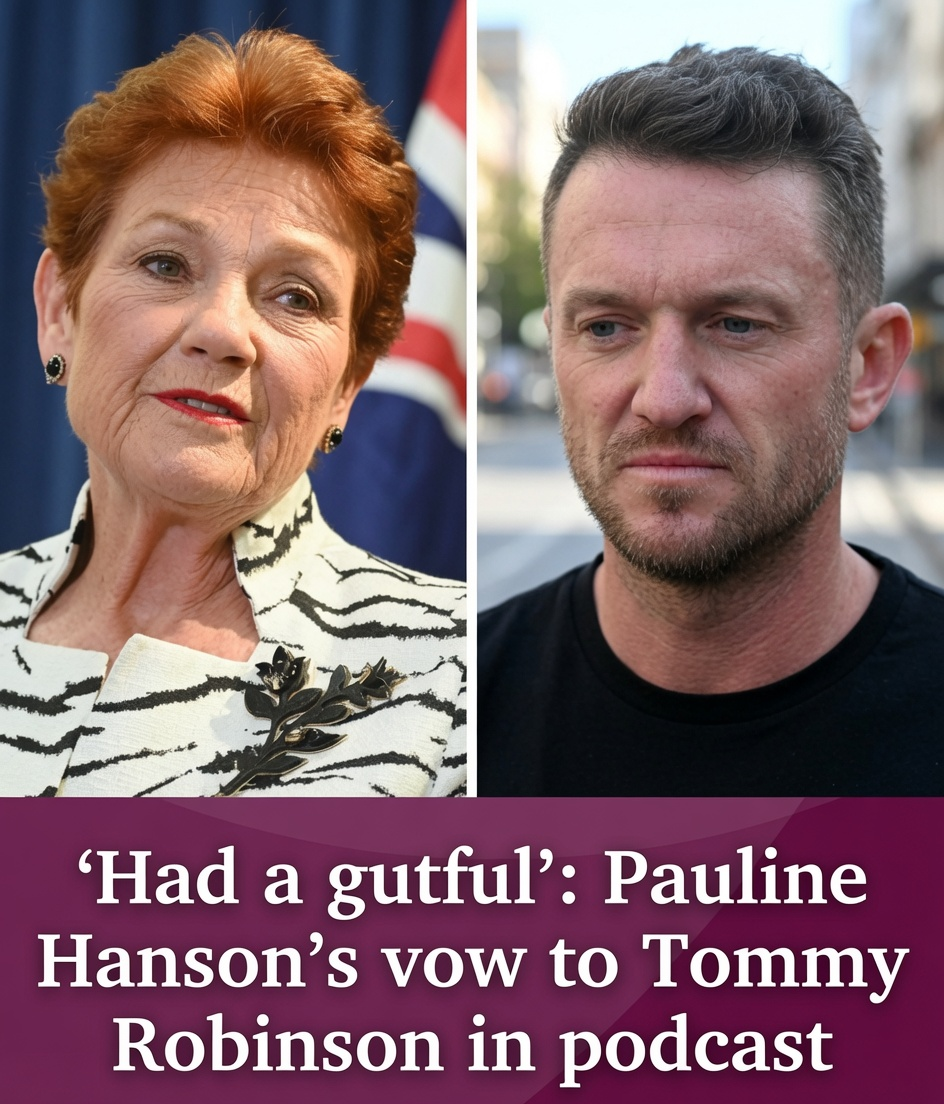
Hanson walked through Luton with Robinson during her high-profile visit to the United Kingdom, speaking with residents and surveying a town the British activist has repeatedly used as a symbol of his campaign against mass immigration and what he describes as the “Islamification” of Britain.
The appearance came after Hanson and Robinson sat down to record a podcast interview, with the pair publicly expressing mutual admiration.
Robinson, whose real name is Stephen Yaxley-Lennon, described the Queensland senator as one of the “bravest” women in the world and said he hoped she would become Australia’s next leader.
Hanson returned the praise, describing Robinson as someone who had been “standing up for his country” and suggesting Australians should listen to his warnings about the social and demographic changes he believes have transformed parts of Britain.
“I definitely don’t want Australia to become like this,” Hanson said during her UK visit.
“This is not Great Britain to me, and that’s why I’m going to protect Australia.”
The remarks have intensified scrutiny of Hanson’s trip and her increasingly open engagement with figures on the British right. But they also come as One Nation attempts to position immigration, national identity and population growth at the centre of Australian political debate.
A walking tour of Luton with Tommy Robinson
Robinson took Hanson through the streets of Luton, the Bedfordshire town where he was born and where he first emerged as a prominent anti-Islam activist.
Video from the tour showed the pair stopping residents and asking whether the town had changed for better or worse.
The reaction was mixed.
Some people were friendly and stopped to talk with Hanson and Robinson. Others made their hostility towards Robinson clear.
“We don’t want you around here,” one person told him.
“You’re a racist.”
The pair also visited the Discover Islam centre, where Robinson asked to film inside. Staff did not allow filming.
The confrontation was later used by Robinson to reinforce his own claims about the town, although some of his descriptions and accusations during the tour were not supported by evidence presented in the video.
For Hanson, however, the political message was broader.
She said she was “gobsmacked” by what she saw and repeatedly linked Britain’s demographic changes with her long-running warnings about Australian immigration policy.
Robinson presented Luton as a preview of what he believes could happen in Australia if migration continues at high levels without stronger demands for integration.
That interpretation is fiercely disputed by Robinson’s critics, who accuse him of using demographic change to inflame anti-Muslim sentiment.
Official census figures do, however, confirm that Luton has undergone significant demographic and religious change.
According to the UK Office for National Statistics, 32.9 per cent of Luton residents described themselves as Muslim in the 2021 census, up from 24.6 per cent in 2011.
The increase of 8.3 percentage points was the largest rise among the broad religious categories recorded in the town over the decade.
The figures establish that Luton has changed. They do not, by themselves, establish Robinson’s broader claims about the causes or consequences of those changes.
That distinction has become central to the controversy surrounding Hanson’s visit.
Hanson and Robinson exchange public praise
The Luton tour followed a podcast interview recorded by Hanson and Robinson earlier in the week.
Robinson posted enthusiastically about the meeting on social media.
“Had a fabulous time chatting to one of the bravest lady’s on the planet,” he wrote.
“Fearless, relentless, consistent, fighting for the Australian people and hopefully the next leader of her nation.”
Hanson also shared a preview of the interview and praised Robinson for his activism.
The relationship is particularly significant because Robinson has become a politically toxic figure even among parts of the British right.
Robinson was a founder and former leader of the English Defence League, an organisation that became known for anti-Islam demonstrations and confrontational street politics.
He has a lengthy criminal history, including convictions involving violence, fraud, passport offences and contempt of court.
His supporters argue he has been targeted because of his willingness to discuss Islamist extremism, grooming gangs and immigration. His critics describe him as a far-right agitator who repeatedly uses inflammatory rhetoric and misinformation to target Muslims.
Hanson’s willingness to appear alongside him therefore represents more than a casual meeting during an overseas trip.
It places the One Nation leader directly inside a broader international network of populist and nationalist political figures who increasingly use podcasts, social media and independent digital platforms to bypass traditional broadcasters.
The strategy also carries obvious risks.
Australian commentators, including some conservatives, have questioned whether Hanson damages One Nation’s attempt to present itself as a serious alternative government by associating with Robinson.
Hanson has shown little indication that the criticism will change her approach.
‘Round them all up and give them an island’
Hanson’s warnings about Britain were accompanied by another provocative moment during her UK visit.
Appearing on The Liz Truss Show with former British prime minister Liz Truss, Hanson was asked whether Australia had its own version of “the Blob”.
The term has been used in British conservative politics to describe parts of the bureaucracy, institutions and political establishment accused of resisting right-wing governments and policies.
Hanson pointed towards her opponents in the Australian Parliament.
“Yes we have, we’ve got some of them sitting on the floor of parliament … they’re called the Greens and a couple of the independents,” she said.
“How about we just round them all up and give them an island or somewhere and say, ‘you go and do what you want to do over there’, leave us alone.”
Hanson and Truss laughed at the remark.
Truss responded with a joke about Britain’s historical transportation of convicts to Australia.
“Didn’t we do that with Australia in the first place?” she said.
The exchange was clearly delivered humorously, rather than as a literal policy proposal. Nevertheless, the “round them up” language immediately attracted attention because it was directed at elected political opponents.
The moment was characteristic of Hanson’s political style: deliberately provocative, dismissive of conventional political language and highly effective at generating online attention.
It also came during a trip in which she has repeatedly argued that Australia’s political establishment is failing to respond to public concerns about immigration, living costs and national identity.
Britain as a warning for Australia
During her discussion with Truss, Hanson said Britain’s decline “really concerns” her.
She argued that problems she identified in the United Kingdom were also becoming visible in Australia, pointing particularly to immigration and the cost-of-living crisis.
Hanson claimed one person was arriving in Australia every 59 seconds and said she did not want the country to experience the changes she believed had occurred in Britain.
One Nation’s formal immigration policy calls for a major reduction in migration and argues Australia’s rapid population growth is placing excessive pressure on housing, infrastructure and essential services.
The party has also proposed large-scale deportations of people it describes as illegal migrants and a more restrictive approach to humanitarian arrivals.
Hanson went further during her British interviews, saying she wanted Australia to withdraw from the 1951 United Nations Refugee Convention.
Her position reflects an increasingly common argument among nationalist political parties in Western countries: that international agreements created after the Second World War are limiting governments’ ability to control modern migration and asylum systems.
Supporters of the Refugee Convention reject that argument and say the agreement remains a fundamental protection for people fleeing persecution.
Hanson made clear she was not concerned about offending critics of her proposal.
The One Nation leader has built much of her political career around opposition to high immigration and multicultural policies. What has changed is the broader political environment surrounding those positions.
Housing shortages, infrastructure pressure and a prolonged cost-of-living crisis have pushed population growth into the centre of mainstream political debate in Australia.
Labor and the Coalition both support managed migration, but each has faced pressure to explain how population growth can be reconciled with housing construction that has struggled to meet demand.
One Nation is attempting to use that frustration to argue that the major parties are unwilling to confront the scale of the problem.
The Tommy Robinson connection carries political danger
Hanson’s embrace of Robinson comes at a particularly sensitive moment in Australian media and politics.
Robinson was recently interviewed by former Today host Karl Stefanovic for a podcast episode that was quickly removed from online platforms after attracting intense criticism.
The interview became a major controversy because Stefanovic praised Robinson’s “tenacity” and “courage” while critics argued he failed to sufficiently challenge inflammatory claims about Muslims, immigration and social unrest.
Stefanovic subsequently left Nine amid the fallout surrounding the interview and his broader relationship with the network.
Hanson publicly defended Stefanovic and reposted the Robinson interview through her own online channels, accusing mainstream media organisations of suppressing uncomfortable political discussion.
Weeks later, she was sitting opposite Robinson herself.
The sequence of events has reinforced a growing divide over how controversial political activists should be covered.
Robinson’s supporters argue refusing to interview him allows media organisations and political institutions to avoid discussing genuine problems involving extremism, integration and crime.
His opponents say uncritical interviews can legitimise a figure with a history of spreading false claims and inflammatory anti-Muslim rhetoric.
Hanson has clearly placed herself on the first side of that argument.
Her decision to tour Luton with Robinson was not presented as a detached investigation. The pair openly praised one another, and Hanson adopted much of Robinson’s framing of Britain as a warning to Australia.
That is likely to make her relationship with Robinson a continuing political issue at home.
A wider battle on the Australian right
The British trip also comes as the struggle between One Nation and the Coalition becomes increasingly hostile.
Opposition leader Angus Taylor has launched one of his strongest attacks yet on Hanson’s party, accusing One Nation of lacking a credible economic plan and warning voters that its policies could produce an “eternity of pain”.
Taylor has argued that One Nation is effectively a one-person political operation built around Hanson and has challenged the party to explain how it would pay for its major promises.
Hanson has responded by urging Taylor to stop attacking One Nation and instead work with her to remove Labor and the Greens from power.
During her UK interviews, however, she also ruled out a conventional coalition agreement with the Liberal and National parties.
The increasingly bitter exchange reflects a serious problem for the Coalition.
One Nation is no longer simply competing for protest votes on the political fringe. It is actively targeting conservative Australians who believe the Liberal and National parties have failed to distinguish themselves sufficiently from Labor on immigration, climate policy and cultural issues.
Hanson’s international tour appears designed, at least in part, to reinforce that political identity.
Her meetings with Robinson and other prominent figures on the British right allow her to present One Nation as part of a larger global political movement challenging established parties.
Critics see the trip as a publicity exercise built around controversy and provocative digital content.
Hanson’s supporters see something different: a political leader willing to visit places, speak with controversial people and discuss issues they believe mainstream politicians avoid.
That divide is precisely where Hanson has operated for three decades.
The warning Hanson wants Australians to hear
For Hanson, the message from Britain is that demographic and cultural change can become difficult to reverse once governments allow it to accelerate.
For Robinson, Hanson offers an influential Australian political ally willing to amplify his warnings to an audience far beyond Britain.
Their mutual admiration was unmistakable.
But the political significance of their meeting will ultimately be determined in Australia, not Luton.
Hanson is asking voters to accept her central argument that Britain provides a preview of Australia’s future unless immigration policy changes dramatically.
Her critics will argue she has chosen an inflammatory and deeply controversial guide to make that case.
The official data confirms Luton has experienced substantial demographic change. It does not settle the much more difficult argument over whether those changes represent the social decline described by Robinson and Hanson.
That debate is now being imported directly into Australian politics.
And after recording a podcast with Robinson, walking his hometown and telling Australians she is determined to “protect” their country, Hanson has made clear she wants it fought openly.






