A potential name change at James Cook University could cost as much as $12.1 million and expose the north Queensland institution to alumni anger, donor withdrawals and a politically charged backlash, according to a detailed internal report.
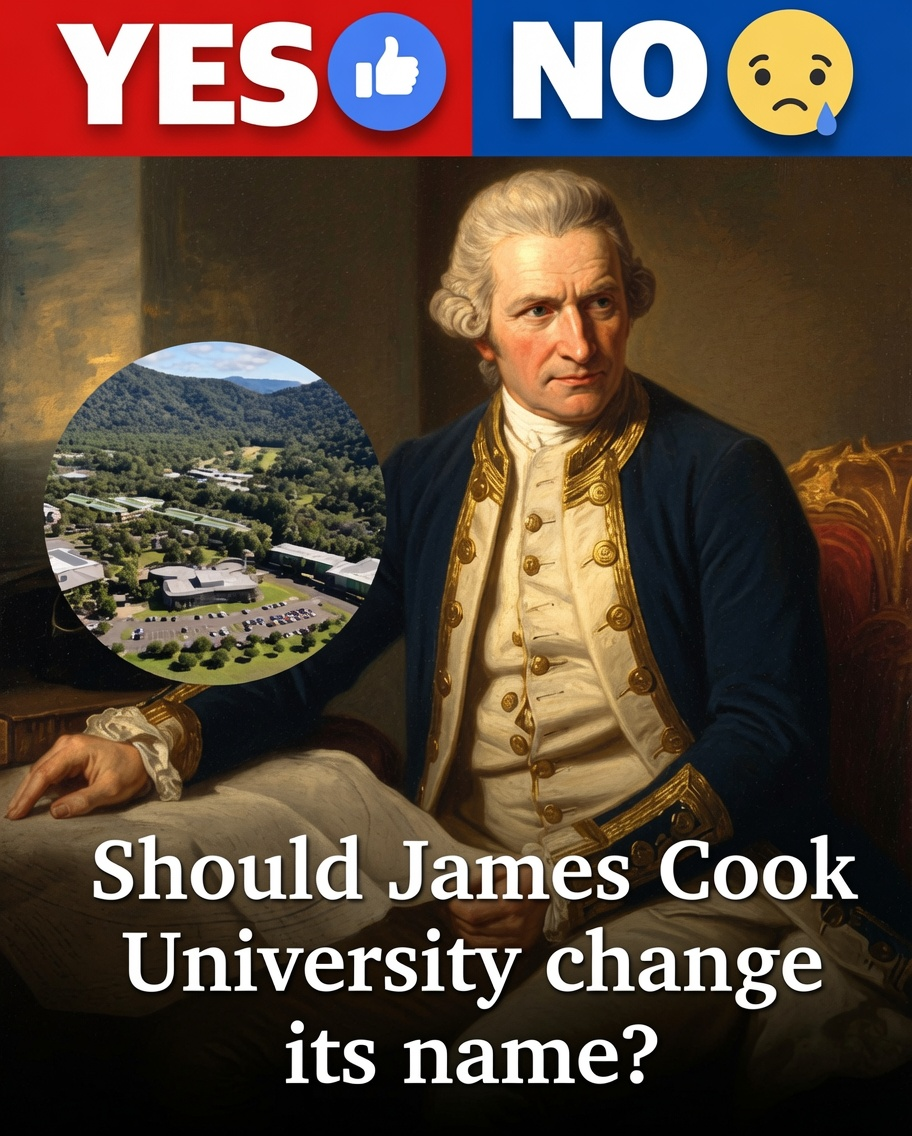
The 58-page final report of the university’s Name Reference Committee has brought fresh attention to a controversy James Cook University has repeatedly insisted is not an active campaign to rename the institution.
Delivered to the university council in May, the report was commissioned to advise how JCU might responsibly deal with questions about its institutional name if such a question arose now or in the future. The committee was not asked to recommend whether the university should change its name and did not put forward an alternative.
But the scale of the work, the detailed examination of Captain James Cook’s contested legacy and the multimillion-dollar estimates attached to a possible rebrand have ensured the issue remains politically explosive.
The report estimates a name change could cost between $4.8 million and $12.1 million, depending on the scale and complexity of the transition. The potential bill covers far more than replacing signs at university entrances.
A university-wide rebrand could affect digital systems, websites, academic records, legal documents, contracts, physical signage, uniforms, merchandise, marketing materials and the enormous number of places where the JCU identity has accumulated during decades of operation.
There would also be less easily measured consequences. The committee’s report warns of possible reputational damage, polarised media coverage, resistance from alumni and the potential withdrawal of financial support from donors who believe a name change would amount to erasing history or diminishing the value of their association with JCU.
Those concerns go to the heart of the argument now surrounding the university: whether examining the James Cook name represents responsible institutional governance or an unnecessary culture-war exercise with a potentially enormous price tag.
JCU has maintained that it is not currently reviewing, proposing or pursuing a change to its institutional name. In a statement issued earlier this year, the university said no name-change proposal had been developed, considered or put to the Queensland Government.
That distinction is important. The committee produced a framework for how the university could deal with a naming question. It did not formally tell JCU to remove James Cook’s name.
Yet critics argue the existence of a dedicated committee and a comprehensive final report shows significant university attention has already been devoted to an issue many Queenslanders never regarded as a priority.
The controversy has become even sharper because the report was handed down after the Queensland Government had already made clear its opposition to a potential change.
Education Minister John-Paul Langbroek previously attacked the prospect of renaming the university as historical revisionism and argued JCU should concentrate on education and the needs of north Queensland communities.
The Crisafulli Government also moved to reshape the university’s governing council, increasing government influence over its composition amid the public dispute. The intervention was widely interpreted as an attempt to prevent a future council from advancing a controversial name change without stronger external scrutiny.
For the university, however, the question is tied to a much broader and increasingly difficult debate about how Australian institutions should deal with historical figures whose reputations are viewed very differently by different parts of the community.
James Cook University was established as an independent university in 1970 and was named after the British navigator whose 1770 voyage along Australia’s east coast became a defining episode in the country’s European history.
The committee report acknowledges the sharply contrasting interpretations attached to Cook.
For supporters of the existing name, Cook is associated with exploration, navigation, scientific inquiry and the Enlightenment tradition. Those connections have particular resonance for a university with a major research profile in tropical science, marine studies and environmental research.
For many Aboriginal and Torres Strait Islander people, however, Cook’s arrival has a profoundly different meaning.
The report states that Cook’s arrival can symbolise “the beginning of colonisation and the profound dispossession” experienced by Indigenous people.
That competing historical symbolism is central to the committee’s work. Its report argues that questions surrounding institutional names can involve cultural sensitivity, community trust, truth-telling and whether an organisation’s public identity remains aligned with its contemporary values.
But changing the name of a university is particularly complicated because the institution’s identity does not belong only to its current management.
Thousands of graduates carry degrees bearing the James Cook University name. Researchers have published work under the JCU affiliation. International partnerships, commercial agreements and government relationships have been built around the brand. Alumni may have spent decades identifying themselves with the institution.
The report recognises the possibility that some graduates could view a change as devaluing or disrupting the identity associated with their qualifications.
Donor reaction is another risk. Universities depend on long-term relationships with supporters, philanthropic organisations and alumni. A divisive rebranding decision could encourage some donors to withdraw, while retaining the existing name could alienate others who believe the institution has failed to respond to Indigenous concerns.
In other words, the report presents no cost-free option if the naming question were ever formally placed before the university.
A change could trigger accusations of cancel culture and historical erasure. Refusing a change could produce criticism that JCU was ignoring legitimate concerns about the symbolic legacy of colonisation.
The political difficulty is compounded by the fact that JCU has already demonstrated it can incorporate Indigenous names into its identity without abandoning the James Cook University brand.
In 2020, the university announced the Indigenous name Bebegu Yumba for its Townsville campus following consultation with Traditional Owners and Indigenous communities. The name means “Place of Learning” in the Birri-Gubba language.
JCU has also adopted Indigenous language names for other locations, including Nguma-bada for its Smithfield campus in Cairns, Bada-jali for its Cairns city campus, Murtupuni in Mount Isa and Ngudya Yamba in Mackay.
The university’s Townsville library also carries the name of Eddie Koiki Mabo, the Torres Strait Islander man whose historic legal challenge led to the High Court’s 1992 Mabo decision and the rejection of the doctrine of terra nullius.
Those changes provide an important context often lost in the political argument. JCU has already pursued substantial Indigenous recognition across its campuses while retaining its institutional name.
For opponents of renaming the university, that offers an obvious alternative: continue recognising Indigenous history, languages and communities without spending millions of dollars dismantling a name used for more than half a century.
Supporters of a deeper review could argue that campus names and symbolic recognition do not resolve the central question of whether James Cook should remain the defining name of the institution itself.
The committee did not attempt to settle that argument.
Instead, its final report establishes principles and processes that could be used if a naming proposal emerged. It examines consultation, governance, regulatory requirements, budgeting and impact assessment, effectively providing JCU with a roadmap for dealing with an issue that may otherwise become chaotic if driven by political or public pressure.
That governance explanation is also the basis of the university’s defence.
JCU says media reporting has mischaracterised the committee’s purpose and insists there is no active name-change proposal. According to the university, preparing advice about how a future question should be handled is not the same as deciding to rename the institution.
The committee members were unpaid and the university has said external consultants were not engaged for the work.
Nevertheless, the newly revealed cost estimates are likely to intensify scrutiny.
At the top end of the report’s range, $12.1 million is a substantial amount for any public university, particularly at a time when Australian students and families remain sensitive to education costs and universities face constant pressure over teaching quality, accommodation, staffing and student services.
The report itself identifies the risk that stakeholders may question whether money devoted to a name change could be better spent on the university’s core purposes.
That question is likely to dominate the political response more than the technical details of rebranding.
A sign can be replaced. A website can be rebuilt. A new logo can be designed. The more difficult task would be convincing students, staff, graduates, Indigenous communities, politicians and north Queensland residents that the expense was justified.
The debate also demonstrates how quickly a governance exercise inside a university can become a national culture-war story.
Historical names have become increasingly contested across Australia as institutions reconsider links to colonisation and figures associated with the country’s British past. Universities are particularly exposed because they are expected both to protect academic examination of history and to respond to changing social values.
JCU’s case is unusually potent because James Cook is not a marginal historical figure. His name is embedded throughout Australian geography, education and public memory, while his 1770 voyage occupies a major place in the traditional narrative of European contact with Australia’s east coast.
That prominence makes any attempt to reconsider his name inherently controversial.
It also means the argument cannot easily be reduced to whether Cook was a hero or a villain. The committee’s report reflects the reality that the same historical figure can carry radically different meanings for different communities.
The political question is whether a public university should resolve those competing interpretations through a new institutional name — and whether taxpayers, students or the university itself should bear a bill potentially exceeding $12 million to do it.
For now, James Cook University says the answer is that no name change is being pursued.
The committee has made no recommendation to rename JCU. No alternative name has been proposed. The Queensland Government has already intervened forcefully in the debate and made its position clear.
But the final report means the issue is no longer hypothetical in the abstract. JCU now has a detailed document setting out the historical arguments, governance pathway, reputational dangers and potential financial cost of changing one of Australia’s best-known university names.
And with a top-end estimate of $12.1 million, the price of that debate is now much clearer than it was when the controversy first erupted.