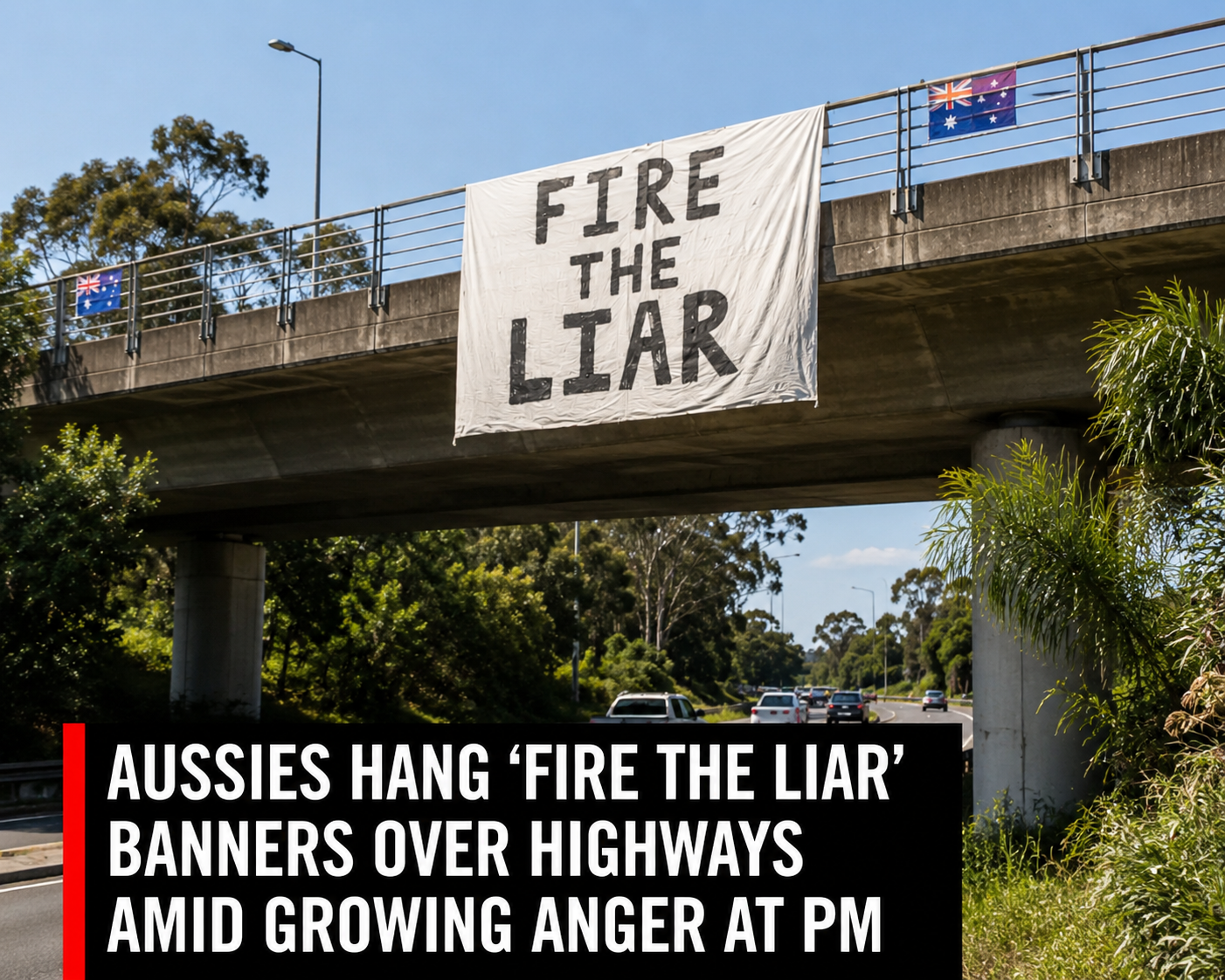
Political campaigning has become increasingly visible across parts of Australia after banners criticising Prime Minister Anthony Albanese were displayed on highway overpasses and other public locations, drawing attention to a growing campaign centred on questions of political trust and election promises.
The banners are part of a broader campaign organised by Pauline Hanson’s One Nation, which has expanded its activities in recent weeks through billboard trucks, fundraising drives and public advertising targeting the Prime Minister. The campaign argues that several major policy decisions made since the federal election differ from commitments presented to voters before polling day.
Among the issues highlighted by campaign organisers are changes to taxation policy, housing measures and other decisions announced after the election. Critics contend these developments represent significant departures from earlier commitments, while Labor ministers have argued that governments sometimes need to respond to changing economic conditions and emerging policy priorities after taking office.
The campaign has attracted attention not only because of its messaging but also because of its scale. One Nation has publicly stated that donations from supporters have funded a series of advertising initiatives, including mobile billboards, roadside banners and other promotional activities intended to increase the visibility of its criticism of the government.
The debate also reflects a broader political question that has surfaced repeatedly in Australian politics: how voters respond when governments alter or abandon election commitments after taking office. Similar arguments have arisen under governments led by both major parties over many years, with supporters often describing policy changes as necessary responses to new circumstances and opponents characterising them as broken promises.
Political commentators note that questions of trust can become particularly influential when governments introduce significant reforms that were either not proposed during an election campaign or differ from previous public statements. Whether those changes are viewed as pragmatic policymaking or a breach of trust is ultimately a matter for public judgement rather than a legal determination.
The visibility of the latest campaign also illustrates the increasingly prominent role that minor parties are playing in Australia’s political landscape. Strong performances by smaller parties in recent elections and by-elections have encouraged them to invest more heavily in high-profile public campaigns aimed at attracting voters who are dissatisfied with the major parties.
For the Labor government, the challenge is not limited to responding to criticism from political opponents. Ministers must also persuade voters that the policy changes introduced since the election are justified by economic conditions and are in the public interest. At the same time, opposition parties and crossbench groups continue to argue that accountability for election commitments remains an important part of Australia’s democratic system.
As campaigning continues, the immediate impact of roadside banners and other political advertising remains difficult to measure. However, the campaign demonstrates how public debate over election promises has become a central feature of Australia’s political conversation, with both government and opposition figures seeking to shape how voters interpret recent policy decisions ahead of future elections.
Ultimately, the effectiveness of campaigns such as this will be determined less by the visibility of their slogans and more by whether they influence public perceptions of government performance over time. As Australians continue to debate taxation, housing, cost-of-living pressures and other policy issues, questions about political trust are likely to remain an important element of the national discussion.






