National Australia Bank is facing growing scrutiny after expanding its Islamic finance services across Australia, with critics questioning whether major financial institutions should be tailoring products around religious requirements.
The debate has emerged as millions of Australians continue to struggle with high interest rates, rising borrowing costs and growing financial pressure.
At the centre of the controversy is NAB’s Islamic finance division, a specialised banking service designed to comply with Islamic financial principles.
Supporters describe it as a legitimate alternative financing model.
Critics argue it represents unnecessary accommodation of religious requirements within Australia’s banking system.
The disagreement has quickly become another flashpoint in Australia’s broader political debate over national identity, multiculturalism and equal treatment.
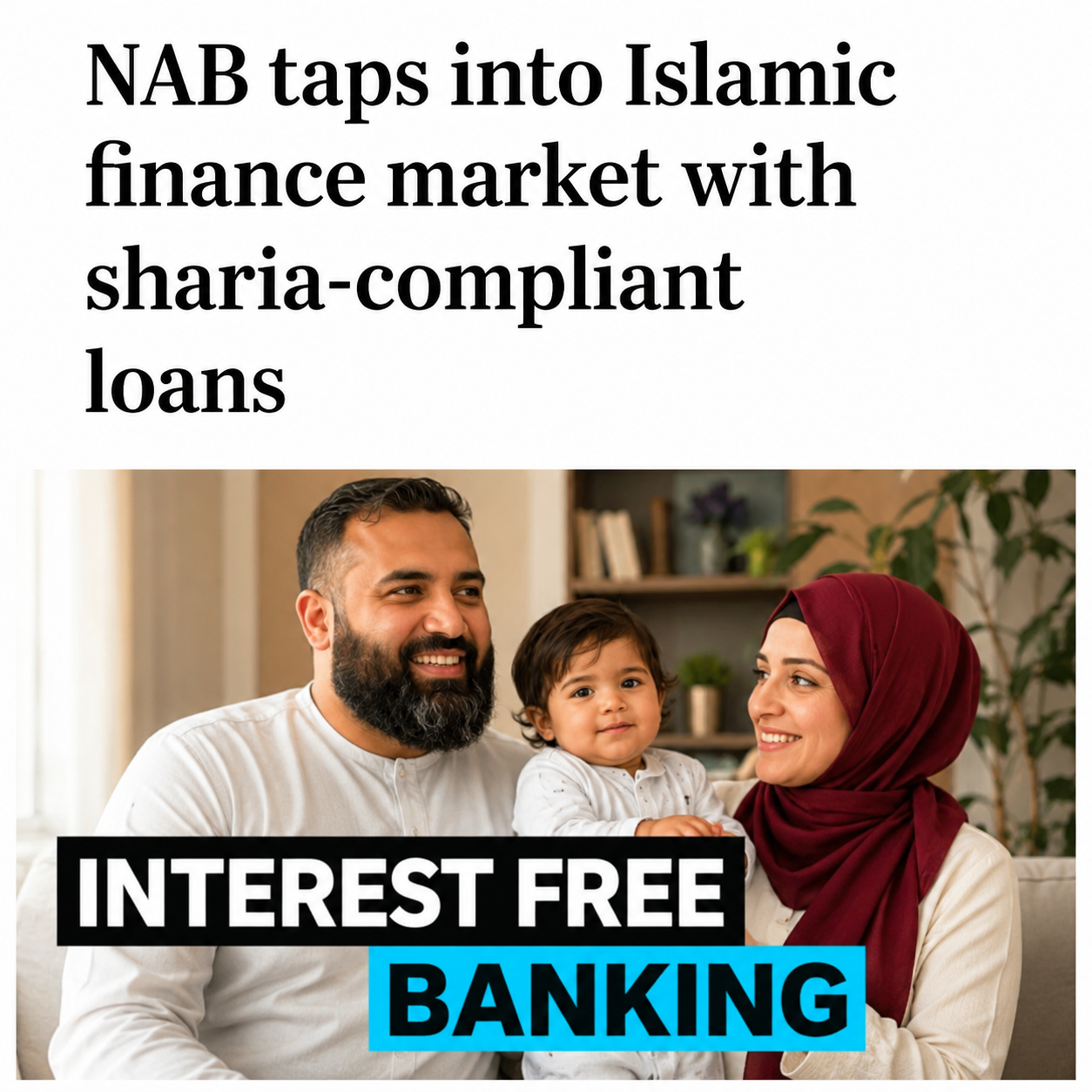
NAB first entered the Islamic finance market in 2021, becoming the first of Australia’s Big Four banks to launch specialised Sharia-compliant business finance products.
The original focus was large commercial property and construction projects worth more than $5 million.
Since then, the bank has steadily expanded the program into additional business sectors.
Today the service is available for a wider range of commercial purposes including business acquisitions, equipment purchases, land purchases and livestock financing.
NAB says the expansion reflects growing demand from Australian businesses seeking financing arrangements that align with Islamic principles.
One of the most common misunderstandings surrounding Islamic finance is the belief that it provides free money or eliminates financing costs altogether.
That is not how the system works.
Instead of charging conventional interest, Islamic finance structures transactions using alternative mechanisms such as leasing arrangements, service fees, profit-sharing agreements or sale margins.
The customer still pays for access to capital.
The difference lies in how the transaction is legally structured.
NAB itself describes Islamic finance as changing the structure rather than the economics of a transaction.
The bank says pricing remains broadly comparable to conventional financing while complying with Islamic financial requirements.
The growth figures help explain why the bank continues investing in the sector.
According to NAB, Islamic finance business customers increased by 28 per cent over the past year.
New South Wales recorded particularly strong growth, with customer numbers rising by more than 50 per cent.
The bank views this as evidence that demand for alternative financing models is continuing to expand.
NAB has also significantly increased its internal capability.
The bank says it now has a network of 90 accredited bankers across Australia who are trained to write Islamic finance transactions and assist customers seeking specialised financing structures.
Supporters of the program argue that Islamic finance simply increases customer choice.
They note that banks already offer a wide range of specialised products aimed at different industries, business sectors and customer needs.
From that perspective, Islamic finance is viewed as another niche product within a competitive financial marketplace.
Supporters also point out that these products remain fully regulated under Australian law and are available only to customers who choose to use them.
Critics see the situation differently.
They argue that Australia’s banking system should operate under a single set of financial rules and standards regardless of religion.
Some believe large banks should focus on lowering borrowing costs for all Australians rather than developing products tailored around religious compliance.
The criticism comes at a time when interest rates remain one of the most sensitive economic issues facing households and businesses.
Many business owners continue to grapple with higher repayments, tighter credit conditions and slower economic growth.
Against that backdrop, specialised finance products inevitably attract greater public attention.
The debate also highlights how Australia’s financial sector is evolving alongside demographic change.
The Muslim population has grown steadily over recent decades, creating demand for financial products that align with particular ethical and religious preferences.
Financial institutions increasingly view those customers as an important market segment.
That trend is not unique to Australia.
Islamic finance has expanded significantly around the world and is now a major global industry worth hundreds of billions of dollars.
Australian banks have gradually begun participating in that market as demand increases domestically and internationally.
The political dimension of the debate may prove just as significant as the banking questions.
Discussions about migration, cultural integration and institutional accommodation have become increasingly prominent in Australian politics.
As a result, issues that might once have remained within the financial sector often become broader public controversies.
NAB’s Islamic finance expansion is the latest example.
For some Australians, it demonstrates a modern banking system adapting to customer needs.
For others, it raises concerns about whether major institutions are moving too far toward specialised arrangements based on religious preferences.
Whatever view people take, one thing is clear.
Islamic finance is no longer a niche concept operating on the margins of Australia’s banking sector.
It has become a growing commercial product offered by one of the country’s largest financial institutions.
And as demand continues to increase, the debate surrounding it is unlikely to disappear anytime soon.






