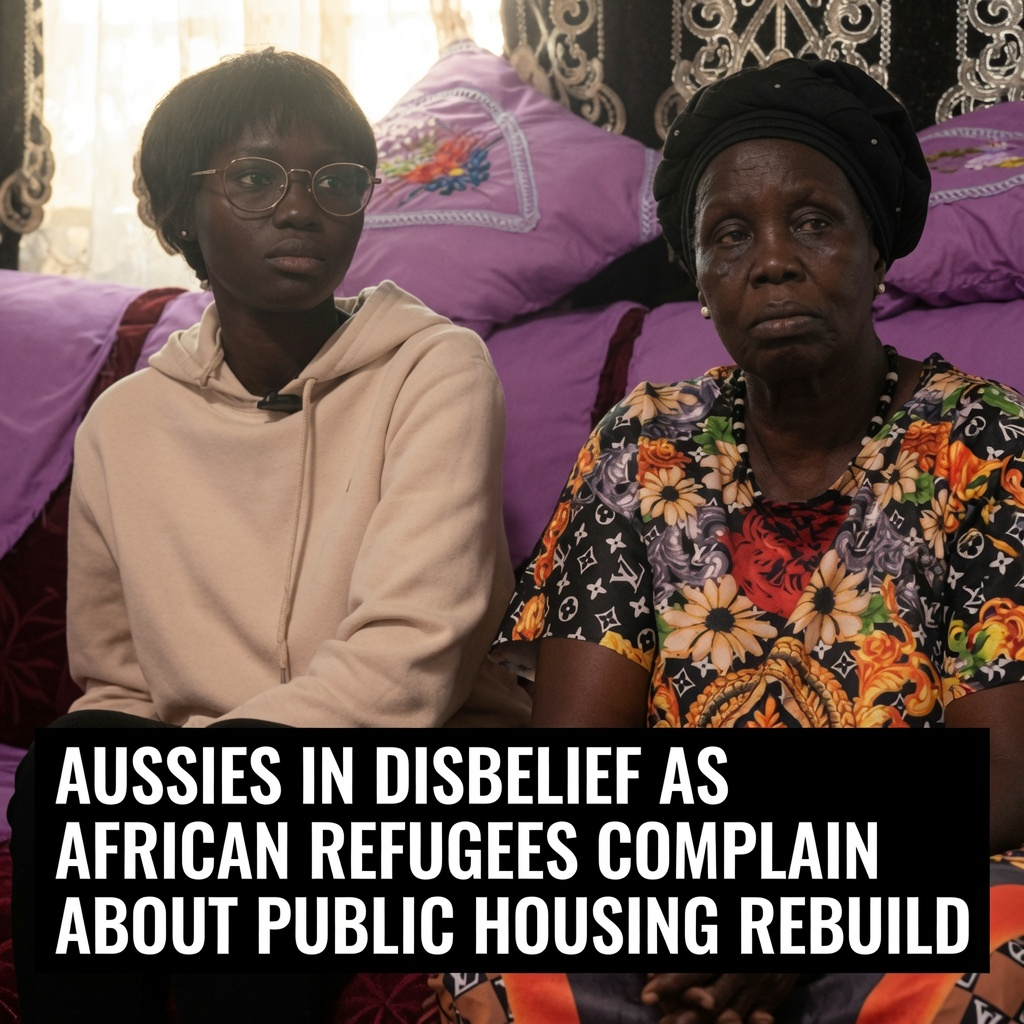
A video showing a group of African refugees objecting to plans to relocate them from a public housing tower has ignited a fierce debate about housing, migration and government priorities.
The footage, which has attracted significant attention online, shows residents speaking with a Greens MP about concerns surrounding the redevelopment of the building they have called home for more than two decades.
For the residents involved, the issue is about community and stability.
For many Australians watching the video, the reaction has been very different.
They see a government-funded housing upgrade and struggle to understand why there is opposition to moving into newer accommodation.
The controversy centres on Victoria’s large-scale public housing redevelopment program.
State authorities have argued that many ageing high-rise towers have reached the point where major reconstruction is required.
Officials say the existing buildings suffer from significant maintenance issues and no longer meet modern housing expectations.
The long-term plan is to replace older towers with new developments containing substantially more housing units.
Supporters argue the project will increase housing supply while improving living conditions for thousands of residents.
Critics, however, worry about the social consequences of relocation.
Many long-term residents have spent years building support networks within the buildings and surrounding neighbourhoods.
Some fear those connections may be disrupted if families are moved to different areas during redevelopment.
That concern featured prominently in the video that has since circulated widely online.
Several residents spoke about the importance of remaining close to schools, community organisations, family members and local services.
For people who have lived in the same location for decades, relocation can be a significant adjustment.
Even when alternative accommodation is provided, uncertainty about the future often creates anxiety.
Those concerns are not unique to refugee communities.
Similar reactions have emerged whenever large housing estates undergo redevelopment.
People naturally develop strong attachments to places where they have raised families and built their lives.
Yet the online response to this particular case has been unusually intense.
Many Australians focused on a different aspect of the story.
They pointed out that public housing remains in extremely high demand across the country.
Waiting lists stretch for years in some areas, while rising rents have placed increasing pressure on low-income households.
Against that backdrop, some viewers argued that receiving upgraded government-supported housing should be welcomed rather than criticised.
Others questioned whether public debate about housing is increasingly being shaped by broader concerns about migration, population growth and affordability.
Those issues have become major political topics in recent years.
As housing costs continue to rise, discussions about who receives assistance and how housing resources are allocated have become increasingly contentious.
The involvement of a Greens MP has added another political dimension.
The Greens have frequently advocated for stronger tenant protections and greater consultation with public housing residents facing redevelopment.
Supporters argue elected representatives should listen carefully to affected communities before major decisions are implemented.
Critics say the focus should remain on delivering new housing as quickly as possible.
The debate also reflects competing views about the purpose of public housing policy.
One side emphasises community stability and resident participation.
The other prioritises increasing housing supply and improving infrastructure.
Both objectives are widely supported in principle, but conflicts can emerge when redevelopment projects require existing residents to move.
The broader housing crisis has ensured that stories like this attract enormous attention.
Australia continues to face significant affordability pressures in both rental and ownership markets.
Governments at all levels are under pressure to increase housing supply while maintaining support for vulnerable residents.
That balancing act has become one of the most difficult policy challenges facing decision-makers.
As a result, individual redevelopment projects increasingly become flashpoints for wider national debates.
Questions about housing availability, migration, public spending and social cohesion often become intertwined.
The video has become the latest example.
What began as a discussion about one building and one relocation program has evolved into a much larger conversation.
Some Australians view the residents’ concerns as understandable and human.
Others see the reaction as evidence of growing expectations despite significant government assistance.
The disagreement helps explain why the footage has generated such strong engagement online.
Ultimately, the redevelopment will move forward regardless of the political arguments surrounding it.
But the public response demonstrates how housing issues continue to touch some of the deepest concerns in Australian society.
As affordability pressures intensify, debates over who gets housing, where they live and how communities change are likely to remain front-page issues for years to come.






